Florida SS.8.FL.6.3
The Standard
- SS.8.FL.6
- Identify and analyze methods of protecting financial investments and personal information.
Describe how a person may self-insure by accepting a risk and saving money on a regular basis to cover a potential loss.
Florida Next Generation Sunshine State Standards for Social Studies
Teacher's field guide
What This Standard Means
What Students Need to Do
- Students explain how setting aside money can pay for future damage, repairs, or replacement costs. They weigh the savings from skipping a policy against the chance of a large loss.
What Mastery Looks Like
- Students can identify a situation where an emergency fund could cover a loss. They can calculate regular deposits and explain who pays if the loss exceeds the amount saved.
Common Misconceptions
- Students may think self-insurance means having an insurance policy or avoiding all risk. They may also assume a small savings balance can cover any loss.
How to Assess It
- Give students this exit ticket: “A family saves $75 monthly instead of buying phone insurance. Explain one benefit, one risk, and who pays for damage.”
Lesson moves
Ways to Teach It
Give groups loss scenario cards, play money, and monthly budgets, then have them build a savings fund and respond to a surprise loss.
Ask students to write whether they would insure or save for a $600 laptop repair, using cost and risk in their explanation.
Play Risk Fund Challenge, where students choose monthly deposits, draw loss cards, and track whether their fund covers each expense.
Compare the yearly cost of phone insurance with monthly emergency savings, then calculate each option’s total after two years.
Free download
Printable SS.8.FL.6.3 Worksheet
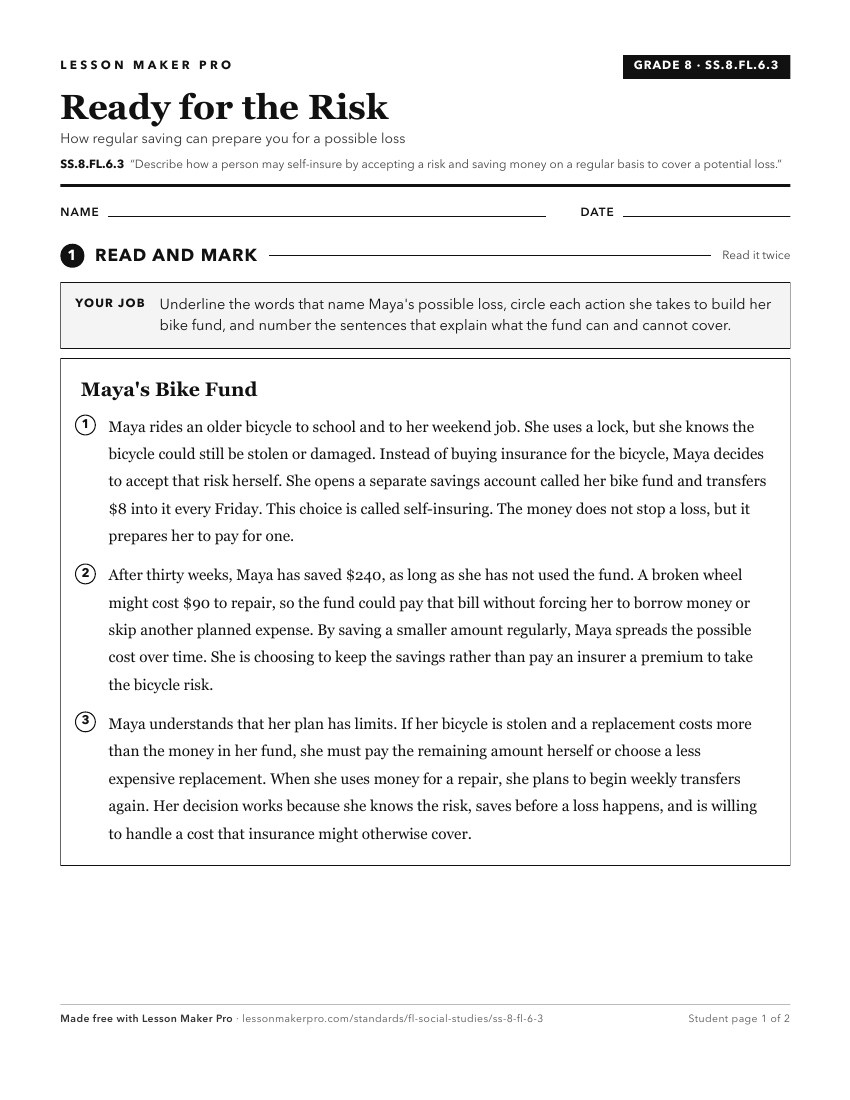
A ready-to-print activity worksheet aligned to SS.8.FL.6.3, with an answer key for the teacher on its own page. No account needed.
PDF, US Letter, prints cleanly in black and white.
Download the worksheetKeep exploring
Related Standards
- SS.4.FL.6.4
Discuss that one method to cope with unexpected losses is to save for emergencies.
- SS.8.FL.6.6
Explain that individuals can choose to accept some risk, to take steps to avoid or reduce risk, or to transfer risk to others through the purchase of insurance ...
- SS.4.FL.6.3
Describe ways that individuals can either choose to accept risk or take steps to protect themselves by avoiding or reducing risk.
- SS.4.FL.3.3
Identify ways that people can choose to save money in many places - for example, at home in a piggy bank or at a commercial bank, credit union, or savings and l...
Turn this exact standard into a lesson
Grade, subject, topic, and the complete standard are prefilled. Create one free, no account needed.
Also for this standard:Make a WorksheetMake a QuizMake a Sub Lesson