Florida SS.8.FL.6.4
The Standard
- SS.8.FL.6
- Identify and analyze methods of protecting financial investments and personal information.
Discuss why insurance policies that guarantee higher levels of payment in the event of a loss (coverage) have higher prices.
Florida Next Generation Sunshine State Standards for Social Studies
Teacher's field guide
What This Standard Means
What Students Need to Do
- Students compare insurance options while keeping the insured person and type of risk the same. They explain that broader coverage raises the insurer’s possible claim costs, so the premium usually rises.
What Mastery Looks Like
- Given two policies, students identify which one should cost more and support the choice with coverage details. They correctly use the terms premium, coverage limit, and claim payment.
Common Misconceptions
- Students may confuse the premium paid by the customer with the claim payment made by the insurer. They may think higher coverage pays every loss in full, ignoring deductibles, limits, and exclusions.
How to Assess It
- Exit ticket: Policy A covers losses up to $10,000, while Policy B covers up to $25,000. Explain why Policy B usually has a higher premium.
Lesson moves
Ways to Teach It
Give groups claim cards and play money, then have them compare insurer payouts under $10,000 and $25,000 coverage limits.
Ask students to write why a $100,000 renters policy usually costs more than a $25,000 policy for the same renter.
Run a policy-match game where teams rank coverage cards by expected premium and earn points for accurate explanations.
Compare two sample auto insurance quotes with driver details held constant, then circle coverage differences that explain the price gap.
Free download
Printable SS.8.FL.6.4 Worksheet
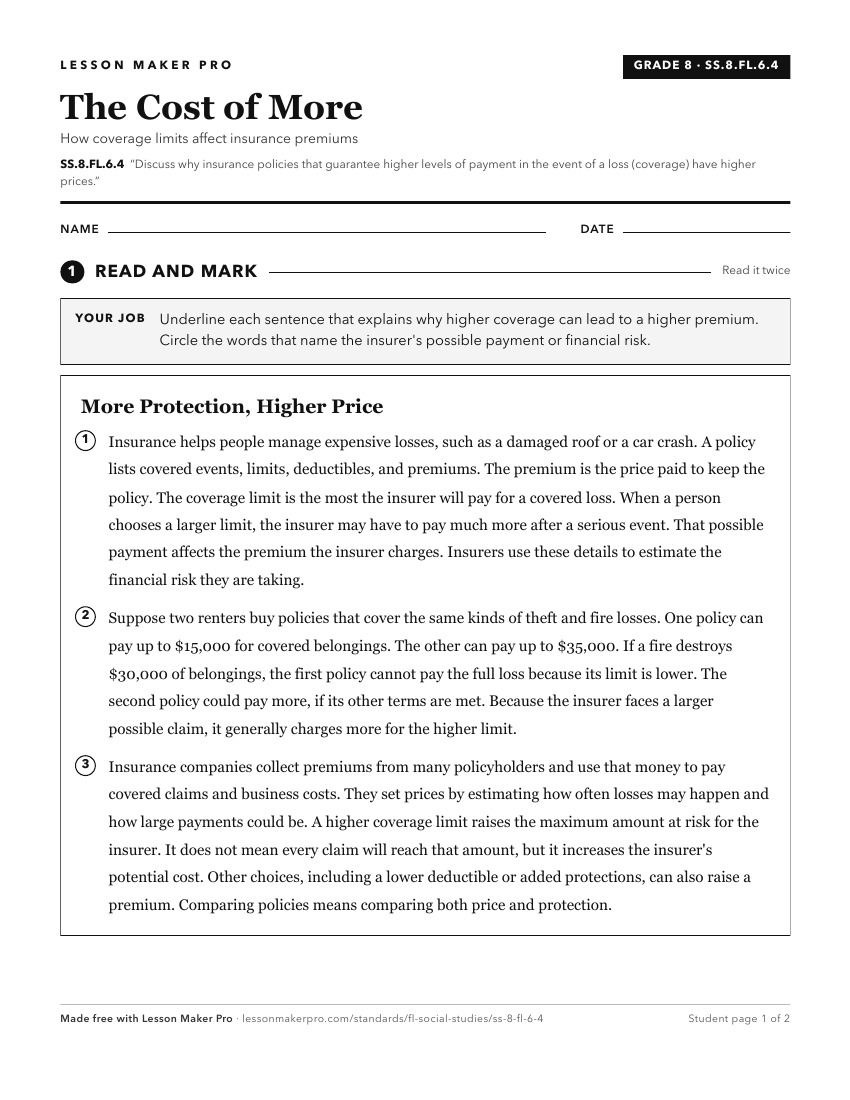
A ready-to-print activity worksheet aligned to SS.8.FL.6.4, with an answer key for the teacher on its own page. No account needed.
PDF, US Letter, prints cleanly in black and white.
Download the worksheetKeep exploring
Related Standards
- SS.8.FL.6.6
Explain that individuals can choose to accept some risk, to take steps to avoid or reduce risk, or to transfer risk to others through the purchase of insurance ...
- SS.8.FL.6.2
Identify insurance as a product that allows people to pay a fee (called a premium) now to transfer the costs of a potential loss to a third party.
- SS.8.FL.6.5
Discuss that insurance companies charge higher premiums to cover higher-risk individuals and events because the risk of monetary loss is greater for these indiv...
- SS.4.FL.6
Protecting and Insuring
Turn this exact standard into a lesson
Grade, subject, topic, and the complete standard are prefilled. Create one free, no account needed.
Also for this standard:Make a WorksheetMake a QuizMake a Sub Lesson