Florida SS.4.A.3
Florida Standard (Benchmark Cluster)
Exploration and Settlement of Florida
Florida Next Generation Sunshine State Standards for Social Studies
Cluster contents
Benchmarks in This Standard
SS.4.A.3 is a Florida social studies standard. These are the benchmarks under it.
- SS.4.A.3.1
Identify explorers who came to Florida and the motivations for their expeditions.
- SS.4.A.3.2
Describe causes and effects of European colonization on the Native American tribes of Florida.
- SS.4.A.3.3
Identify the significance of St. Augustine as the oldest permanent European settlement in the United States.
- SS.4.A.3.4
Explain the purpose of and daily life on missions (San Luis de Talimali in present-day Tallahassee).
- SS.4.A.3.5
Identify the significance of Fort Mose as the first free African community in the United States.
- SS.4.A.3.6
Identify the effects of Spanish rule in Florida.
- SS.4.A.3.7
Identify nations (Spain, France, England) that controlled Florida before it became a United States territory.
- SS.4.A.3.8
Explain how the Seminole tribe formed and the purpose for their migration.
- SS.4.A.3.9
Explain how Florida (Adams-Onis Treaty) became a United States territory.
- SS.4.A.3.10
Identify the causes and effects of the Seminole Wars.
Teacher's field guide
What This Cluster Means
What Students Need to Do
- Students identify major explorers, settlements, and reasons Europeans came to Florida. They place events in order and explain how exploration affected Native peoples and later settlement.
What Mastery Looks Like
- Students can locate key routes and settlements on a map and build an accurate timeline. They explain motives and results using specific people, places, and events.
Common Misconceptions
- Students may think explorers entered an empty land or that every expedition created a lasting settlement. They may call St. Augustine Florida’s first community rather than its oldest permanent European settlement.
How to Assess It
- Give students a blank Florida map and three event cards. Ask them to place each event, order the cards, and explain one effect on Native peoples.
Lesson moves
Ways to Teach It
Build a floor timeline using explorer, settlement, conflict, and mission cards, then have students justify where each card belongs.
Write a journal entry from a Native Floridian or European explorer describing one meeting and its effects.
Play a route-matching game in which teams connect explorers, motives, landing places, and outcomes using card sets.
Examine Florida place names on a current map and research how one name connects to Spanish, French, or Native history.
Free download
Printable SS.4.A.3 Worksheet
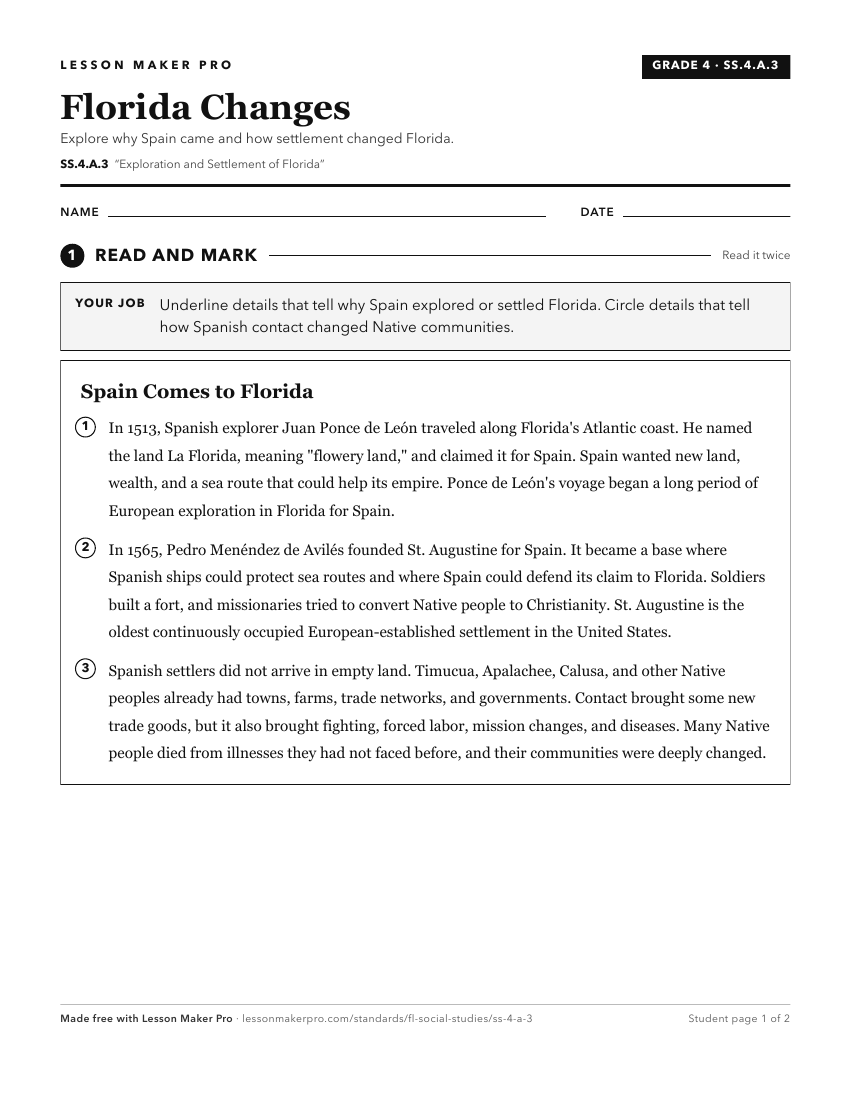
A ready-to-print activity worksheet aligned to SS.4.A.3, with an answer key for the teacher on its own page. No account needed.
PDF, US Letter, prints cleanly in black and white.
Download the worksheetKeep exploring
Related Standards
Turn this cluster into a lesson
Grade, subject, and topic are prefilled; the lesson picks the standards under this heading. Create one free, no account needed.
Also for this cluster:Make a WorksheetMake a QuizMake a Sub Lesson