Alabama Science PS.4
Standard Cluster
Evaluate the effects of using ions or isotopes of elements as a solution to a complex real-world problem, including cost, safety, trade-offs, and environmental impacts. a. Obtain, evaluate, and communicate information from the periodic table concerning the structure of an atom and the arrangement of the atom’s protons, neutrons, and electrons. b. Predict the properties of an element based on the element’s number of protons and valence electrons. c. Analyze and interpret data to predict properties of ionic and covalent compounds. d. Use mathematics and computational thinking to determine the charge of an ion and the mass number of an isotope based on the number of subatomic particles. e. Analyze and interpret data to explain how radioactive decay changes a radioactive isotope over time and explain how the age of an object can be estimated by the ratio of radioactive isotopes contained within the object’s atoms. f. Use mathematics and computational thinking to identify types of radioactive decay based on balanced chemical equations, penetrating power, identity of emitted particles, and charge. g. Use models to explain how nuclear fission and fusion reactions can be used as energy sources. h. Generate and defend a data-based claim regarding the use of radioactive materials as an energy source.
2023 Alabama Course of Study: Science · Matter and Its Interactions
Cluster contents
Standards in This Cluster
PS.4 is a cluster heading. These are the individual standards under it.
- PS.4.a
Obtain, evaluate, and communicate information from the periodic table concerning the structure of an atom and the arrangement of the atom’s protons, neutrons, a...
- PS.4.b
Predict the properties of an element based on the element’s number of protons and valence electrons.
- PS.4.c
Analyze and interpret data to predict properties of ionic and covalent compounds.
- PS.4.d
Use mathematics and computational thinking to determine the charge of an ion and the mass number of an isotope based on the number of subatomic particles.
- PS.4.e
Analyze and interpret data to explain how radioactive decay changes a radioactive isotope over time and explain how the age of an object can be estimated by the...
- PS.4.f
Use mathematics and computational thinking to identify types of radioactive decay based on balanced chemical equations, penetrating power, identity of emitted p...
- PS.4.g
Use models to explain how nuclear fission and fusion reactions can be used as energy sources.
- PS.4.h
Generate and defend a data-based claim regarding the use of radioactive materials as an energy source.
Teacher's field guide
What This Cluster Means
What Students Need to Do
- Students use the periodic table to count protons, neutrons, and electrons. They find ion charge and isotope mass, then use valence electrons and compound data to predict properties. They read decay data, model fission and fusion, and weigh the costs, safety, and environmental effects of radioactive materials.
What Mastery Looks Like
- Given particle counts, a student identifies an element, calculates an ion's charge, and finds an isotope's mass number. They use conductivity data to distinguish ionic and covalent compounds, identify radiation from decay equations, and estimate age from isotope ratios. They compare fission and fusion and defend an energy choice with figures for cost, safety, and waste.
Common Misconceptions
- Students may think adding a neutron changes the element, or that losing an electron changes its mass number. They may think all radiation penetrates materials equally or that gamma emission changes atomic number. Some assume fusion powers current nuclear plants or that all atoms decay after one half-life.
How to Assess It
- Give students a chart comparing uranium-fueled and gas power by cost, emissions, accident risk, and waste. Ask them to choose one and cite two figures plus one trade-off.
Lesson moves
Ways to Teach It
Build sodium-23, sodium-24, and sodium-23 ions with colored counters; record proton, neutron, and electron counts, mass number, and charge.
Ask: Should our town support a nuclear power plant? Write a claim using cost, emissions, safety, and waste figures from a provided chart.
Sort NaCl, CO2, and alpha, beta, and gamma decay cards; label bonds or radiation, then check mass and atomic numbers in equations.
Give students carbon-14 ratios for two artifacts and a living sample; use a 5,730-year half-life chart to estimate each artifact's age.
Free download
Printable PS.4 Worksheet
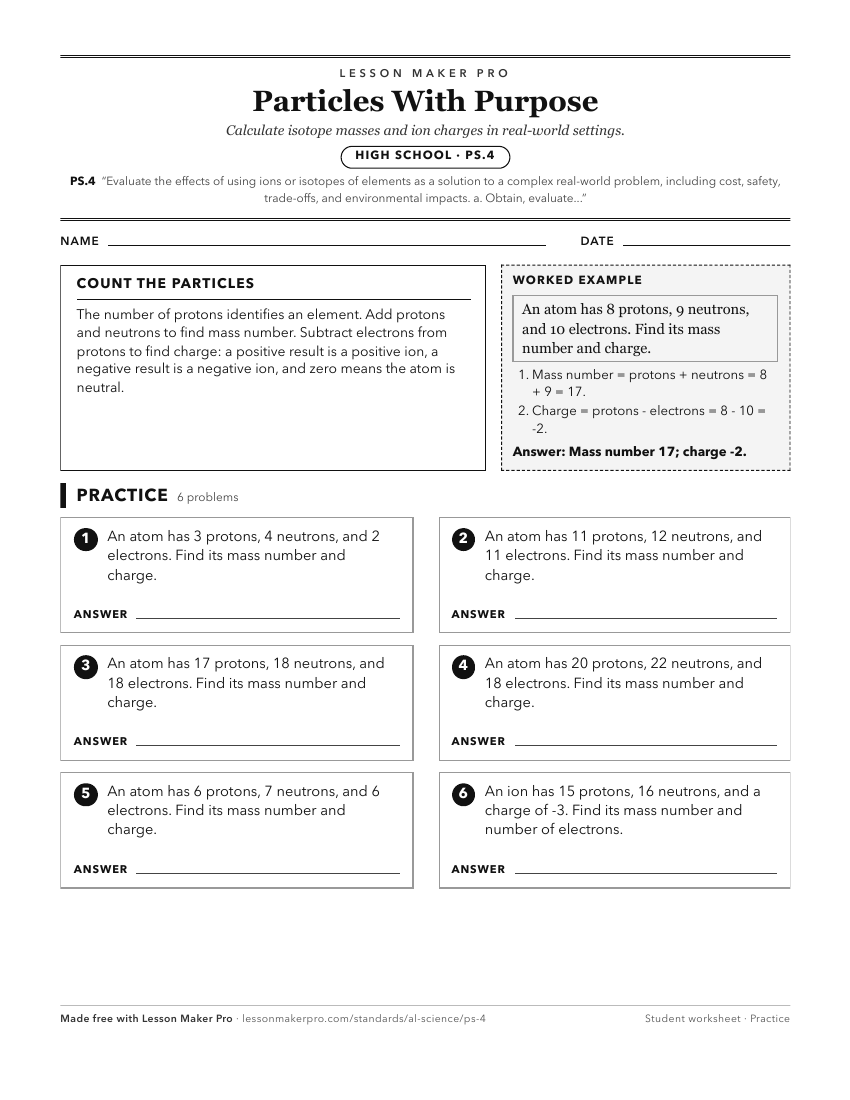
A ready-to-print activity worksheet aligned to PS.4, with an answer key for the teacher on its own page. No account needed.
PDF, US Letter, prints cleanly in black and white.
Download the worksheetKeep exploring
Related Standards
- CHE.1.b
Develop and use models of an element’s subatomic particles to compare and contrast its atoms, ions, and isotopes.
- PS.6
Obtain, evaluate, and communicate information to explain how the properties of various types of solutions make them useful in real-world applications.
- CHE.6
Make qualitative and quantitative claims, based on ion concentration, about the acidic, basic, or neutral characteristics of a solution.
Turn this cluster into a lesson
Grade, subject, topic, and the complete cluster are prefilled. Create one free, no account needed.
Also for this cluster:Make a WorksheetMake a QuizMake a Sub Lesson