Alabama Science PS.4.d
The Standard
- PS.4
- Evaluate the effects of using ions or isotopes of elements as a solution to a complex real-world problem, including cost, safety, trade-offs, and environmental impacts.
Use mathematics and computational thinking to determine the charge of an ion and the mass number of an isotope based on the number of subatomic particles.
2023 Alabama Course of Study: Science · Matter and Its Interactions
Teacher's field guide
What This Standard Means
What Students Need to Do
- Students subtract electrons from protons to find an ion’s charge. They add protons and neutrons to find an isotope’s mass number.
What Mastery Looks Like
- Given 17 protons, 18 neutrons, and 18 electrons, a student finds a charge of −1 and a mass number of 35. They can explain why changing electrons affects charge, while changing neutrons makes a different isotope.
Common Misconceptions
- Students may include electrons when finding mass number. They may also give a positive charge when a particle has more electrons than protons.
How to Assess It
- Exit ticket: A particle has 17 protons, 18 neutrons, and 18 electrons. What are its charge and mass number? Show both calculations.
Lesson moves
Ways to Teach It
Use three colors of counters to build 6 protons, 8 neutrons, and 6 electrons; change one count and record what changes.
Compare cards marked 8 protons, 8 neutrons, 10 electrons and 8 protons, 9 neutrons, 8 electrons. What changed in charge and isotope?
Enter four sets of particle counts in a spreadsheet; write formulas for charge and mass number, then check the results by hand.
Use an americium-241 smoke detector information sheet; given its 95 protons, calculate how many neutrons it has.
Free download
Printable PS.4.d Worksheet
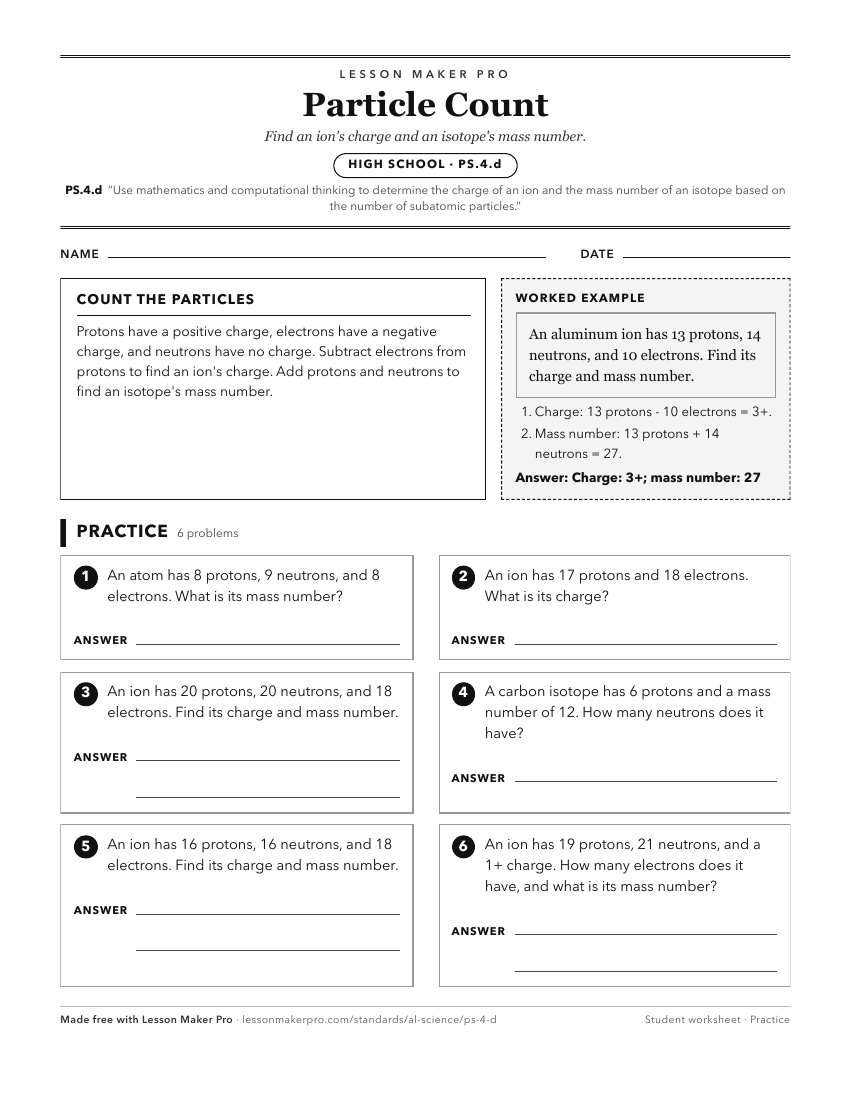
A ready-to-print activity worksheet aligned to PS.4.d, with an answer key for the teacher on its own page. No account needed.
PDF, US Letter, prints cleanly in black and white.
Download the worksheetKeep exploring
Related Standards
- PS.4.f
Use mathematics and computational thinking to identify types of radioactive decay based on balanced chemical equations, penetrating power, identity of emitted p...
- CHE.1.b
Develop and use models of an element’s subatomic particles to compare and contrast its atoms, ions, and isotopes.
- CHE.1.a
Assess the merits and limitations of historic and modern atomic models pertaining to the presence, position, mass, and charge of subatomic particles.
- PS.4.b
Predict the properties of an element based on the element’s number of protons and valence electrons.
Turn this exact standard into a lesson
Grade, subject, topic, and the complete standard are prefilled. Create one free, no account needed.
Also for this standard:Make a WorksheetMake a QuizMake a Sub Lesson