Alabama Science PS.4.f
The Standard
- PS.4
- Evaluate the effects of using ions or isotopes of elements as a solution to a complex real-world problem, including cost, safety, trade-offs, and environmental impacts.
Use mathematics and computational thinking to identify types of radioactive decay based on balanced chemical equations, penetrating power, identity of emitted particles, and charge.
2023 Alabama Course of Study: Science · Matter and Its Interactions
Teacher's field guide
What This Standard Means
What Students Need to Do
- Students balance nuclear equations by checking mass numbers and atomic numbers on both sides. They identify alpha, beta-minus, beta-plus, or gamma decay from the emitted particle, its charge, and its penetrating power.
What Mastery Looks Like
- Given an equation with a missing particle, students find the particle and name the decay. They explain why paper blocks alpha particles, thin aluminum blocks many beta particles, and thick lead reduces gamma radiation.
Common Misconceptions
- Students may subtract one from the mass number in beta decay or think gamma emission changes the element. They may mix up the charges of electrons and positrons, or assume the largest particle penetrates farthest.
How to Assess It
- Exit ticket: Complete U-238 (atomic number 92) → Th-234 (atomic number 90) + ? Name the decay, give the particle's charge, and choose paper, thin aluminum, or thick lead as a shield.
Lesson moves
Ways to Teach It
Give pairs isotope cards and number tiles; have them build daughter nuclei after alpha, beta-minus, and gamma emissions.
Ask students to write why carbon-14 becomes nitrogen-14 after beta-minus decay while its mass number stays 14.
Play a four-corner match with decay labels; call out a particle charge, a change in atomic number, or a shielding clue.
Show a photo of an americium-241 smoke detector label; ask why its alpha source is sealed inside the housing.
Free download
Printable PS.4.f Worksheet
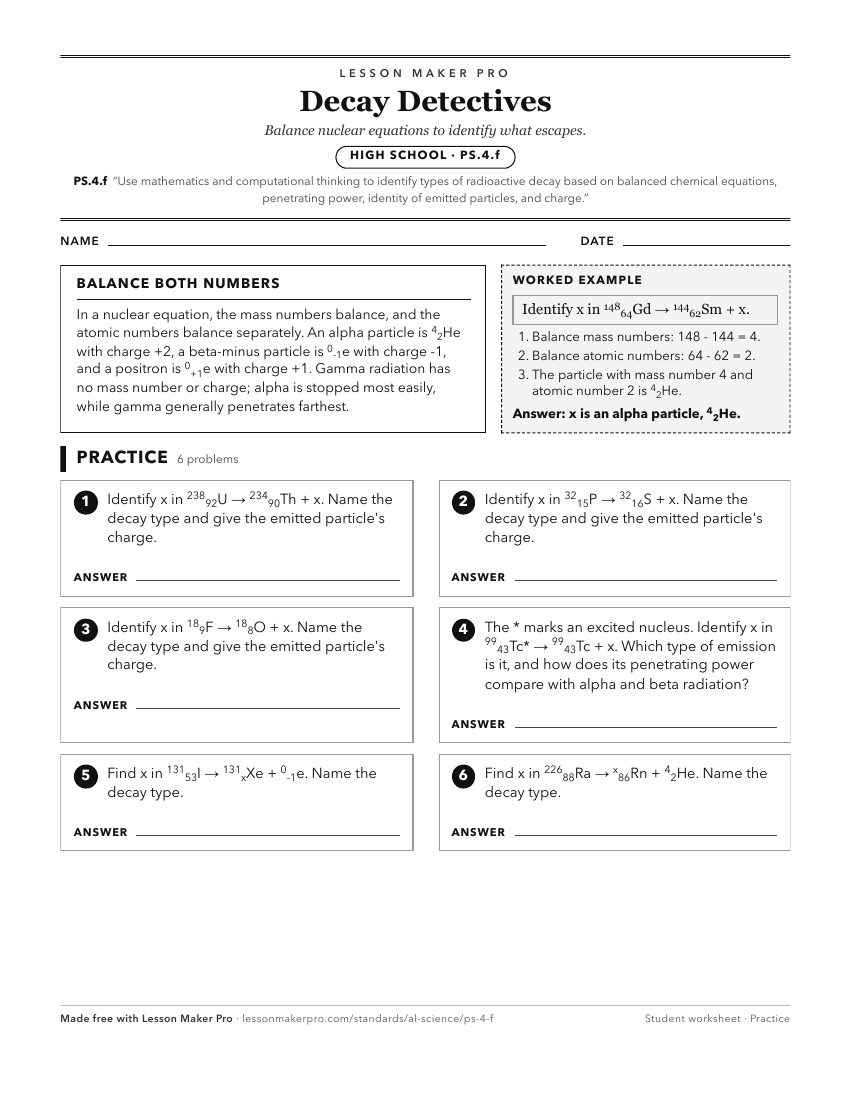
A ready-to-print activity worksheet aligned to PS.4.f, with an answer key for the teacher on its own page. No account needed.
PDF, US Letter, prints cleanly in black and white.
Download the worksheetKeep exploring
Related Standards
- PS.4.d
Use mathematics and computational thinking to determine the charge of an ion and the mass number of an isotope based on the number of subatomic particles.
- PS.4.e
Analyze and interpret data to explain how radioactive decay changes a radioactive isotope over time and explain how the age of an object can be estimated by the...
- CHE.1.b
Develop and use models of an element’s subatomic particles to compare and contrast its atoms, ions, and isotopes.
- PS.4.g
Use models to explain how nuclear fission and fusion reactions can be used as energy sources.
Turn this exact standard into a lesson
Grade, subject, topic, and the complete standard are prefilled. Create one free, no account needed.
Also for this standard:Make a WorksheetMake a QuizMake a Sub Lesson