Alabama Science CHE.1.b
The Standard
- CHE.1
- Use the periodic table as a model to predict the structure and properties of atoms and elements.
Develop and use models of an element’s subatomic particles to compare and contrast its atoms, ions, and isotopes.
2023 Alabama Course of Study: Science · Matter and Its Interactions
Teacher's field guide
What This Standard Means
What Students Need to Do
- Students draw or build models that show an element’s protons, neutrons, and electrons. They use the counts to tell neutral atoms, ions, and isotopes apart.
What Mastery Looks Like
- A student keeps the proton count the same when modeling one element. They change electrons to show an ion and neutrons to show an isotope, then explain the charge or mass difference.
Common Misconceptions
- Students may think gaining an electron changes the element. They may also change the proton count to make an isotope or think a positive ion has gained electrons.
How to Assess It
- Exit ticket: Model particles with counts of 12p, 12n, 12e; 12p, 13n, 12e; and 12p, 12n, 10e. Label the isotope pair and the ion, then explain each choice.
Lesson moves
Ways to Teach It
Give pairs three colors of counters to build a magnesium atom, a magnesium ion, and a second magnesium isotope.
Ask: “If an atom gains a neutron, is it still the same element?” Have students defend an answer with two carbon models.
Hand out particle-count cards and have students match ion cards to neutral atoms and isotope cards to others with the same proton count.
Give students a note about carbon-14 dating old wood, then have them model carbon-12 and carbon-14 side by side.
Free download
Printable CHE.1.b Worksheet
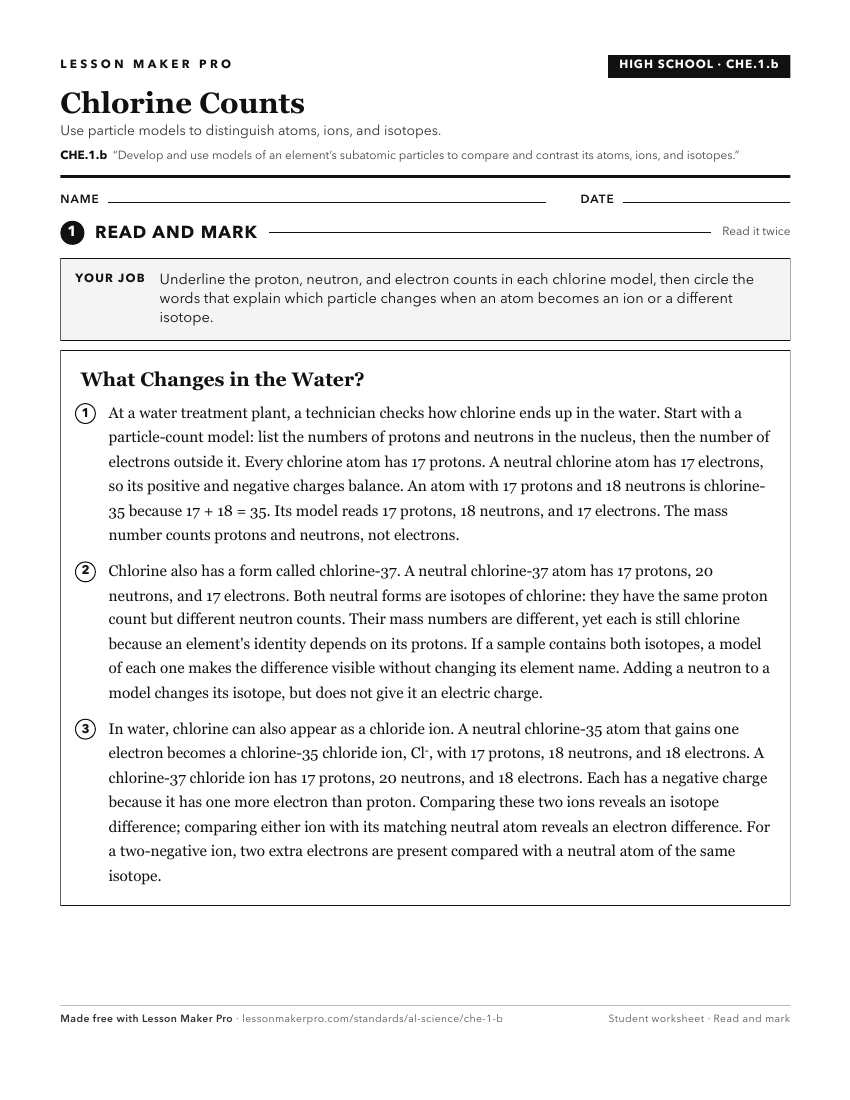
A ready-to-print activity worksheet aligned to CHE.1.b, with an answer key for the teacher on its own page. No account needed.
PDF, US Letter, prints cleanly in black and white.
Download the worksheetKeep exploring
Related Standards
- CHE.1.a
Assess the merits and limitations of historic and modern atomic models pertaining to the presence, position, mass, and charge of subatomic particles.
- CHE.1
Use the periodic table as a model to predict the structure and properties of atoms and elements.
- CHE.1.c
Analyze and interpret data to identify or describe an element based on its number of protons, its relative abundance of isotopes, its organization and placement...
- 6.5.a
Develop and use models to demonstrate the processes that form rocks and cycle Earth’s materials.
Turn this exact standard into a lesson
Grade, subject, topic, and the complete standard are prefilled. Create one free, no account needed.
Also for this standard:Make a WorksheetMake a QuizMake a Sub Lesson