Alabama Science CHE.1.a
The Standard
- CHE.1
- Use the periodic table as a model to predict the structure and properties of atoms and elements.
Assess the merits and limitations of historic and modern atomic models pertaining to the presence, position, mass, and charge of subatomic particles.
2023 Alabama Course of Study: Science · Matter and Its Interactions
Teacher's field guide
What This Standard Means
What Students Need to Do
- Students compare older atomic models with the modern model. They identify which particles each model includes, where those particles are placed, their charges and relative masses, and what each model cannot explain.
What Mastery Looks Like
- A student can use gold foil results to explain why positive charge and most mass are in a tiny nucleus. They place protons and neutrons in the nucleus and electrons in a cloud, with electrons much lighter than either nuclear particle. They can explain that Bohr's fixed paths helped account for hydrogen's light but are not exact electron paths.
Common Misconceptions
- Students may draw electron clouds as fixed tracks or assume every model includes neutrons. Some put most of an atom's mass in its electrons or give neutrons a negative charge.
How to Assess It
- Give students blank Thomson and modern atom diagrams. Ask them to label particle locations, charges, and relative masses, then explain which diagram fits the gold foil results and why.
Lesson moves
Ways to Teach It
Build Thomson and modern atom diagrams with paper circles and colored dots; label which particles each includes and where mass and charge sit.
Ask: What did the gold foil results show about where an atom keeps most of its mass and positive charge?
Deal Dalton, Thomson, Rutherford, Bohr, and electron cloud cards; match each to clues about neutrons, nuclei, and electron positions.
Show a neon sign photo and its line spectrum; have students explain its colors using electron energy changes rather than fixed electron tracks.
Free download
Printable CHE.1.a Worksheet
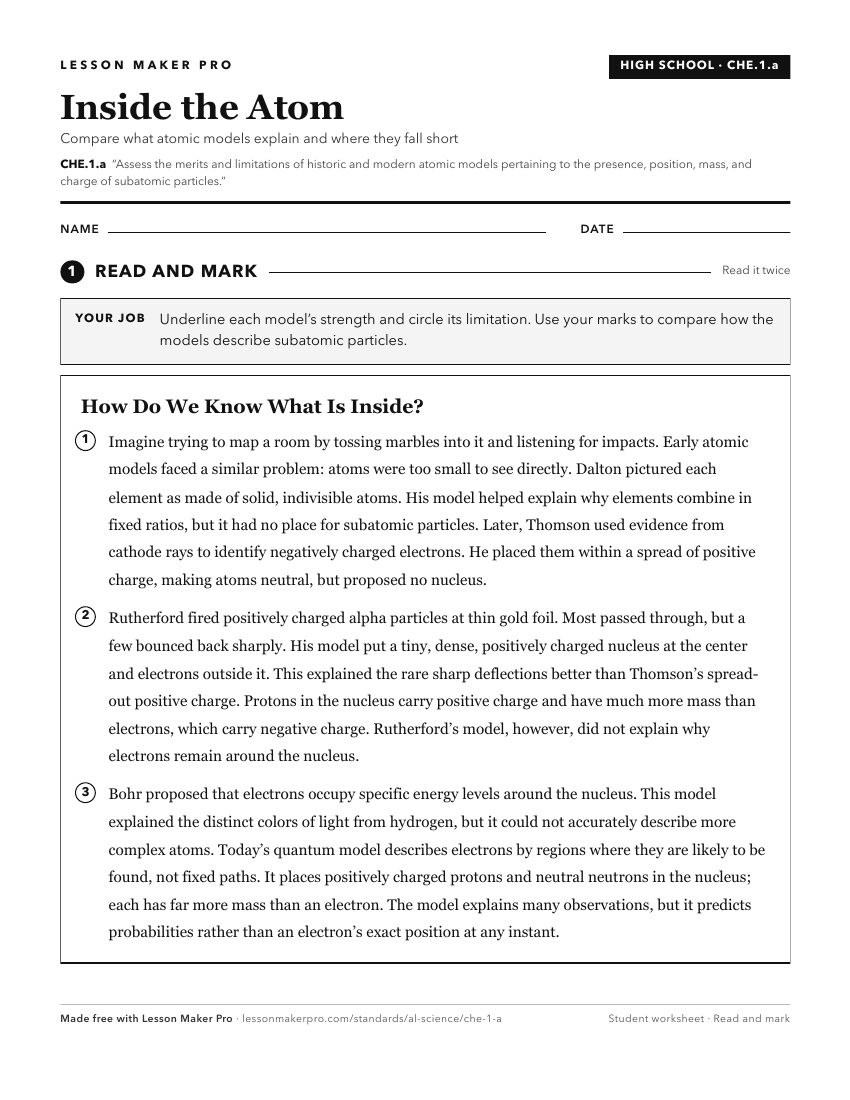
A ready-to-print activity worksheet aligned to CHE.1.a, with an answer key for the teacher on its own page. No account needed.
PDF, US Letter, prints cleanly in black and white.
Download the worksheetKeep exploring
Related Standards
- CHE.1.b
Develop and use models of an element’s subatomic particles to compare and contrast its atoms, ions, and isotopes.
- PS.4.d
Use mathematics and computational thinking to determine the charge of an ion and the mass number of an isotope based on the number of subatomic particles.
- CHE.1
Use the periodic table as a model to predict the structure and properties of atoms and elements.
- PS.4.a
Obtain, evaluate, and communicate information from the periodic table concerning the structure of an atom and the arrangement of the atom’s protons, neutrons, a...
Turn this exact standard into a lesson
Grade, subject, topic, and the complete standard are prefilled. Create one free, no account needed.
Also for this standard:Make a WorksheetMake a QuizMake a Sub Lesson