Alabama Science CHE.1
Standard Cluster
Use the periodic table as a model to predict the structure and properties of atoms and elements. a. Assess the merits and limitations of historic and modern atomic models pertaining to the presence, position, mass, and charge of subatomic particles. b. Develop and use models of an element’s subatomic particles to compare and contrast its atoms, ions, and isotopes. c. Analyze and interpret data to identify or describe an element based on its number of protons, its relative abundance of isotopes, its organization and placement of electrons, and its light emission spectrum. d. Ask questions to determine the relationship between an element’s physical and chemical properties and its position on the periodic table. e. Construct explanations of how periodic trends can be used to predict the properties of elements.
2023 Alabama Course of Study: Science · Matter and Its Interactions
Cluster contents
Standards in This Cluster
CHE.1 is a cluster heading. These are the individual standards under it.
- CHE.1.a
Assess the merits and limitations of historic and modern atomic models pertaining to the presence, position, mass, and charge of subatomic particles.
- CHE.1.b
Develop and use models of an element’s subatomic particles to compare and contrast its atoms, ions, and isotopes.
- CHE.1.c
Analyze and interpret data to identify or describe an element based on its number of protons, its relative abundance of isotopes, its organization and placement...
- CHE.1.d
Ask questions to determine the relationship between an element’s physical and chemical properties and its position on the periodic table.
- CHE.1.e
Construct explanations of how periodic trends can be used to predict the properties of elements.
Teacher's field guide
What This Cluster Means
What Students Need to Do
- Students use the periodic table to work out proton, neutron, and electron counts in atoms, ions, and isotopes. They use isotope data, electron arrangements, and light spectra to identify elements. They compare atomic models and use an element’s position to predict its size and reactivity.
What Mastery Looks Like
- Given particle counts, students can draw an atom and its ion or isotope. They can calculate average atomic mass from isotope data and use spectral lines to identify an element. They can explain why Rutherford’s model fits scattering evidence but cannot explain an element’s spectral lines.
Common Misconceptions
- Students may think gaining an electron makes a new element, or that isotopes have different numbers of protons. They may read the atomic mass on the table as the mass of every atom of that element. Some draw electrons in fixed, planetlike paths and assume every trend increases across a row.
How to Assess It
- Exit ticket: An atom has 11 protons, 12 neutrons, and 10 electrons. Identify its element, isotope, and charge, then compare the size of its neutral atom with potassium using the periodic table.
Lesson moves
Ways to Teach It
Give pairs 11 proton, 13 neutron, and 11 electron counters; have them build sodium-23, sodium-24, and a sodium-23 ion.
Show Dalton and Rutherford diagrams; ask, “Which better explains particle scattering, and why can neither explain colored spectral lines?”
Deal cards for Li, Na, K, F, Cl, and Br; partners rank each group by atomic size and predict reactivity.
Give students printed streetlamp spectra and reference spectra for sodium, neon, and mercury; have them match bright lines to identify each lamp’s element.
Free download
Printable CHE.1 Worksheet
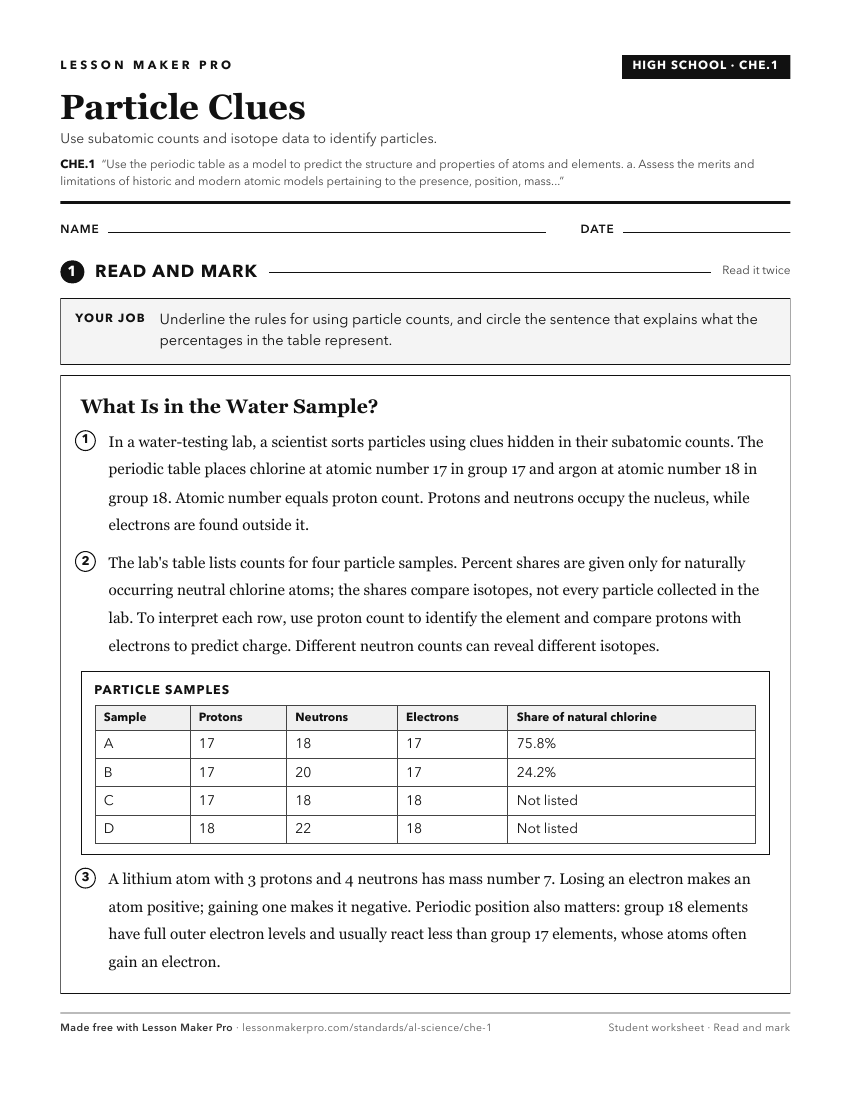
A ready-to-print activity worksheet aligned to CHE.1, with an answer key for the teacher on its own page. No account needed.
PDF, US Letter, prints cleanly in black and white.
Download the worksheetKeep exploring
Related Standards
- 8.4
Obtain and communicate information from the periodic table, including atomic number, number of electrons and neutrons, average atomic mass, groups, and periods,...
- 8.5
Obtain, evaluate, and communicate information from the periodic table to make predictions about the reactivity of the main group elements.
Turn this cluster into a lesson
Grade, subject, topic, and the complete cluster are prefilled. Create one free, no account needed.
Also for this cluster:Make a WorksheetMake a QuizMake a Sub Lesson