Alabama Science CHE.1.e
The Standard
- CHE.1
- Use the periodic table as a model to predict the structure and properties of atoms and elements.
Construct explanations of how periodic trends can be used to predict the properties of elements.
2023 Alabama Course of Study: Science · Matter and Its Interactions
Teacher's field guide
What This Standard Means
What Students Need to Do
- Students use an element's place on the periodic table to predict atomic size, electronegativity, and how easily it loses an electron. They explain their predictions using nuclear pull and electron shielding.
What Mastery Looks Like
- A student can compare two elements and predict which has the larger atom or stronger pull on bonding electrons. They use the elements' positions to explain why.
Common Misconceptions
- Students may think atoms always get bigger as atomic number rises, even across a row. They may think more electrons always mean a stronger pull on bonding electrons, overlooking shielding down a group.
How to Assess It
- Exit ticket: Compare sodium and chlorine. Which has the larger atom, and which attracts bonding electrons more strongly? Give a reason for each answer.
Lesson moves
Ways to Teach It
Give pairs cards for Li, Na, K, F, Cl, and Br; have them arrange each group by atomic size.
Ask students to write why chlorine attracts bonding electrons more strongly than sodium, even though both are in the same row.
Play trend tic-tac-toe: each square names two elements, and students claim it by choosing the larger atom and explaining why.
Have students predict whether aluminum foil or a sulfur sample conducts electricity, then check each with a battery-and-bulb circuit.
Free download
Printable CHE.1.e Worksheet
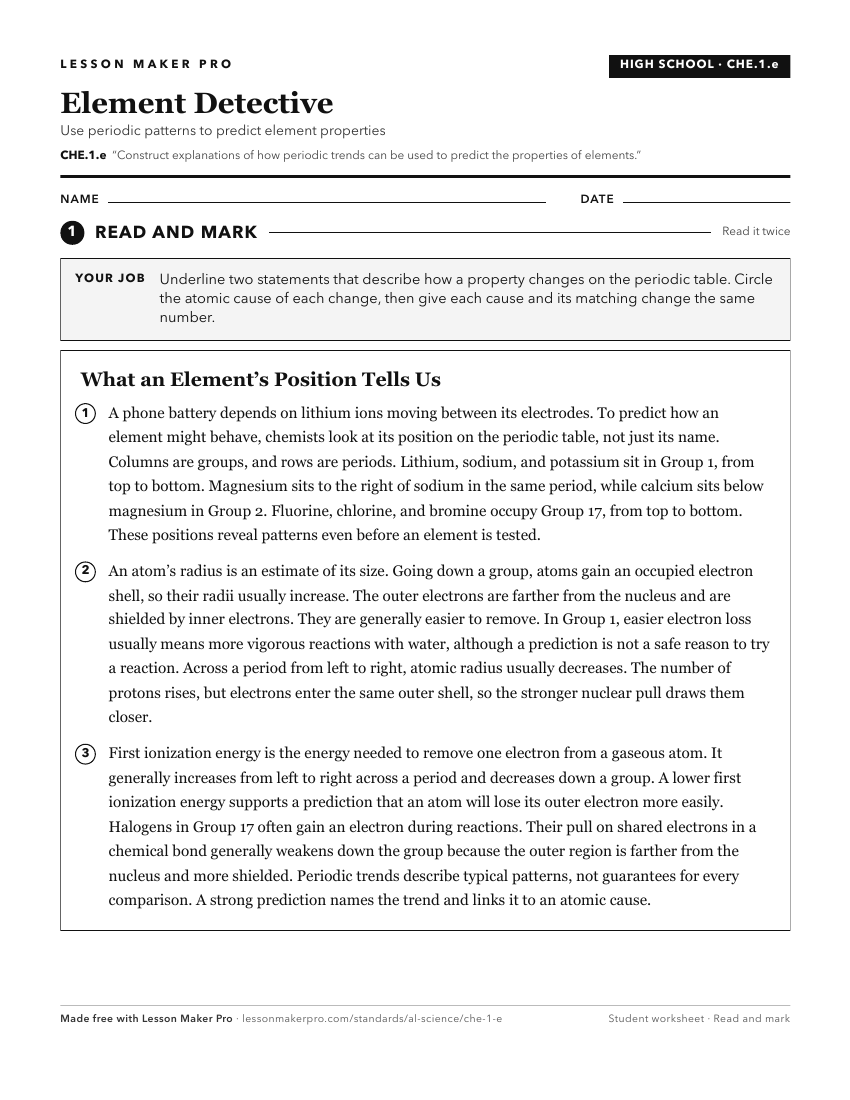
A ready-to-print activity worksheet aligned to CHE.1.e, with an answer key for the teacher on its own page. No account needed.
PDF, US Letter, prints cleanly in black and white.
Download the worksheetKeep exploring
Related Standards
- CHE.1
Use the periodic table as a model to predict the structure and properties of atoms and elements.
- 8.5
Obtain, evaluate, and communicate information from the periodic table to make predictions about the reactivity of the main group elements.
- CHE.1.d
Ask questions to determine the relationship between an element’s physical and chemical properties and its position on the periodic table.
- PS.4.b
Predict the properties of an element based on the element’s number of protons and valence electrons.
Turn this exact standard into a lesson
Grade, subject, topic, and the complete standard are prefilled. Create one free, no account needed.
Also for this standard:Make a WorksheetMake a QuizMake a Sub Lesson