Alabama Science 8.5
Standard Cluster
Obtain, evaluate, and communicate information from the periodic table to make predictions about the reactivity of the main group elements. a. Use valence electron configuration to model ionic and covalent bonds.
2023 Alabama Course of Study: Science · Matter and Its Interactions
Cluster contents
Standards in This Cluster
8.5 is a cluster heading. These are the individual standards under it.
Teacher's field guide
What This Cluster Means
What Students Need to Do
- Students use the periodic table to find the outer electrons of main group elements and predict which are likely to react. They model bonds by showing electrons transferred between a metal and a nonmetal or shared between nonmetals.
What Mastery Looks Like
- A student can explain why sodium bonds with chlorine but neon rarely reacts. Their electron dot models show transfer in NaCl and sharing in H2O, with the right number of outer electrons.
Common Misconceptions
- Students may count all electrons instead of just outer electrons. They may show sodium and chlorine sharing electrons, or assume neon is highly reactive because it has many outer electrons.
How to Assess It
- Exit ticket: Using a periodic table, circle the least reactive of Na, Cl, and Ne. Draw electron dot models for NaCl and H2O, and label each bond as transfer or sharing.
Lesson moves
Ways to Teach It
Give pairs Na, Cl, H, and O cards with counters for valence electrons; have them build NaCl by transfer and H2O by sharing.
Ask, “Why does sodium react with chlorine while neon rarely reacts?” Require students to use outer electrons in their answer.
Sort NaCl, MgO, H2O, and Cl2 cards into transfer and sharing piles, then draw electron dots to check each choice.
Put a salt packet and water bottle on the desk; students sketch the bonds in each substance and explain the difference.
Free download
Printable 8.5 Worksheet
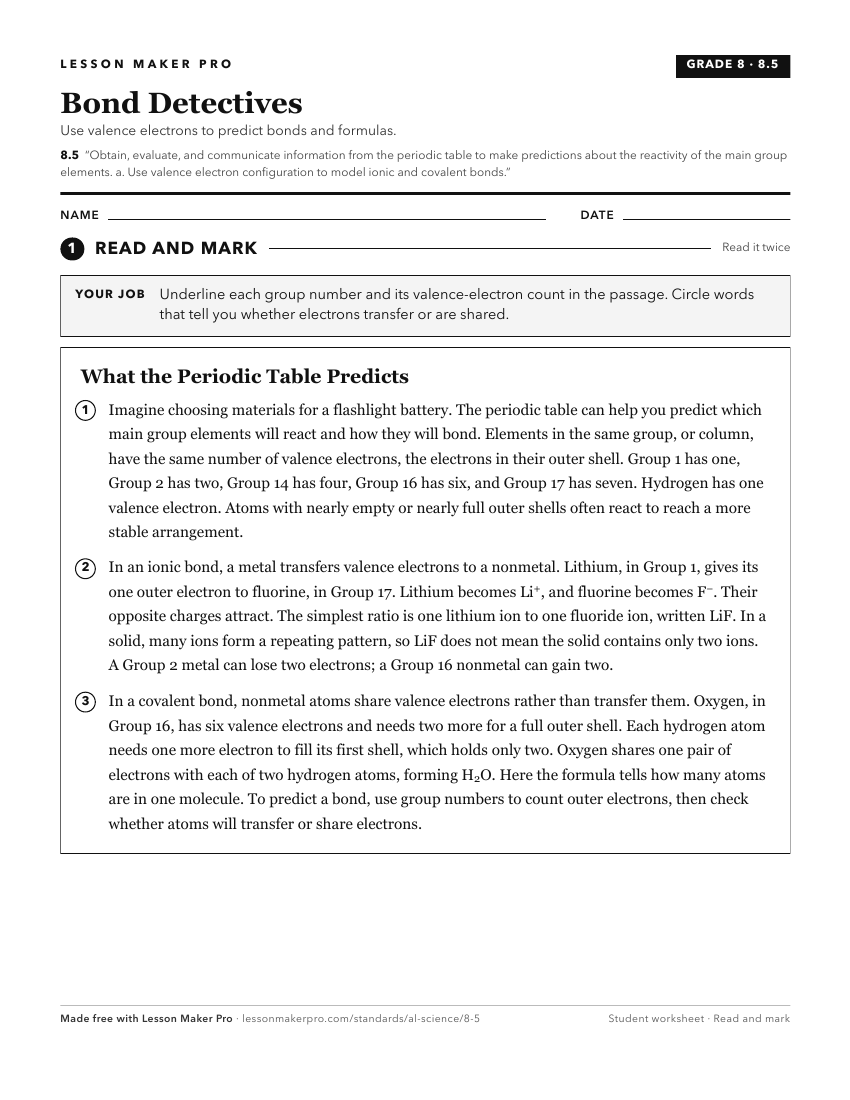
A ready-to-print activity worksheet aligned to 8.5, with an answer key for the teacher on its own page. No account needed.
PDF, US Letter, prints cleanly in black and white.
Download the worksheetKeep exploring
Related Standards
- 8.4
Obtain and communicate information from the periodic table, including atomic number, number of electrons and neutrons, average atomic mass, groups, and periods,...
- PS.4.a
Obtain, evaluate, and communicate information from the periodic table concerning the structure of an atom and the arrangement of the atom’s protons, neutrons, a...
- CHE.1
Use the periodic table as a model to predict the structure and properties of atoms and elements.
- CHE.1.d
Ask questions to determine the relationship between an element’s physical and chemical properties and its position on the periodic table.
Turn this cluster into a lesson
Grade, subject, topic, and the complete cluster are prefilled. Create one free, no account needed.
Also for this cluster:Make a WorksheetMake a QuizMake a Sub Lesson