Alabama Science 8.4
Standard Cluster
Obtain and communicate information from the periodic table, including atomic number, number of electrons and neutrons, average atomic mass, groups, and periods, to illustrate the structure and composition of atoms of different elements. a. Analyze and interpret data to differentiate among elements based on their properties and classify the elements as metals, nonmetals, or metalloids.
2023 Alabama Course of Study: Science · Matter and Its Interactions
Cluster contents
Standards in This Cluster
8.4 is a cluster heading. These are the individual standards under it.
Teacher's field guide
What This Cluster Means
What Students Need to Do
- Students find an element’s atomic number, average atomic mass, group, and period on a periodic table. They use atomic number to count protons and electrons in a neutral atom, then round average mass to estimate neutrons. They compare property data to classify elements as metals, nonmetals, or metalloids.
What Mastery Looks Like
- A student can describe carbon and sodium atoms using the periodic table. They can explain that an estimated neutron count does not apply to every atom of an element. They use evidence such as brittleness and conductivity to classify an unfamiliar element.
Common Misconceptions
- Some students subtract atomic number from the unrounded average mass and report a decimal neutron count. Others swap groups and periods or call shiny silicon a metal without checking its other properties.
How to Assess It
- Give students a periodic table and a card that says silicon is shiny, brittle, and conducts electricity less well than copper. Ask for its atomic number, average atomic mass, group, period, proton and electron counts, estimated neutrons, and classification with one property as evidence.
Lesson moves
Ways to Teach It
Give pairs three colors of beads to model carbon and sodium atoms; have them label protons, electrons, and estimated neutrons.
Give students a silicon property card: shiny, brittle, moderate conductor; ask them to justify its classification in writing.
Play element bingo: call out “group 17, period 3” or “atomic number 8”; students cover chlorine or oxygen on element cards.
Show aluminum foil and a silicon phone chip photo; students use a property chart to classify both and explain their different uses.
Free download
Printable 8.4 Worksheet
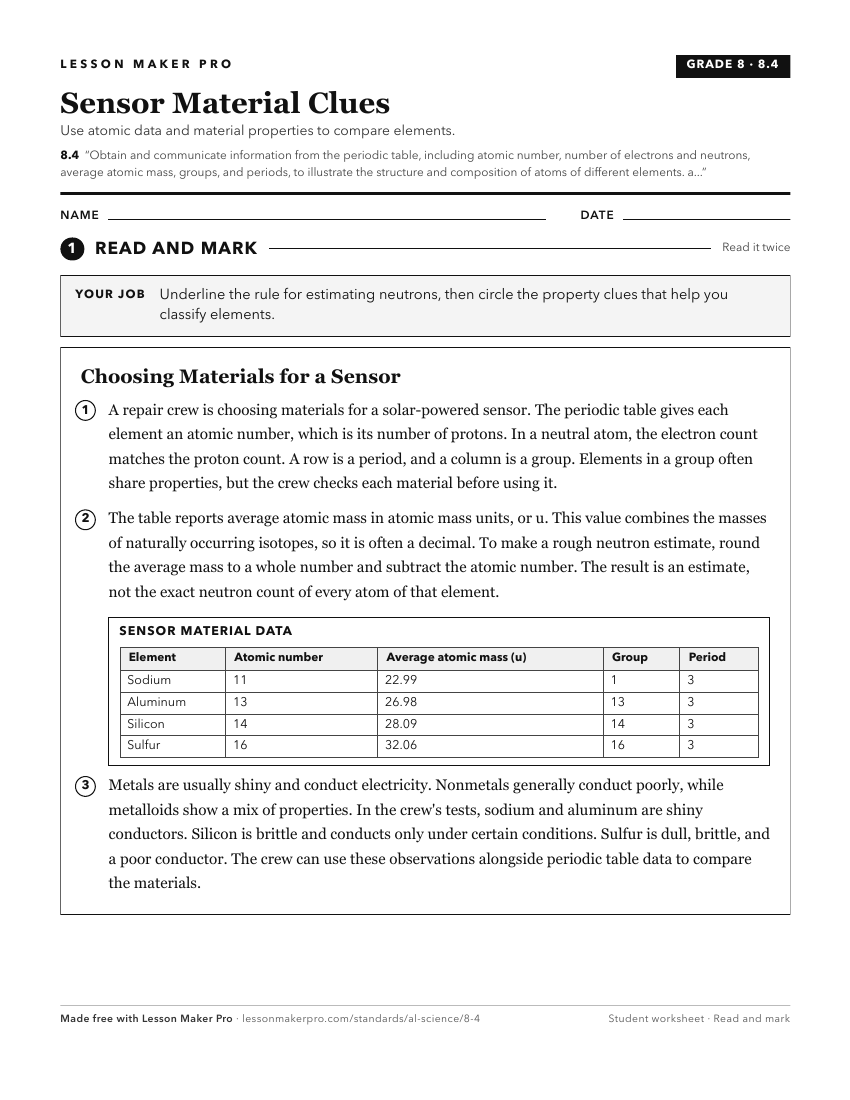
A ready-to-print activity worksheet aligned to 8.4, with an answer key for the teacher on its own page. No account needed.
PDF, US Letter, prints cleanly in black and white.
Download the worksheetKeep exploring
Related Standards
- PS.4.a
Obtain, evaluate, and communicate information from the periodic table concerning the structure of an atom and the arrangement of the atom’s protons, neutrons, a...
- 8.5
Obtain, evaluate, and communicate information from the periodic table to make predictions about the reactivity of the main group elements.
- CHE.1
Use the periodic table as a model to predict the structure and properties of atoms and elements.
- CHE.1.c
Analyze and interpret data to identify or describe an element based on its number of protons, its relative abundance of isotopes, its organization and placement...
Turn this cluster into a lesson
Grade, subject, topic, and the complete cluster are prefilled. Create one free, no account needed.
Also for this cluster:Make a WorksheetMake a QuizMake a Sub Lesson