Alabama Science 8.4.a
The Standard
- 8.4
- Obtain and communicate information from the periodic table, including atomic number, number of electrons and neutrons, average atomic mass, groups, and periods, to illustrate the structure and composition of atoms of different elements.
Analyze and interpret data to differentiate among elements based on their properties and classify the elements as metals, nonmetals, or metalloids.
2023 Alabama Course of Study: Science
Teacher's field guide
What This Standard Means
What Students Need to Do
- Students read data on luster, brittleness, and electrical conductivity. They use several properties to sort elements into metals, nonmetals, and metalloids, then explain their choices.
What Mastery Looks Like
- Given an unfamiliar element's property table, a student places it in a group and cites at least two clues. They do not rely on shine alone.
Common Misconceptions
- Students may think every shiny element is a metal or every nonmetal is dull. They may call graphite a metal because it conducts electricity, even though it is brittle.
How to Assess It
- Exit ticket: A is shiny, bends, and conducts well. B is dull, brittle, and does not conduct. C is shiny, brittle, and conducts weakly. Classify each element and give two clues for C.
Lesson moves
Ways to Teach It
Give pairs aluminum foil, copper wire, and mechanical pencil leads to bend gently and inspect, then record luster and breakage in a table.
Ask pairs to explain why shiny, brittle silicon with limited electrical conductivity belongs with metalloids rather than metals.
Play a sorting relay with property cards for copper, sulfur, silicon, and graphite; require two data clues before each card stays put.
Show photos of copper wires and silicon chips; ask why one carries current easily while the other can control its flow.
Free download
Printable 8.4.a Worksheet
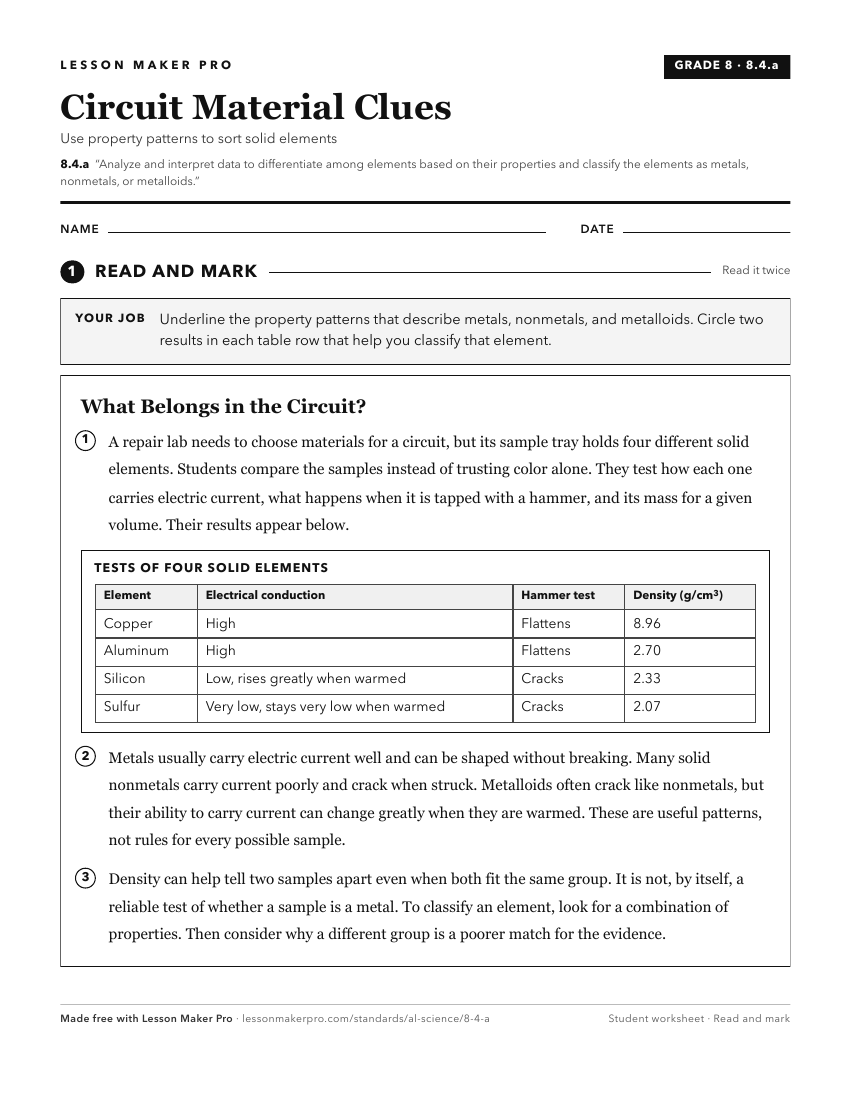
A ready-to-print activity worksheet aligned to 8.4.a, with an answer key for the teacher on its own page. No account needed.
PDF, US Letter, prints cleanly in black and white.
Download the worksheetKeep exploring
Related Standards
- PS.4.c
Analyze and interpret data to predict properties of ionic and covalent compounds.
- 5.2
Analyze data collected through observations and measurements to identify materials based on their properties, including color, hardness, and reflectivity.
- CHE.1.c
Analyze and interpret data to identify or describe an element based on its number of protons, its relative abundance of isotopes, its organization and placement...
- CHE.2.f
Analyze and interpret data from the periodic table to derive chemical formulas and names for ionic and covalent compounds.
Turn this exact standard into a lesson
Grade, subject, topic, and the complete standard are prefilled. Create one free, no account needed.
Also for this standard:Make a WorksheetMake a QuizMake a Sub Lesson