Alabama Science CHE.2.f
The Standard
- CHE.2
- Construct explanations of the formation of intramolecular and intermolecular forces and their effects on atomic and molecular interactions.
Analyze and interpret data from the periodic table to derive chemical formulas and names for ionic and covalent compounds.
2023 Alabama Course of Study: Science · Motion and Stability: Forces and Interactions
Teacher's field guide
What This Standard Means
What Students Need to Do
- Students use the periodic table to identify metals, nonmetals, and common ion charges. They balance charges to write ionic formulas and names. For covalent compounds, they use prefixes to match names with atom counts.
What Mastery Looks Like
- A student writes MgCl2 for magnesium chloride and explains why two chloride ions are needed. They name CO2 carbon dioxide and write N2O4 for dinitrogen tetroxide.
Common Misconceptions
- Students write MgCl because they forget to balance charges. They add prefixes to ionic names or use ion charges to set covalent subscripts. Some think the “di” in dioxide means two molecules.
How to Assess It
- Exit ticket: Use a periodic table to write and name the compound formed by Mg and Cl. Then write the formula for dinitrogen tetroxide and name CO2.
Lesson moves
Ways to Teach It
Give pairs ion cards labeled Mg2+ and Cl−; have them arrange cards until the total charge is zero, then write the formula.
Ask students to explain in writing why MgCl2 has no prefix but CO2 is called carbon dioxide.
Play a matching game with cards showing compound names, formulas, and either ion charges or prefix meanings.
Bring table salt and seltzer labels; have students find sodium chloride and carbon dioxide, then write their formulas.
Free download
Printable CHE.2.f Worksheet
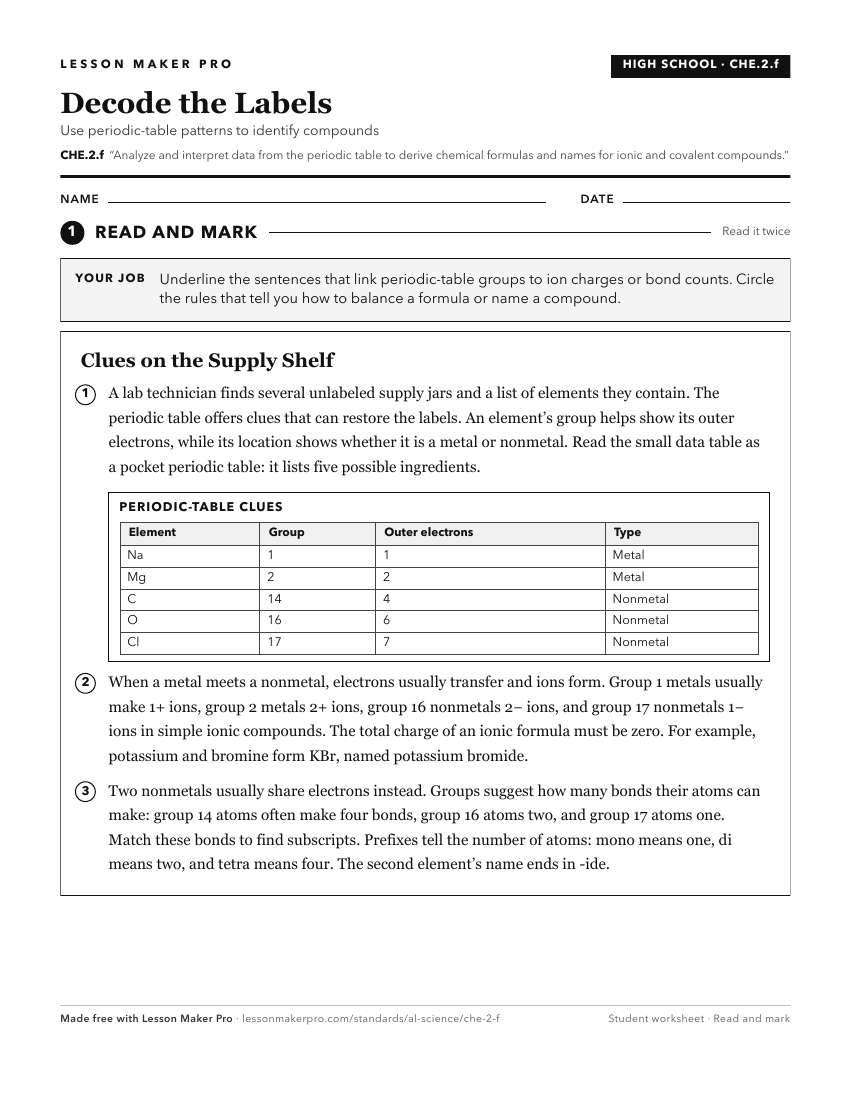
A ready-to-print activity worksheet aligned to CHE.2.f, with an answer key for the teacher on its own page. No account needed.
PDF, US Letter, prints cleanly in black and white.
Download the worksheetKeep exploring
Related Standards
- PS.4.c
Analyze and interpret data to predict properties of ionic and covalent compounds.
- CHE.6.b
Use the periodic table and computational thinking to derive chemical formulas and names of acids and bases.
- CHE.2.a
Develop and use Lewis dot diagrams to model the formation of covalent and ionic bonds.
- 8.5
Obtain, evaluate, and communicate information from the periodic table to make predictions about the reactivity of the main group elements.
Turn this exact standard into a lesson
Grade, subject, topic, and the complete standard are prefilled. Create one free, no account needed.
Also for this standard:Make a WorksheetMake a QuizMake a Sub Lesson