Alabama Science PS.4.c
The Standard
- PS.4
- Evaluate the effects of using ions or isotopes of elements as a solution to a complex real-world problem, including cost, safety, trade-offs, and environmental impacts.
Analyze and interpret data to predict properties of ionic and covalent compounds.
2023 Alabama Course of Study: Science · Matter and Its Interactions
Teacher's field guide
What This Standard Means
What Students Need to Do
- Students compare data such as melting point and electrical conductivity. They use patterns in the data to predict whether an unknown compound is ionic or covalent and how it will behave.
What Mastery Looks Like
- A student uses a high melting point and conductivity when dissolved to identify a likely ionic compound. They can predict that its dry solid will not conduct electricity and point to the data behind their answer.
Common Misconceptions
- Students may think solid ionic compounds conduct electricity because they contain charged particles. They may also assume every ionic compound dissolves in water or every covalent compound has a low melting point.
How to Assess It
- Give students an unknown that melts at 770°C and conducts electricity when dissolved, but not as a solid. Ask whether it is likely ionic or covalent and which two observations support their answer.
Lesson moves
Ways to Teach It
Use a conductivity probe to test distilled water, salt water, and sugar water, then have students record and compare the readings.
Show melting-point and conductivity data for salt and sugar, then ask: Which measurement gives the strongest clue about each compound?
Give teams data cards for known compounds and unknowns; have them sort the cards and defend each unknown's placement.
Compare conductivity readings for a sports drink and sugar water, then ask students what the readings suggest about dissolved salts.
Free download
Printable PS.4.c Worksheet
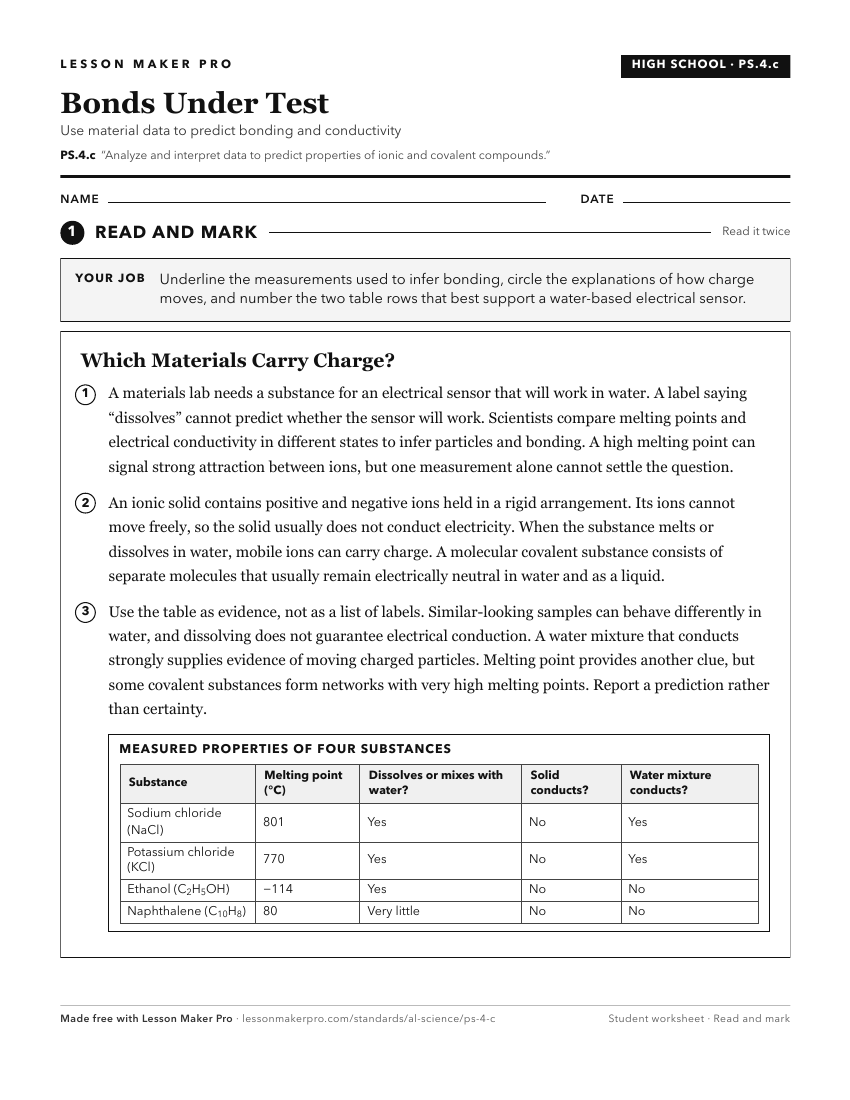
A ready-to-print activity worksheet aligned to PS.4.c, with an answer key for the teacher on its own page. No account needed.
PDF, US Letter, prints cleanly in black and white.
Download the worksheetKeep exploring
Related Standards
- CHE.2.f
Analyze and interpret data from the periodic table to derive chemical formulas and names for ionic and covalent compounds.
- CHE.2.g
Analyze and interpret data to compare the strengths of intermolecular forces and to explain how these forces affect physical properties.
- CHE.2.c
Plan and carry out an investigation to identify specific physical and chemical properties of compounds formed from ionic, covalent, and metallic bonding.
- 8.4.a
Analyze and interpret data to differentiate among elements based on their properties and classify the elements as metals, nonmetals, or metalloids.
Turn this exact standard into a lesson
Grade, subject, topic, and the complete standard are prefilled. Create one free, no account needed.
Also for this standard:Make a WorksheetMake a QuizMake a Sub Lesson