Alabama Science CHE.2.c
The Standard
- CHE.2
- Construct explanations of the formation of intramolecular and intermolecular forces and their effects on atomic and molecular interactions.
Plan and carry out an investigation to identify specific physical and chemical properties of compounds formed from ionic, covalent, and metallic bonding.
2023 Alabama Course of Study: Science · Motion and Stability: Forces and Interactions
Teacher's field guide
What This Standard Means
What Students Need to Do
- Students plan and run safe tests on ionic compounds, covalent compounds, and metallic samples. They record conductivity, solubility, and reactions with vinegar. They use the results to identify each bonding type.
What Mastery Looks Like
- A student keeps sample amounts and water volumes the same and records results in a table. They explain why saltwater conducts, sugarwater does not, and aluminum foil conducts while dry. They identify baking soda fizzing with vinegar as a chemical change.
Common Misconceptions
- Students may label sugar ionic because it dissolves in water. They may expect solid salt to conduct like aluminum foil or call dissolving a chemical reaction. They may also call aluminum foil a compound, though it is a metallic sample.
How to Assess It
- Exit ticket: Dry salt and sugar do not conduct; saltwater and aluminum foil do, but sugarwater does not; baking soda fizzes with vinegar. Name the bonding type in salt, sugar, and aluminum, identify one physical and one chemical property, and name one test condition to keep the same.
Lesson moves
Ways to Teach It
Give pairs salt, sugar, baking soda, aluminum foil, water, vinegar, and a low-voltage conductivity tester; have them plan solubility, conductivity, and vinegar tests.
Ask: Why does solid salt fail a conductivity test while saltwater passes, but aluminum foil conducts without dissolving?
Hand out result cards for salt, sugar, and aluminum foil; teams match each card to a bonding type and defend one match.
Show a rusted nail beside an unrusted nail; ask which observation shows metal reacting with oxygen and which test would measure conductivity.
Free download
Printable CHE.2.c Worksheet
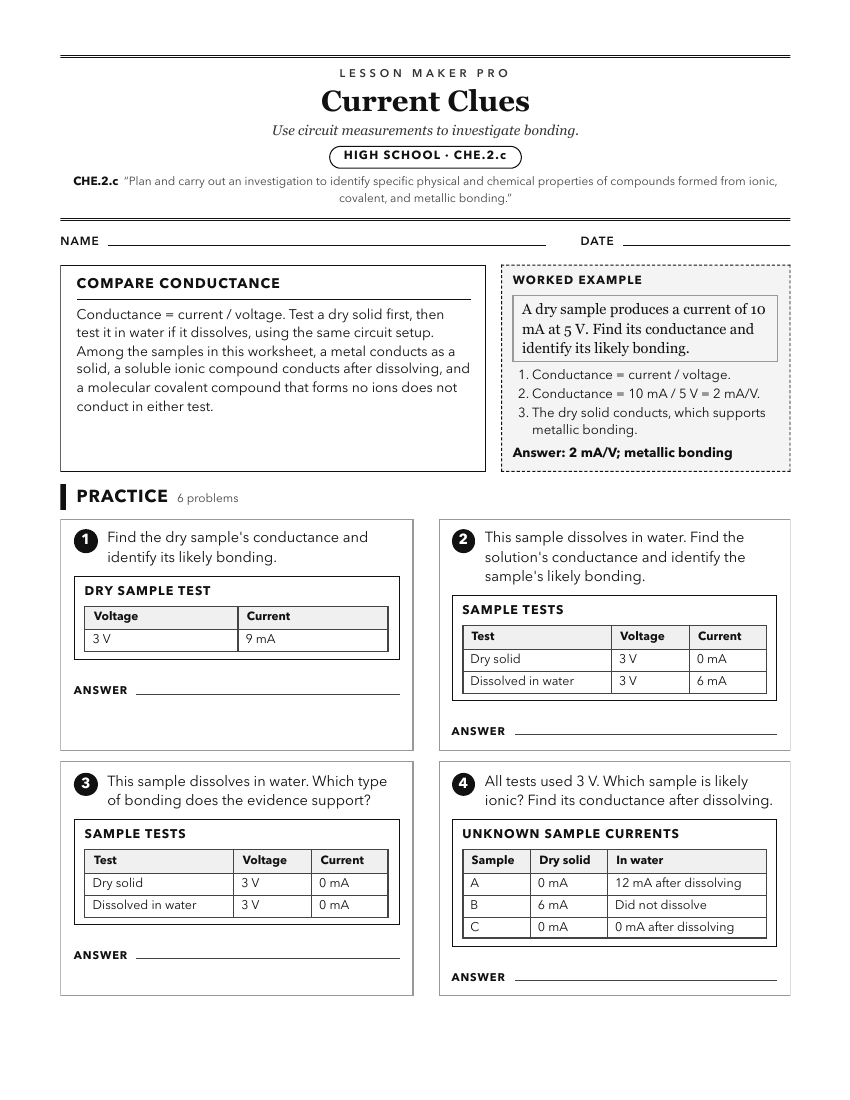
A ready-to-print activity worksheet aligned to CHE.2.c, with an answer key for the teacher on its own page. No account needed.
PDF, US Letter, prints cleanly in black and white.
Download the worksheetKeep exploring
Related Standards
- PS.4.c
Analyze and interpret data to predict properties of ionic and covalent compounds.
- PS.5.a
Carry out investigations and use results to compare and contrast the physical and chemical properties of matter.
- 8.1
Plan and carry out investigations to support the claim that pure substances can be described and defined by their properties, including solubility, electrical c...
- 2.1
Plan and carry out investigations to compare, contrast, and classify various solid and liquid materials according to physical properties, including color and te...
Turn this exact standard into a lesson
Grade, subject, topic, and the complete standard are prefilled. Create one free, no account needed.
Also for this standard:Make a WorksheetMake a QuizMake a Sub Lesson