Alabama Science CHE.2.g
The Standard
- CHE.2
- Construct explanations of the formation of intramolecular and intermolecular forces and their effects on atomic and molecular interactions.
Analyze and interpret data to compare the strengths of intermolecular forces and to explain how these forces affect physical properties.
2023 Alabama Course of Study: Science · Motion and Stability: Forces and Interactions
Teacher's field guide
What This Standard Means
What Students Need to Do
- Students compare boiling-point and vapor-pressure data measured under the same conditions. They use molecular structures to explain which substances have stronger attractions between molecules and how those attractions affect the data.
What Mastery Looks Like
- Given ethanol and dimethyl ether, students identify hydrogen bonding in ethanol and explain why it has the higher boiling point. They predict that ethanol has lower vapor pressure at the same temperature.
Common Misconceptions
- Students may confuse bonds within a molecule with attractions between molecules. Some think any molecule containing hydrogen can form hydrogen bonds. Others think a higher boiling point means weaker attractions.
How to Assess It
- Exit ticket: Ethanol (CH3CH2OH) boils at 78°C, while dimethyl ether (CH3OCH3) boils at −25°C. Which has stronger intermolecular forces, and what feature of its structure explains the difference?
Lesson moves
Ways to Teach It
Count how many drops of water and rubbing alcohol separate clean pennies hold, then use the results to compare surface tension.
Display ethanol and dimethyl ether structures and boiling points; ask students to write why their boiling points differ despite identical formulas.
Give pairs molecule cards and boiling-point cards for water, ethanol, acetone, and dimethyl ether; have them match and defend their choices.
Time water and rubbing alcohol drying on glass, then link the results to why alcohol wipes dry quickly.
Free download
Printable CHE.2.g Worksheet
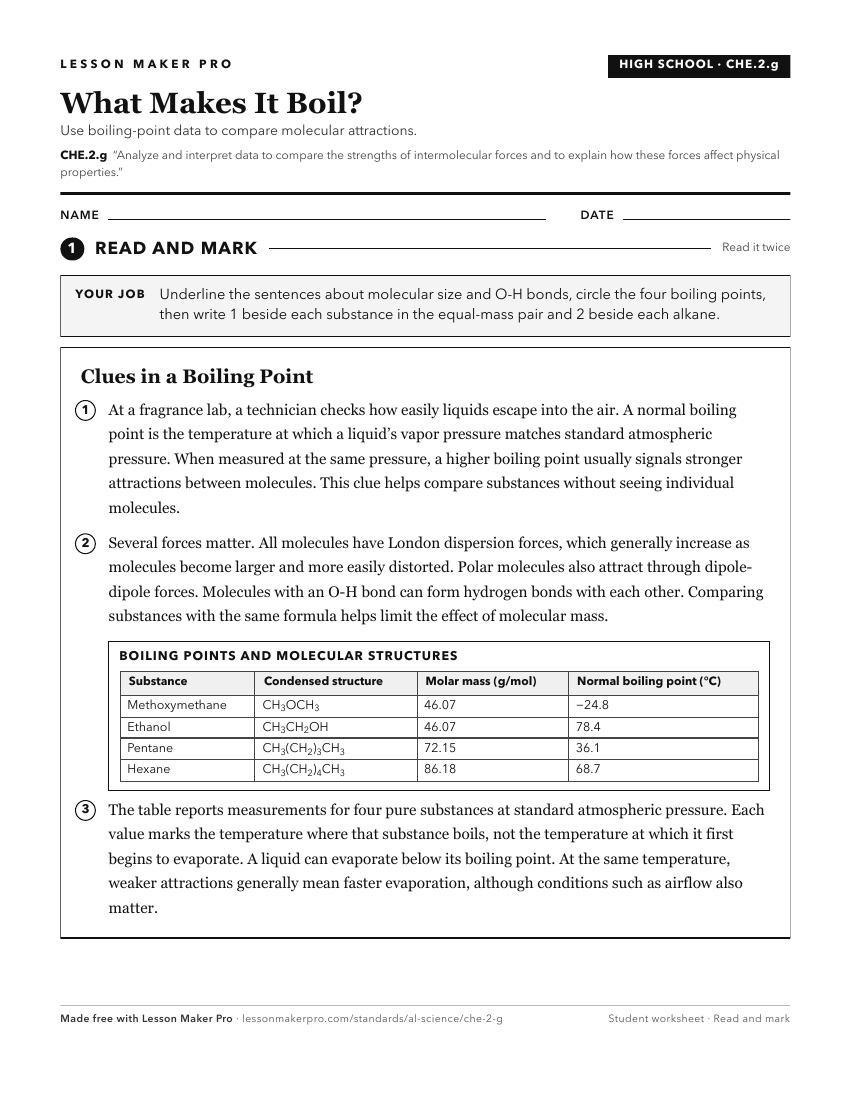
A ready-to-print activity worksheet aligned to CHE.2.g, with an answer key for the teacher on its own page. No account needed.
PDF, US Letter, prints cleanly in black and white.
Download the worksheetKeep exploring
Related Standards
- PS.4.c
Analyze and interpret data to predict properties of ionic and covalent compounds.
- CHE.2
Construct explanations of the formation of intramolecular and intermolecular forces and their effects on atomic and molecular interactions.
- PS.5.a
Carry out investigations and use results to compare and contrast the physical and chemical properties of matter.
- PS.5.b
Analyze and interpret data to predict changes in the phase of a material based on changes in particle motion, temperature, pressure, or thermal energy.
Turn this exact standard into a lesson
Grade, subject, topic, and the complete standard are prefilled. Create one free, no account needed.
Also for this standard:Make a WorksheetMake a QuizMake a Sub Lesson