Alabama Science CHE.2
Standard Cluster
Construct explanations of the formation of intramolecular and intermolecular forces and their effects on atomic and molecular interactions. a. Develop and use Lewis dot diagrams to model the formation of covalent and ionic bonds. b. Construct an explanation of the change in potential energy that occurs when chemical bonds are formed. c. Plan and carry out an investigation to identify specific physical and chemical properties of compounds formed from ionic, covalent, and metallic bonding. d. Develop and use models based on valence shell electron pair repulsion (VSEPR) theory to predict the shape of a molecule up to four electron domains around the central atom. e. Construct an explanation of the polarity of a molecule based on electronegativity data and molecular geometry. f. Analyze and interpret data from the periodic table to derive chemical formulas and names for ionic and covalent compounds. g. Analyze and interpret data to compare the strengths of intermolecular forces and to explain how these forces affect physical properties.
2023 Alabama Course of Study: Science · Motion and Stability: Forces and Interactions
Cluster contents
Standards in This Cluster
CHE.2 is a cluster heading. These are the individual standards under it.
- CHE.2.a
Develop and use Lewis dot diagrams to model the formation of covalent and ionic bonds.
- CHE.2.b
Construct an explanation of the change in potential energy that occurs when chemical bonds are formed.
- CHE.2.c
Plan and carry out an investigation to identify specific physical and chemical properties of compounds formed from ionic, covalent, and metallic bonding.
- CHE.2.d
Develop and use models based on valence shell electron pair repulsion (VSEPR) theory to predict the shape of a molecule up to four electron domains around the c...
- CHE.2.e
Construct an explanation of the polarity of a molecule based on electronegativity data and molecular geometry.
- CHE.2.f
Analyze and interpret data from the periodic table to derive chemical formulas and names for ionic and covalent compounds.
- CHE.2.g
Analyze and interpret data to compare the strengths of intermolecular forces and to explain how these forces affect physical properties.
Teacher's field guide
What This Cluster Means
What Students Need to Do
- Students draw Lewis diagrams to show electrons being transferred or shared. They use periodic table data to write and name compounds, then predict molecular shape and polarity. They explain bond energy changes and use test results to compare ionic, covalent, and metallic substances and the forces between molecules.
What Mastery Looks Like
- A student draws Lewis diagrams for MgCl2 and CO2, names both compounds, and explains why bond formation lowers potential energy. They model H2O as bent and CO2 as linear, then explain why only water is polar. They use conductivity, solubility, and boiling-point data to identify bonding types and compare forces between molecules.
Common Misconceptions
- Students may draw an ionic bond as a shared electron pair instead of showing electron transfer and charged ions. They may call CO2 polar because its C=O bonds are polar, without checking whether the bond effects cancel. They may confuse forces between molecules with bonds inside molecules, or assume solid salt conducts electricity.
How to Assess It
- Give students H2O and CH4, their electronegativity values, and their boiling points. Ask them to draw Lewis diagrams, label each shape and polarity, and explain which has stronger attractions between molecules.
Lesson moves
Ways to Teach It
Test salt, sugar, copper foil, and baking soda for solubility and conductivity; add vinegar to each and record any reaction.
Sketch an energy-versus-distance curve for two hydrogen atoms; explain why energy falls as a bond forms and rises if the atoms get too close.
Give pairs element cards and a periodic table; have them race to write formulas, name compounds, and draw Lewis diagrams for NaCl and CO2.
Give students boiling-point data for water and ethanol; ask why alcohol-based hand sanitizer dries faster than water on hands.
Free download
Printable CHE.2 Worksheet
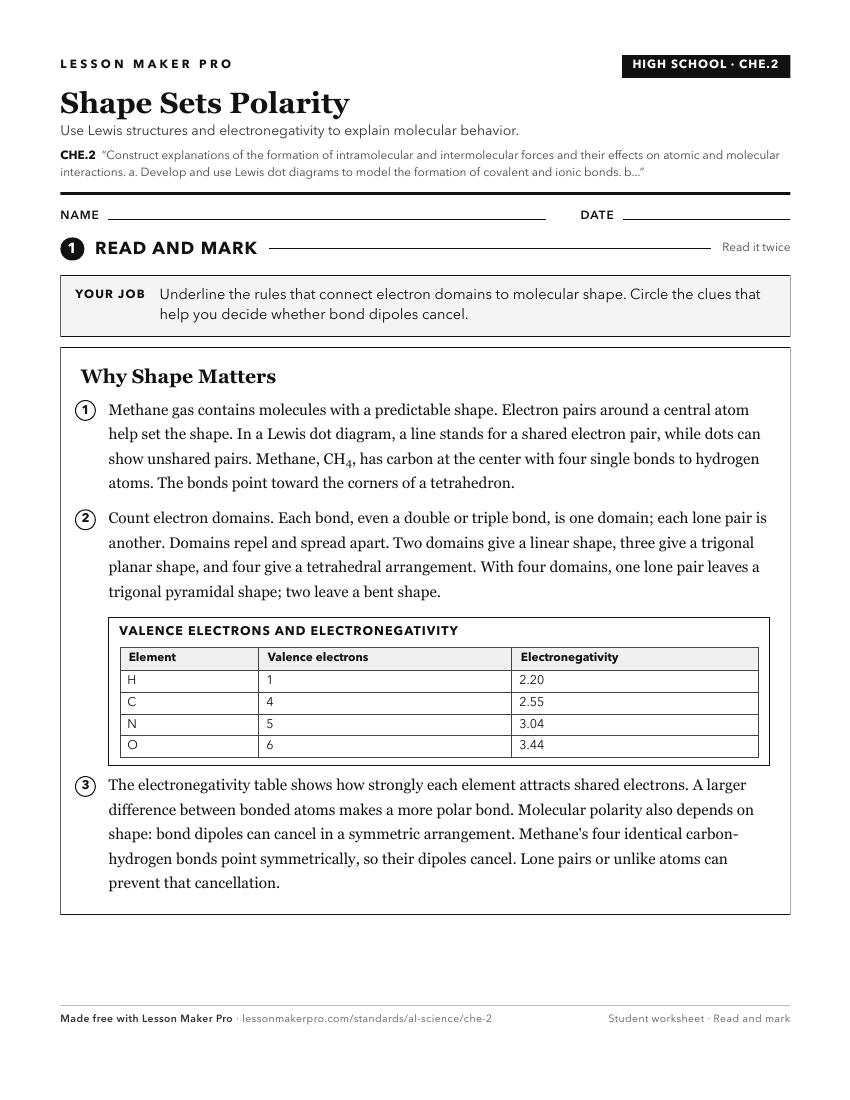
A ready-to-print activity worksheet aligned to CHE.2, with an answer key for the teacher on its own page. No account needed.
PDF, US Letter, prints cleanly in black and white.
Download the worksheetKeep exploring
Related Standards
Turn this cluster into a lesson
Grade, subject, topic, and the complete cluster are prefilled. Create one free, no account needed.
Also for this cluster:Make a WorksheetMake a QuizMake a Sub Lesson