Alabama Science CHE.2.d
The Standard
- CHE.2
- Construct explanations of the formation of intramolecular and intermolecular forces and their effects on atomic and molecular interactions.
Develop and use models based on valence shell electron pair repulsion (VSEPR) theory to predict the shape of a molecule up to four electron domains around the central atom.
2023 Alabama Course of Study: Science · Motion and Stability: Forces and Interactions
Teacher's field guide
What This Standard Means
What Students Need to Do
- Students draw Lewis structures and count bonding regions and lone pairs around a central atom. They use those counts to build a model and predict the molecule’s shape.
What Mastery Looks Like
- A student can predict the shapes of CO2, BF3, CH4, NH3, and H2O from their Lewis structures. They include lone pairs in the model but name the shape by the positions of the atoms.
Common Misconceptions
- Students may count a double bond as two electron domains. They may also call NH3 tetrahedral because it has four domains, or miss the two lone pairs on oxygen in H2O.
How to Assess It
- Exit ticket: Draw a Lewis structure for NH3, mark the electron domains around nitrogen, and name its molecular shape. Explain why the shape is not called tetrahedral.
Lesson moves
Ways to Teach It
Build CH4, NH3, and H2O with clay balls and toothpicks; use paper flags for lone pairs, then name each shape.
Ask: CH4, NH3, and H2O each have four electron domains. Why do their molecular shapes have different names?
Sort Lewis structure cards for CO2, BF3, CH4, NH3, and H2O by shape, then check each domain count with a partner.
Draw water molecules in a glass and methane molecules in stove fuel, then label their shapes and lone pairs.
Free download
Printable CHE.2.d Worksheet
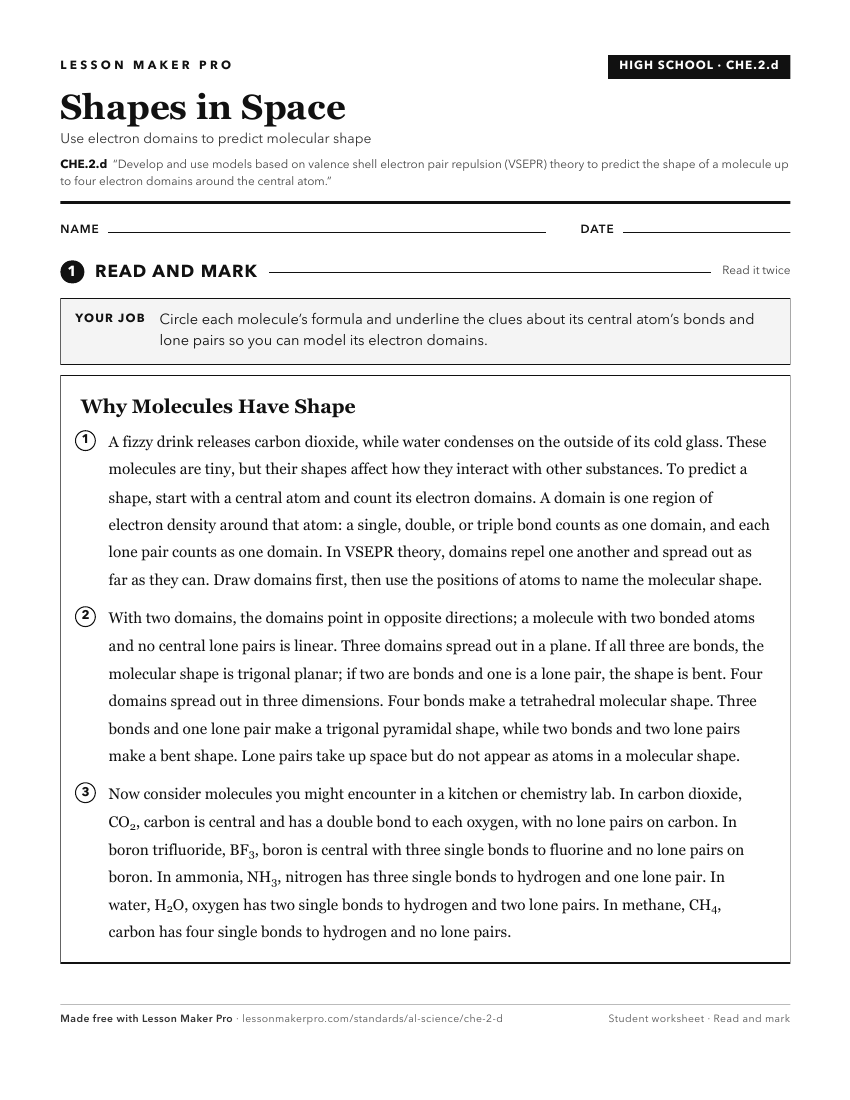
A ready-to-print activity worksheet aligned to CHE.2.d, with an answer key for the teacher on its own page. No account needed.
PDF, US Letter, prints cleanly in black and white.
Download the worksheetKeep exploring
Related Standards
- CHE.2.a
Develop and use Lewis dot diagrams to model the formation of covalent and ionic bonds.
- 8.5.a
Use valence electron configuration to model ionic and covalent bonds.
- CHE.3
Develop and use multiple types of models to represent chemical reactions.
- CHE.1
Use the periodic table as a model to predict the structure and properties of atoms and elements.
Turn this exact standard into a lesson
Grade, subject, topic, and the complete standard are prefilled. Create one free, no account needed.
Also for this standard:Make a WorksheetMake a QuizMake a Sub Lesson