Alabama Science CHE.3
Standard Cluster
Develop and use multiple types of models to represent chemical reactions. a. Use qualitative and quantitative reasoning to describe and balance chemical equations to satisfy the law of conservation of matter. b. Use qualitative and quantitative reasoning to classify chemical reactions, predict the products of single replacement and double replacement reactions, and represent chemical reactions using ionic equations. c. Analyze and interpret temperature and bond energy data to classify a reaction as endothermic or exothermic. d. Construct an explanation, using particle diagrams and collision theory, for how particle size, concentration, and temperature affect the rate of a chemical reaction.
2023 Alabama Course of Study: Science · Matter and Its Interactions: Energy
Cluster contents
Standards in This Cluster
CHE.3 is a cluster heading. These are the individual standards under it.
- CHE.3.a
Use qualitative and quantitative reasoning to describe and balance chemical equations to satisfy the law of conservation of matter.
- CHE.3.b
Use qualitative and quantitative reasoning to classify chemical reactions, predict the products of single replacement and double replacement reactions, and repr...
- CHE.3.c
Analyze and interpret temperature and bond energy data to classify a reaction as endothermic or exothermic.
- CHE.3.d
Construct an explanation, using particle diagrams and collision theory, for how particle size, concentration, and temperature affect the rate of a chemical reac...
Teacher's field guide
What This Cluster Means
What Students Need to Do
- Students balance equations and draw particle models that account for every atom. They classify reactions, predict replacement products, and write ionic equations. They use temperature and bond energy data to identify heat flow, then explain reaction rates through particle collisions.
What Mastery Looks Like
- Given reactants, a student predicts products, balances the equation, and removes spectator ions from a net ionic equation. They use temperature changes and bond energies to tell whether a reaction absorbs or releases energy. Their particle sketches show how surface area, concentration, and temperature change effective collisions.
Common Misconceptions
- Students may change subscripts instead of coefficients when balancing equations. They may swap ions without checking charges or leave spectator ions in a net ionic equation. Some think larger chunks react faster or that breaking bonds releases energy.
How to Assess It
- Exit ticket: Zinc powder reacts with aqueous copper(II) sulfate, and the solution warms. Ask students to predict products, balance the equation, write the net ionic equation, and sketch why powder reacts faster than a zinc strip.
Lesson moves
Ways to Teach It
Drop equal masses of whole and crushed effervescent tablets into identical cups of water, time the fizz, and sketch collision diagrams.
Ask: Why might concentrated vinegar react faster with baking soda? Have students draw particles and explain the change in collision frequency.
Give pairs reaction cards to sort by type, predict replacement products, balance equations, and cross out spectator ions for net ionic equations.
Give students a gas-stove water-temperature log and methane bond-energy totals; have them explain why burning gas heats the pot.
Free download
Printable CHE.3 Worksheet
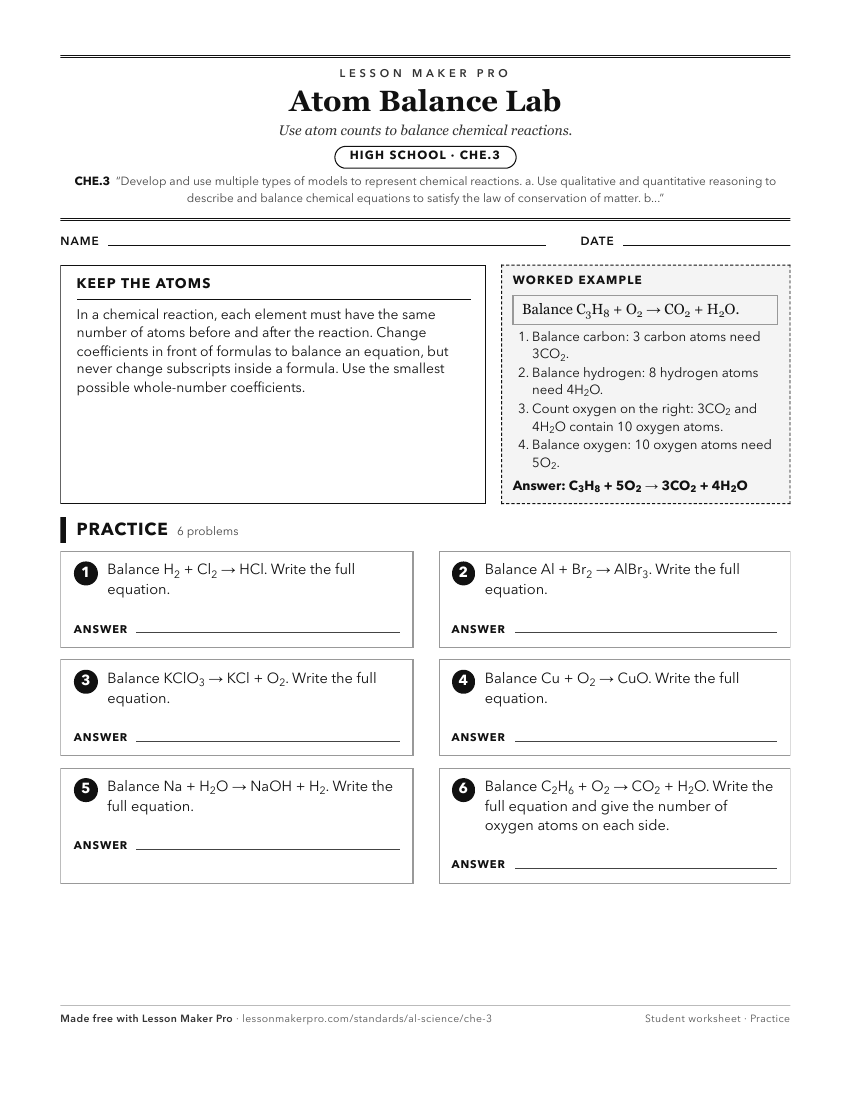
A ready-to-print activity worksheet aligned to CHE.3, with an answer key for the teacher on its own page. No account needed.
PDF, US Letter, prints cleanly in black and white.
Download the worksheetKeep exploring
Related Standards
- PS.5.d
Utilize multiple types of models to support and verify the claim that matter is conserved during a simple chemical reaction.
- CHE.4.c
Use mathematical models to reveal the relationships among the theoretical, actual, and percent yields of chemical reactions.
- 8.8.a
Use a model to verify that atoms of reactants are conserved as products in a chemical reaction.
- CHE.5.b
Develop and use models to illustrate solute-solvent interactions.
Turn this cluster into a lesson
Grade, subject, topic, and the complete cluster are prefilled. Create one free, no account needed.
Also for this cluster:Make a WorksheetMake a QuizMake a Sub Lesson