Alabama Science CHE.3.c
The Standard
- CHE.3
- Develop and use multiple types of models to represent chemical reactions.
Analyze and interpret temperature and bond energy data to classify a reaction as endothermic or exothermic.
2023 Alabama Course of Study: Science · Matter and Its Interactions: Energy
Teacher's field guide
What This Standard Means
What Students Need to Do
- Students use temperature readings to tell whether a reaction warms or cools its surroundings. They compare the energy needed to break bonds with the energy released when new bonds form. They use both clues to classify the reaction.
What Mastery Looks Like
- A student can explain that a warmer reaction mixture points to an exothermic reaction, while a cooler mixture points to an endothermic one. They can total bond energies, account for the number of each bond, and reach the same conclusion from the energy data.
Common Misconceptions
- Students may think breaking bonds releases energy. They may also forget to count every bond formed or confuse the temperature of the mixture with the energy change of the reaction.
How to Assess It
- Exit ticket: A cup cools from 23°C to 19°C during a reaction. Breaking bonds takes 760 kJ, and forming bonds releases 620 kJ. Classify the reaction and cite both clues.
Lesson moves
Ways to Teach It
Mix vinegar and baking soda in a cup, measure the temperature before and after, and ask students to classify the reaction.
Ask students to explain in two sentences where the energy comes from when a reaction mixture gets colder.
Give students bond energy cards for H₂ + Cl₂ → 2HCl and have them total energy used and released before classifying it.
Activate a disposable hand warmer, record its temperature each minute for five minutes, and link the rise to iron reacting with oxygen.
Free download
Printable CHE.3.c Worksheet
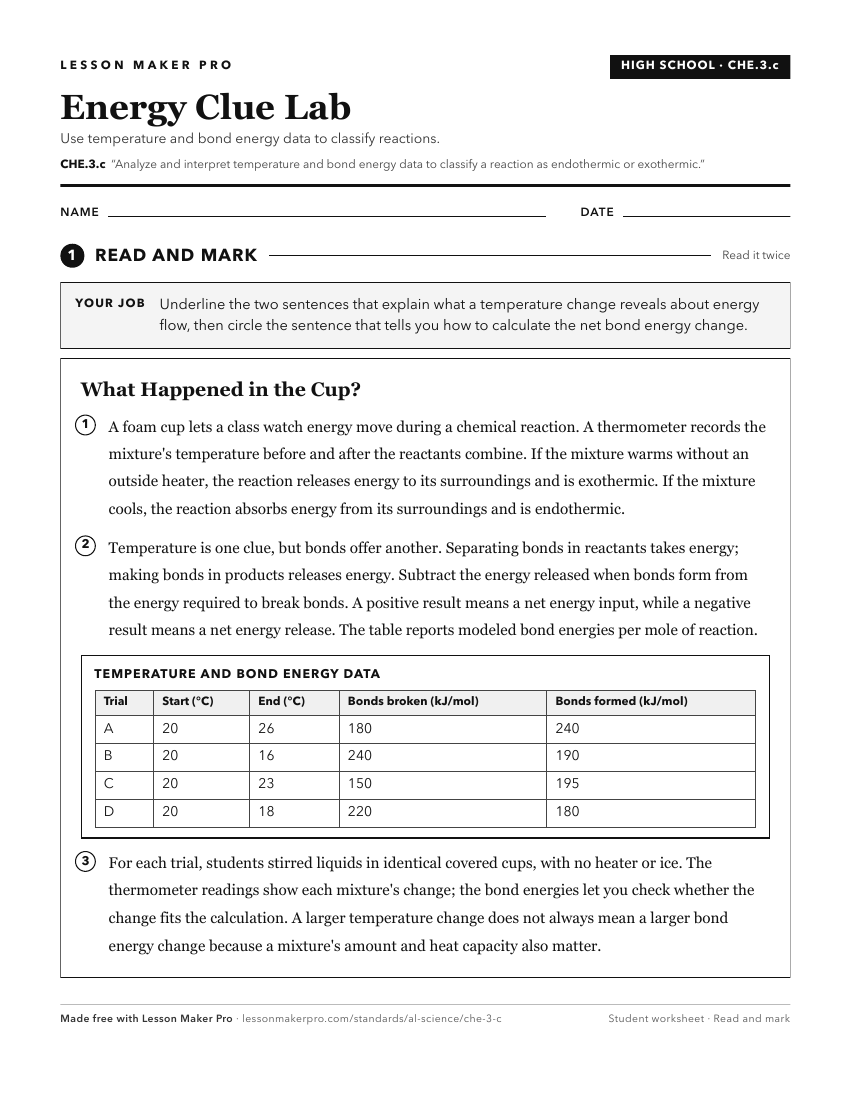
A ready-to-print activity worksheet aligned to CHE.3.c, with an answer key for the teacher on its own page. No account needed.
PDF, US Letter, prints cleanly in black and white.
Download the worksheetKeep exploring
Related Standards
- 8.7
Analyze data from an investigation to determine whether thermal energy is released or absorbed in a chemical reaction.
- PS.5.b
Analyze and interpret data to predict changes in the phase of a material based on changes in particle motion, temperature, pressure, or thermal energy.
- PS.1.b
Collect, analyze, and use data to explain how thermal energy is transferred by conduction, convection, and radiation.
- CHE.2.g
Analyze and interpret data to compare the strengths of intermolecular forces and to explain how these forces affect physical properties.
Turn this exact standard into a lesson
Grade, subject, topic, and the complete standard are prefilled. Create one free, no account needed.
Also for this standard:Make a WorksheetMake a QuizMake a Sub Lesson