Alabama Science PS.5.b
The Standard
- PS.5
- Analyze and interpret data to justify the selection of a specific material for a practical application, considering a range of constraints.
Analyze and interpret data to predict changes in the phase of a material based on changes in particle motion, temperature, pressure, or thermal energy.
2023 Alabama Course of Study: Science · Matter and Its Interactions
Teacher's field guide
What This Standard Means
What Students Need to Do
- Students use temperature graphs and pressure data to predict when a material melts, freezes, boils, or condenses. They explain each prediction using particle motion and thermal energy.
What Mastery Looks Like
- A student can identify melting and boiling on a heating curve. They can explain why temperature stays steady during a phase change and use pressure data to predict a different boiling point.
Common Misconceptions
- Students may think particles keep speeding up while temperature stays flat during boiling. They may also think added heat always raises temperature, or that higher pressure lowers water's boiling point.
How to Assess It
- Exit ticket: At normal air pressure, water stays at 100°C for two minutes while heat is added. What phase change is happening, and what happens to average particle speed and spacing?
Lesson moves
Ways to Teach It
Warm crushed ice in a beaker on a hot plate, record its temperature every minute, and mark when melting begins and ends.
Ask: Why might water boil at 93°C on a mountain but at 100°C near sea level?
Give pairs heating-curve cards and particle diagrams to match, then have them explain each match.
Give students boiling-point data for an open pot and a pressure cooker; have them explain why beans cook faster in the cooker.
Free download
Printable PS.5.b Worksheet
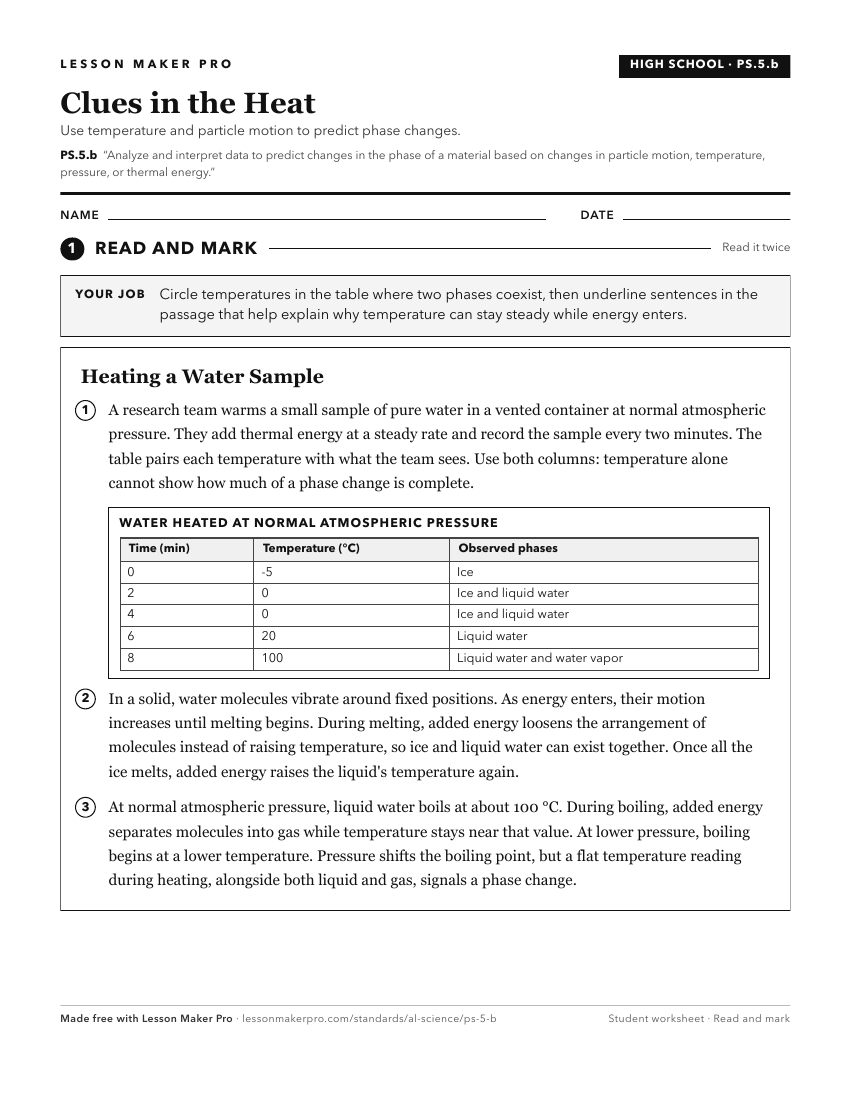
A ready-to-print activity worksheet aligned to PS.5.b, with an answer key for the teacher on its own page. No account needed.
PDF, US Letter, prints cleanly in black and white.
Download the worksheetKeep exploring
Related Standards
- 8.2
Develop and manipulate models to explain changes in particle motion, temperature, and state of a pure substance when thermal energy is added to or removed from ...
- 8.7
Analyze data from an investigation to determine whether thermal energy is released or absorbed in a chemical reaction.
- CHE.7.a
Qualitatively and quantitatively relate changes in the temperature and pressure of a gas to particle motion and number of collisions.
- CHE.2.g
Analyze and interpret data to compare the strengths of intermolecular forces and to explain how these forces affect physical properties.
Turn this exact standard into a lesson
Grade, subject, topic, and the complete standard are prefilled. Create one free, no account needed.
Also for this standard:Make a WorksheetMake a QuizMake a Sub Lesson