Alabama Science 8.2
The Standard
Develop and manipulate models to explain changes in particle motion, temperature, and state of a pure substance when thermal energy is added to or removed from a system.
2023 Alabama Course of Study: Science · Matter and Its Interactions
Teacher's field guide
What This Standard Means
What Students Need to Do
- Students draw and revise particle models as one substance is heated or cooled. They show particle motion, changes of state, and when temperature rises, falls, or stays steady.
What Mastery Looks Like
- A student can update a particle sketch without changing the type or size of the particles. They show that temperature stays steady during melting or freezing, even as energy moves in or out.
Common Misconceptions
- Students may draw particles growing larger when heated. They may show particles in ice as motionless. They may assume temperature rises throughout melting or falls throughout freezing.
How to Assess It
- Exit ticket: Sketch ice, melting ice, and liquid water as heat keeps entering. Label particle motion and say when temperature stays steady or rises.
Lesson moves
Ways to Teach It
Put crushed ice and water in a cup, measure the temperature each minute as the ice melts, and sketch the particles.
Ask, 'Why can ice keep melting while its temperature stays near 0°C?' Have students answer with a particle sketch.
Give pairs cards labeled ice warming, ice melting, water cooling, and water freezing, then have them match particle sketches and temperature trends.
Ask students to sketch what happens to water particles when a puddle freezes overnight, then mark where its thermal energy goes.
Free download
Printable 8.2 Worksheet
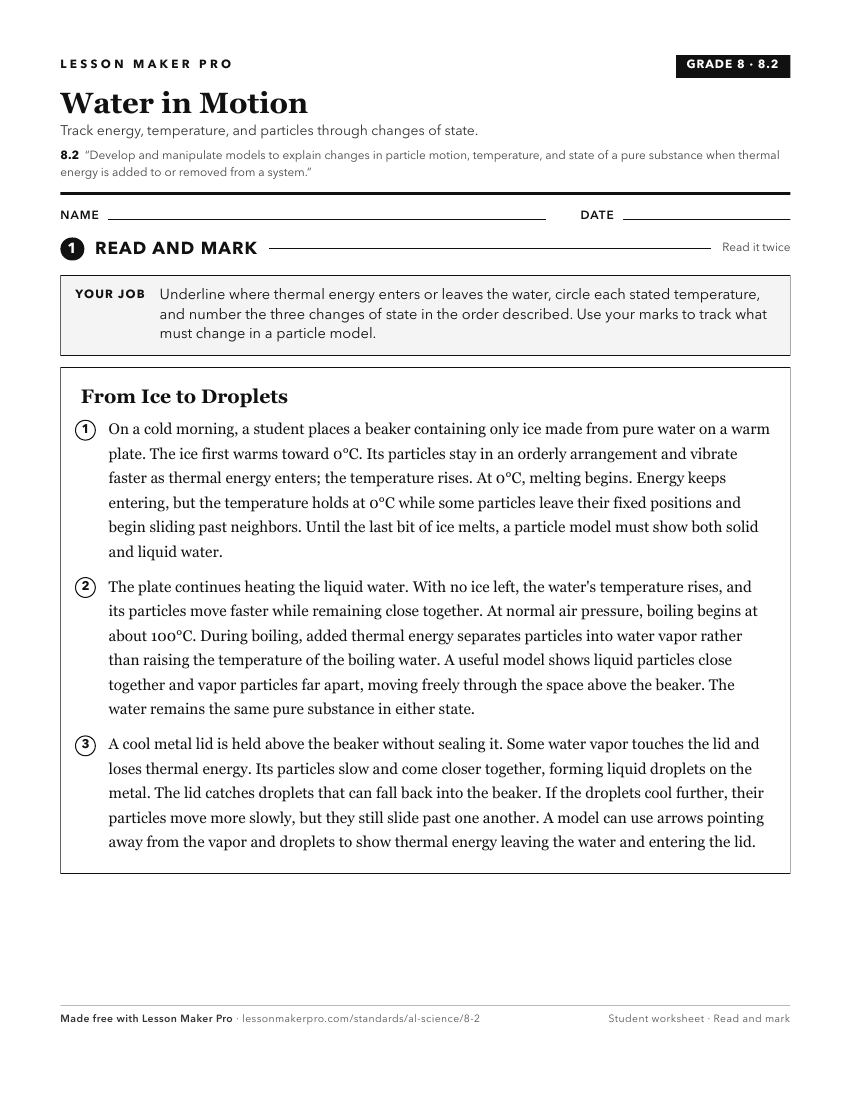
A ready-to-print activity worksheet aligned to 8.2, with an answer key for the teacher on its own page. No account needed.
PDF, US Letter, prints cleanly in black and white.
Download the worksheetKeep exploring
Related Standards
- PS.5.b
Analyze and interpret data to predict changes in the phase of a material based on changes in particle motion, temperature, pressure, or thermal energy.
- 6.8.b
Develop and use a model that illustrates how differences in heat and pressure affect density and the relationship between density and convection.
- CHE.7.a
Qualitatively and quantitatively relate changes in the temperature and pressure of a gas to particle motion and number of collisions.
- 8.10
Develop and use models to illustrate how individual external forces affect the motion of objects.
Turn this exact standard into a lesson
Grade, subject, topic, and the complete standard are prefilled. Create one free, no account needed.
Also for this standard:Make a WorksheetMake a QuizMake a Sub Lesson