Alabama Science CHE.7.a
The Standard
- CHE.7
- Plan and carry out investigations to determine how the atomic and molecular motion in chemical and physical processes is related to the kinetic molecular theory.
Qualitatively and quantitatively relate changes in the temperature and pressure of a gas to particle motion and number of collisions.
2023 Alabama Course of Study: Science
Teacher's field guide
What This Standard Means
What Students Need to Do
- Students explain how heating a gas makes its particles move faster and hit container walls more often and harder. For a sealed, rigid container, they use Kelvin temperatures to calculate how pressure changes.
What Mastery Looks Like
- A student predicts that raising a sealed tank from 300 K to 450 K raises its pressure from 100 kPa to 150 kPa. They explain the change using faster particles and more frequent, harder wall collisions.
Common Misconceptions
- Some students think heating creates more gas particles or makes the particles larger. Others use Celsius in pressure calculations or think higher pressure always means faster particles, even when a gas is compressed at a steady temperature.
How to Assess It
- Exit ticket: A sealed, rigid tank is at 100 kPa and 300 K. What is its pressure at 450 K, and what happens to particle motion and wall collisions?
Lesson moves
Ways to Teach It
Place a sealed flask fitted with a pressure probe in warm and cool water baths; record temperature and pressure after each reading settles.
Ask students to draw particle motion before and after heating a sealed tank, then explain the change in wall collisions.
Give pairs temperature and pressure cards to match, using Kelvin ratios to check each match.
Compare tire pressure readings on a cold morning and warm afternoon; ask students to explain the difference using particle collisions.
Free download
Printable CHE.7.a Worksheet
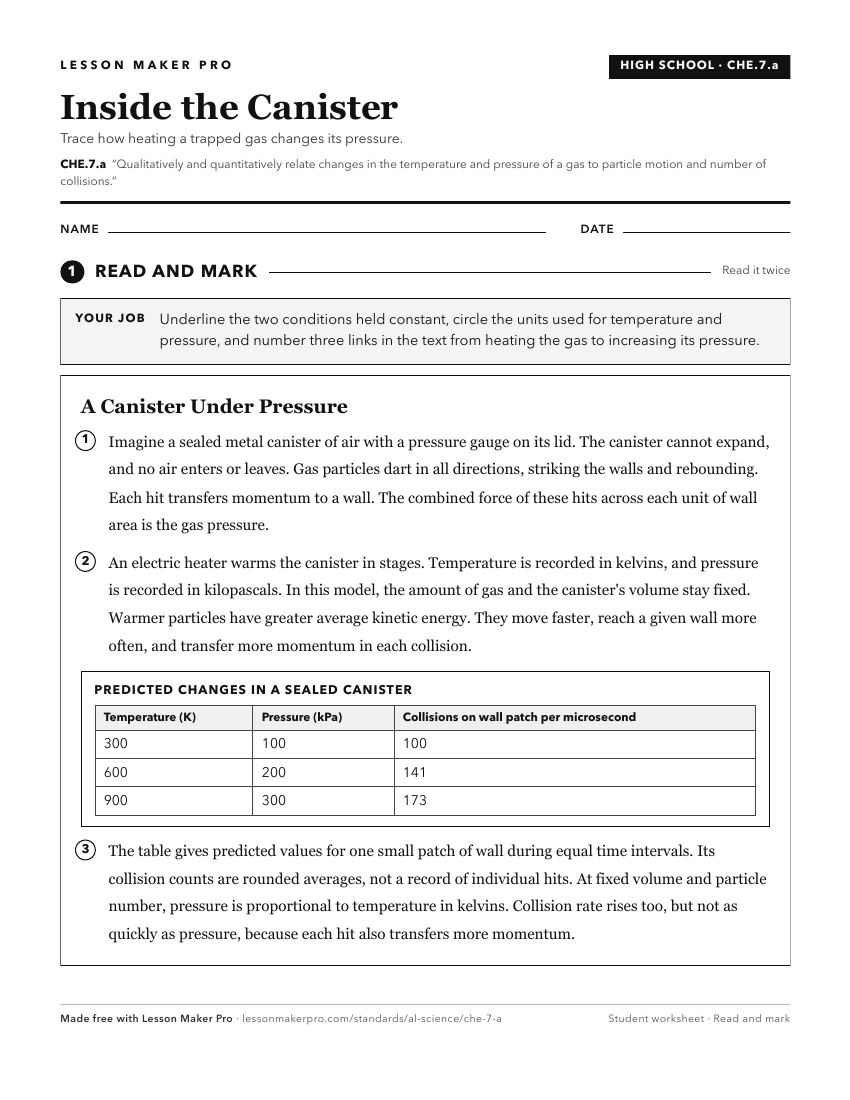
A ready-to-print activity worksheet aligned to CHE.7.a, with an answer key for the teacher on its own page. No account needed.
PDF, US Letter, prints cleanly in black and white.
Download the worksheetKeep exploring
Related Standards
- PS.5.c
Use mathematical and computational thinking to determine the quantitative relationships among temperature, pressure, and volume of confined gases.
- PS.5.b
Analyze and interpret data to predict changes in the phase of a material based on changes in particle motion, temperature, pressure, or thermal energy.
- CHE.7.b
Express the relationship among pressure, volume, temperature, and the number of moles of a gas quantitatively, conceptually, and graphically.
- 8.2
Develop and manipulate models to explain changes in particle motion, temperature, and state of a pure substance when thermal energy is added to or removed from ...
Turn this exact standard into a lesson
Grade, subject, topic, and the complete standard are prefilled. Create one free, no account needed.
Also for this standard:Make a WorksheetMake a QuizMake a Sub Lesson