Alabama Science CHE.7.b
The Standard
- CHE.7
- Plan and carry out investigations to determine how the atomic and molecular motion in chemical and physical processes is related to the kinetic molecular theory.
Express the relationship among pressure, volume, temperature, and the number of moles of a gas quantitatively, conceptually, and graphically.
2023 Alabama Course of Study: Science
Teacher's field guide
What This Standard Means
What Students Need to Do
- Students predict how gas pressure, volume, temperature, and amount change when other conditions stay fixed. They calculate missing values, draw labeled graphs, and explain changes using gas particles.
What Mastery Looks Like
- A student can choose what stays fixed and use PV = nRT with temperature in kelvin. They can draw a curved pressure-volume graph and straight-line volume-temperature and pressure-moles graphs under the right conditions.
Common Misconceptions
- Students may use Celsius in gas law calculations instead of kelvin. They may draw pressure versus volume as a straight line or assume adding gas raises pressure even when the container can expand.
How to Assess It
- Exit ticket: A gas is at 1.0 atm. Its amount doubles while volume and temperature stay fixed. Find the new pressure, sketch pressure versus moles, and explain your answer.
Lesson moves
Ways to Teach It
Connect a syringe to a pressure sensor, record pressures at 10, 15, and 20 mL, and graph the results.
Ask pairs: If a sealed syringe is heated while its plunger moves freely, what changes, and what stays fixed?
Give pairs cards marked 'halve volume,' 'double kelvin temperature,' 'double moles,' and 'double volume'; have them sort the resulting pressures.
Show a photo of a sealed chip bag puffed up during a flight; ask students why its volume increased.
Free download
Printable CHE.7.b Worksheet
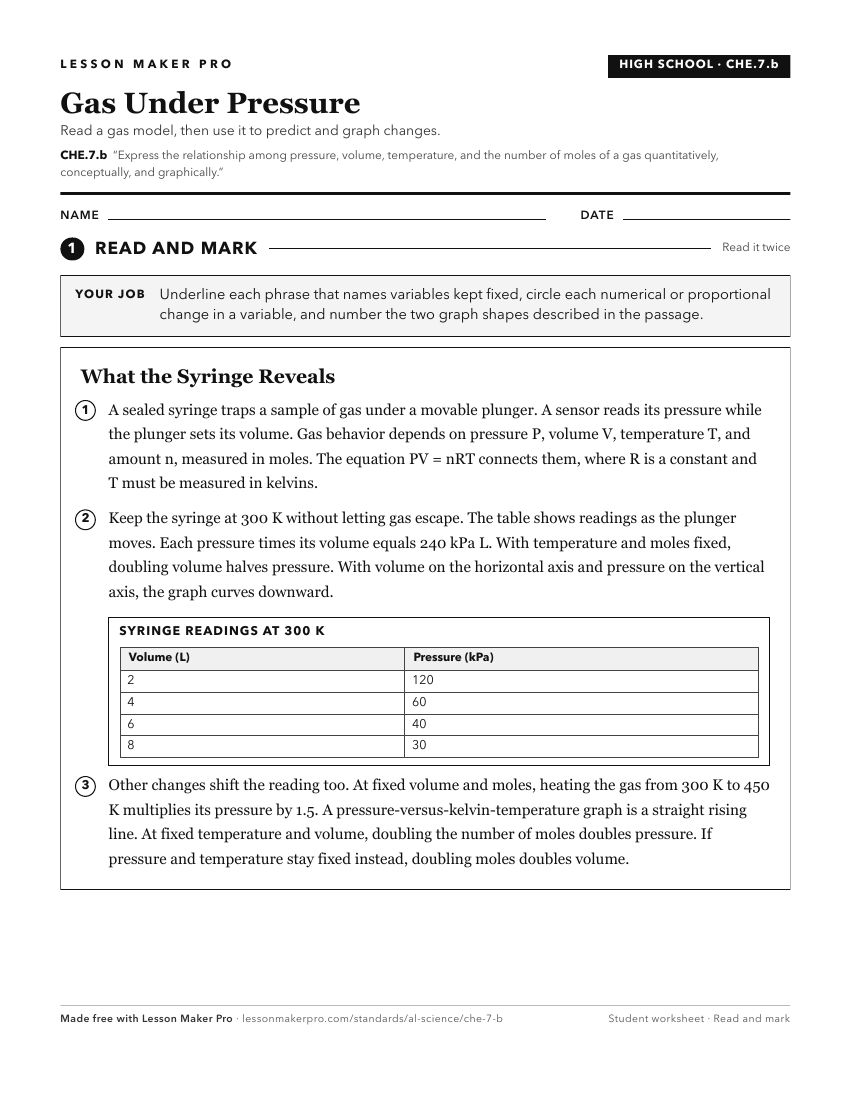
A ready-to-print activity worksheet aligned to CHE.7.b, with an answer key for the teacher on its own page. No account needed.
PDF, US Letter, prints cleanly in black and white.
Download the worksheetKeep exploring
Related Standards
- PS.5.c
Use mathematical and computational thinking to determine the quantitative relationships among temperature, pressure, and volume of confined gases.
- CHE.7.a
Qualitatively and quantitatively relate changes in the temperature and pressure of a gas to particle motion and number of collisions.
- CHE.4.e
Use mathematics and computational thinking to perform gas stoichiometry calculations involving mass, volume, and number of moles at standard temperature and pre...
- P.4.b
Use and solve algebraic formulas to determine the relationships between pressure, force, area, and density.
Turn this exact standard into a lesson
Grade, subject, topic, and the complete standard are prefilled. Create one free, no account needed.
Also for this standard:Make a WorksheetMake a QuizMake a Sub Lesson