Alabama Science P.4.b
The Standard
- P.4
- Use mathematics and computational thinking to analyze the effects of pressure changes and buoyant forces in fluid systems.
Use and solve algebraic formulas to determine the relationships between pressure, force, area, and density.
2023 Alabama Course of Study: Science · Motion and Stability: Forces and Interactions
Teacher's field guide
What This Standard Means
What Students Need to Do
- Students calculate pressure from force and contact area. They rearrange the formula to find a missing force or area. They calculate density from mass and volume, then use density and depth to compare fluid pressures.
What Mastery Looks Like
- Given a 60 N force over 0.20 m², a student finds a pressure of 300 Pa. They can solve for a missing force or area. They can explain why a denser liquid has more pressure at the same depth.
Common Misconceptions
- Students may multiply force and area instead of dividing. Some think a larger contact area raises pressure. Others assume a denser liquid always has more pressure, even when the liquids are at different depths.
How to Assess It
- Exit ticket: A 60 N force acts over 0.20 m²; find the pressure. At equal depths, which has greater pressure, freshwater or denser seawater, and why?
Lesson moves
Ways to Teach It
Set one brick on clay on its wide and narrow faces, measure each dent, and calculate pressure using its weight and measured face areas.
Have students explain in two sentences why a snowshoe sinks less than a boot under the same person's weight.
Deal pairs cards showing two of pressure, force, and area; have them race to calculate the missing value.
Use freshwater (1,000 kg/m³) and seawater (1,025 kg/m³) densities to compare pressure on tank walls 2 m down, with g = 10 m/s².
Free download
Printable P.4.b Worksheet
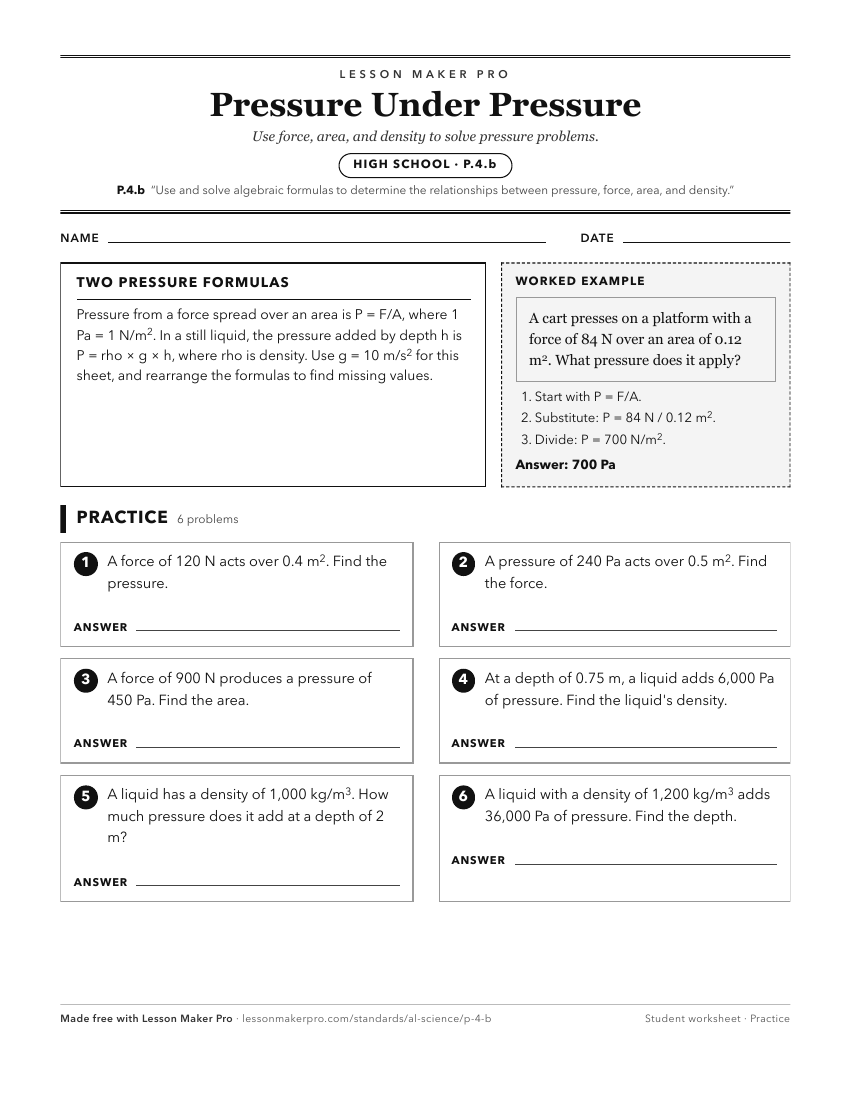
A ready-to-print activity worksheet aligned to P.4.b, with an answer key for the teacher on its own page. No account needed.
PDF, US Letter, prints cleanly in black and white.
Download the worksheetKeep exploring
Related Standards
- P.4
Use mathematics and computational thinking to analyze the effects of pressure changes and buoyant forces in fluid systems.
- PS.5.c
Use mathematical and computational thinking to determine the quantitative relationships among temperature, pressure, and volume of confined gases.
- P.5.b
Develop and use a model to describe the mathematical relationship between mass, distance, and force as expressed by Newton’s law of universal gravitation.
- CHE.7.b
Express the relationship among pressure, volume, temperature, and the number of moles of a gas quantitatively, conceptually, and graphically.
Turn this exact standard into a lesson
Grade, subject, topic, and the complete standard are prefilled. Create one free, no account needed.
Also for this standard:Make a WorksheetMake a QuizMake a Sub Lesson