Alabama Science P.4
Standard Cluster
Use mathematics and computational thinking to analyze the effects of pressure changes and buoyant forces in fluid systems. a. Plan and carry out experiments to determine the density of objects. b. Use and solve algebraic formulas to determine the relationships between pressure, force, area, and density. c. Design solutions to determine the magnitude and direction of the buoyant force acting on an object and the effects of the buoyant forces on the object's motion. d. Use the buoyant force acting on an object and free body diagrams to determine the acceleration of submerged objects.
2023 Alabama Course of Study: Science · Motion and Stability: Forces and Interactions
Cluster contents
Standards in This Cluster
P.4 is a cluster heading. These are the individual standards under it.
- P.4.a
Plan and carry out experiments to determine the density of objects.
- P.4.b
Use and solve algebraic formulas to determine the relationships between pressure, force, area, and density.
- P.4.c
Design solutions to determine the magnitude and direction of the buoyant force acting on an object and the effects of the buoyant forces on the object's motion.
- P.4.d
Use the buoyant force acting on an object and free body diagrams to determine the acceleration of submerged objects.
Teacher's field guide
What This Cluster Means
What Students Need to Do
- Students measure mass and displaced water to find an object's density. They calculate pressure from force and area, and pressure changes from fluid density and depth. They use displaced water to find buoyant force, then draw forces and calculate acceleration.
What Mastery Looks Like
- Given a mass and a change in water level, students calculate density with units. They can solve for force, area, pressure, or depth when given the other values. For a submerged object, they find buoyant force, subtract weight, and calculate the direction and size of its acceleration.
Common Misconceptions
- Students may divide volume by mass, or use the object's density instead of the water's to find buoyant force. Some think deeper water always increases the buoyant force on a fully submerged rigid object. Others leave weight off the force diagram or think a smaller area means less pressure for the same force.
How to Assess It
- Exit ticket: A sealed 2 kg box displaces 0.003 m³ of water at a depth of 2 m. Using water density of 1000 kg/m³ and g = 10 m/s², find the box's density, the pressure increase from the surface, and its buoyant force. Draw a force diagram and calculate its acceleration, ignoring drag.
Lesson moves
Ways to Teach It
Weigh a steel bolt, measure its water displacement in a graduated cylinder, and calculate its density.
Ask: Two equal-volume blocks are fully underwater, but one is heavier. Is their buoyant force the same? How could their accelerations differ?
Give pairs cards showing 100 N over 0.02 m² and water at 2 m depth; have them calculate each pressure using g = 10.
Use a submarine ballast example: a 50 kg model displaces 0.06 m³ of water; draw its force diagram and calculate acceleration without drag.
Free download
Printable P.4 Worksheet
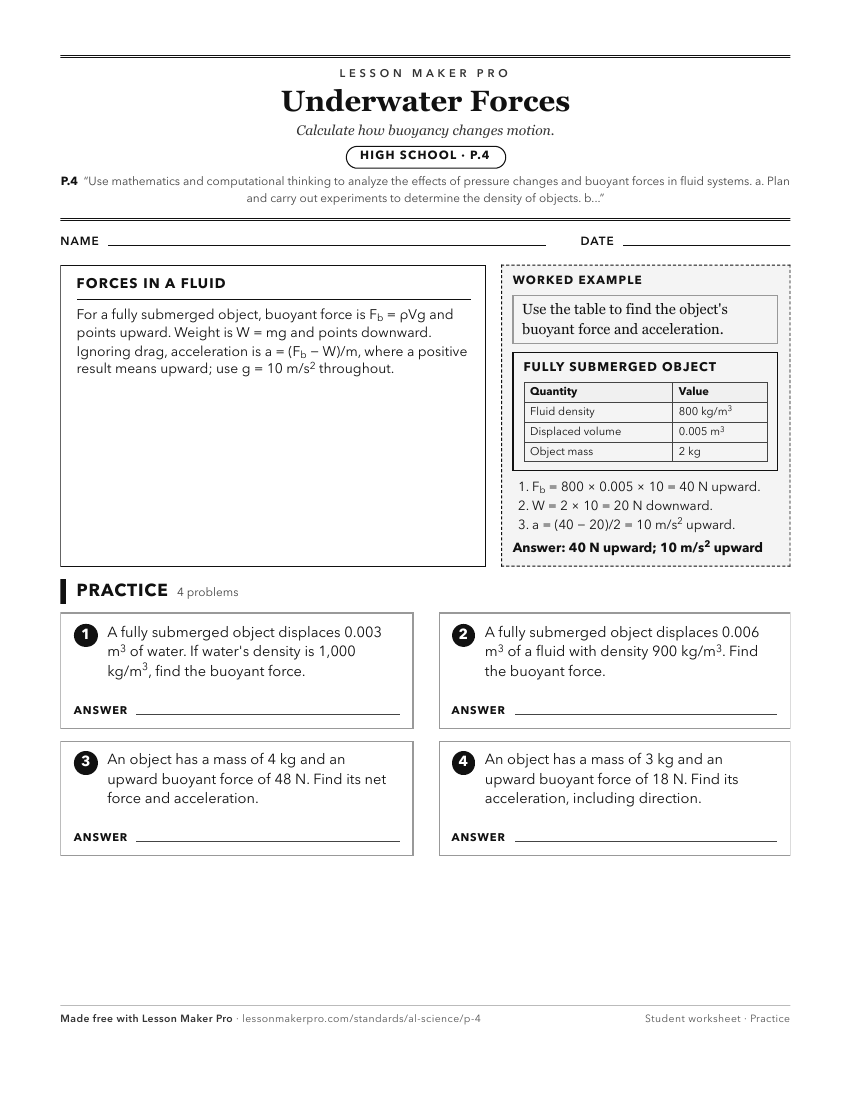
A ready-to-print activity worksheet aligned to P.4, with an answer key for the teacher on its own page. No account needed.
PDF, US Letter, prints cleanly in black and white.
Download the worksheetKeep exploring
Related Standards
Turn this cluster into a lesson
Grade, subject, topic, and the complete cluster are prefilled. Create one free, no account needed.
Also for this cluster:Make a WorksheetMake a QuizMake a Sub Lesson