Alabama Science P.4.d
The Standard
- P.4
- Use mathematics and computational thinking to analyze the effects of pressure changes and buoyant forces in fluid systems.
Use the buoyant force acting on an object and free body diagrams to determine the acceleration of submerged objects.
2023 Alabama Course of Study: Science · Motion and Stability: Forces and Interactions
Teacher's field guide
What This Standard Means
What Students Need to Do
- Students draw a force diagram for an object released from rest underwater. They label buoyancy upward and weight downward, then use net force and mass to find its initial acceleration. When needed, they find buoyoyancy from the weight of displaced water.
What Mastery Looks Like
- Given a 2 kg object that displaces 3 L of water, they mark 30 N upward and 20 N downward, using g = 10 N/kg. They calculate an initial acceleration of 5 m/s² upward. They also know that balanced forces mean zero acceleration, not necessarily zero speed.
Common Misconceptions
- Some students draw buoyancy downward because the object is moving down. Others assume buoyancy always equals weight underwater. They may find the net force but forget to divide by mass.
How to Assess It
- Exit ticket: A 4 kg object is released from rest underwater and displaces 3 L of water. Use g = 10 N/kg and 1 L of water = 1 kg; draw its force diagram and find its initial acceleration, ignoring drag.
Lesson moves
Ways to Teach It
Hang a stone from a spring scale, record its weight in air and underwater, then use the difference to label buoyancy.
Two balls displace 0.2 L of water and weigh 1 N and 1.5 N. Which accelerates upward faster, and why?
Post water density and g; pairs pick a mass-and-volume card, sketch the force diagram, and calculate acceleration before checking an answer key.
A mini-sub has a mass of 900 kg and displaces 1,000 L of water; students sketch forces and calculate its initial acceleration.
Free download
Printable P.4.d Worksheet
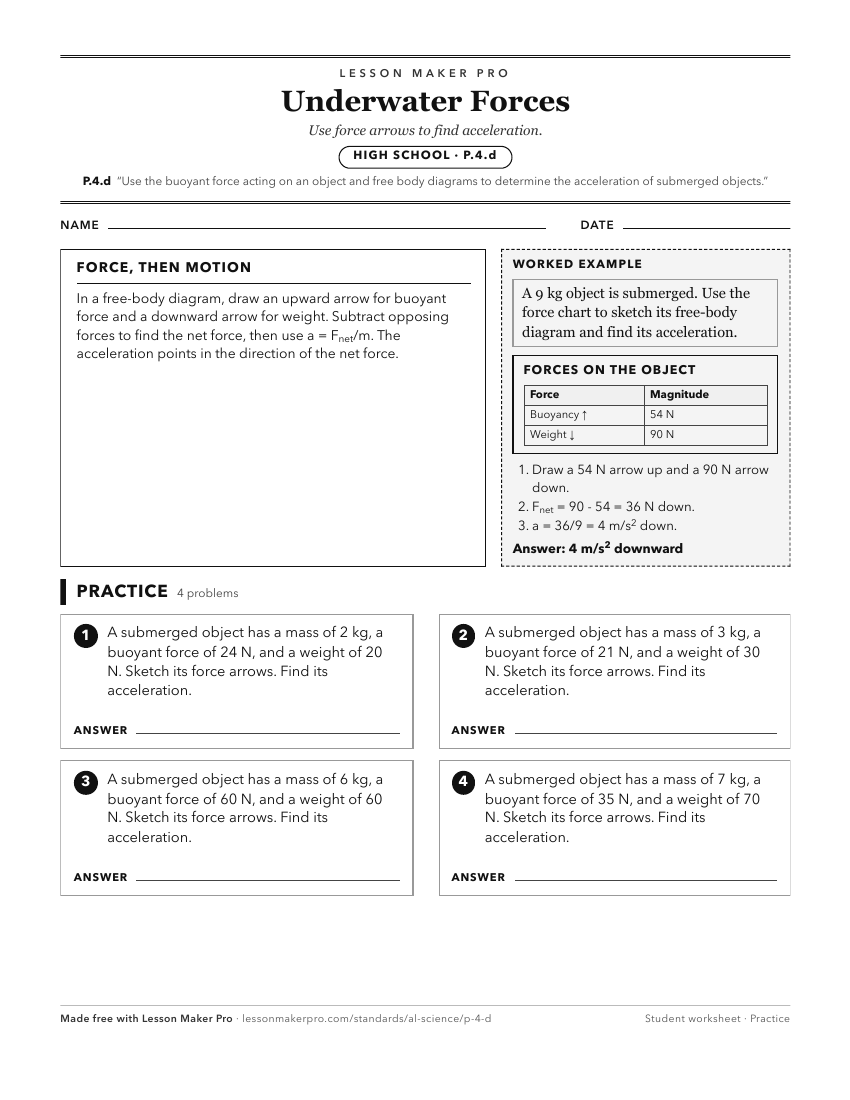
A ready-to-print activity worksheet aligned to P.4.d, with an answer key for the teacher on its own page. No account needed.
PDF, US Letter, prints cleanly in black and white.
Download the worksheetKeep exploring
Related Standards
- P.4.c
Design solutions to determine the magnitude and direction of the buoyant force acting on an object and the effects of the buoyant forces on the object's motion.
- P.2.b
Use mathematical, graphical, and narrative methods to explain the relationships among net force, mass, and acceleration of a single object.
- 8.11.a
Use mathematical representations to explain how the sum of external forces on an object and the object’s mass affect its acceleration.
- P.2.c
Create free and fixed body diagrams to model all the forces acting on a single object.
Turn this exact standard into a lesson
Grade, subject, topic, and the complete standard are prefilled. Create one free, no account needed.
Also for this standard:Make a WorksheetMake a QuizMake a Sub Lesson