Alabama Science CHE.5.a
The Standard
- CHE.5
- Obtain, evaluate, and communicate information concerning factors that affect solubility and the properties of solutions.
Use mathematics and computational thinking to express the concentrations of given solutions in terms of molarity and molality.
2023 Alabama Course of Study: Science
Teacher's field guide
What This Standard Means
What Students Need to Do
- Students convert a solute’s mass to moles. They calculate molarity using the volume of the finished solution and molality using the mass of the solvent.
What Mastery Looks Like
- Given 5.85 g NaCl in 100 mL of solution, a student finds about 1.00 mol/L. In a separate problem with 5.85 g NaCl dissolved in 200 g water, they find about 0.500 mol/kg.
Common Misconceptions
- Students may use the volume of water added instead of the final solution volume. They may use the mass of the whole solution instead of the solvent, or forget to convert milliliters to liters.
How to Assess It
- Exit ticket: Dissolve 5.85 g NaCl (58.44 g/mol) in 200 g water. The final solution volume is 202 mL. Find the molarity and molality, and label each denominator.
Lesson moves
Ways to Teach It
Weigh 5.85 g table salt and 100 g water, dissolve the salt, measure the final volume, then calculate both concentrations.
Ask, “Why does 100 mL of solution not mean 100 g of solvent?” Have students explain with a labeled beaker sketch.
Give teams 34.2 g sucrose, 342 g/mol, 200 g water, and 220 mL solution; race to calculate both concentrations.
Use a saline label showing 0.9 g NaCl per 100 mL solution; have students calculate its molarity using 58.44 g/mol.
Free download
Printable CHE.5.a Worksheet
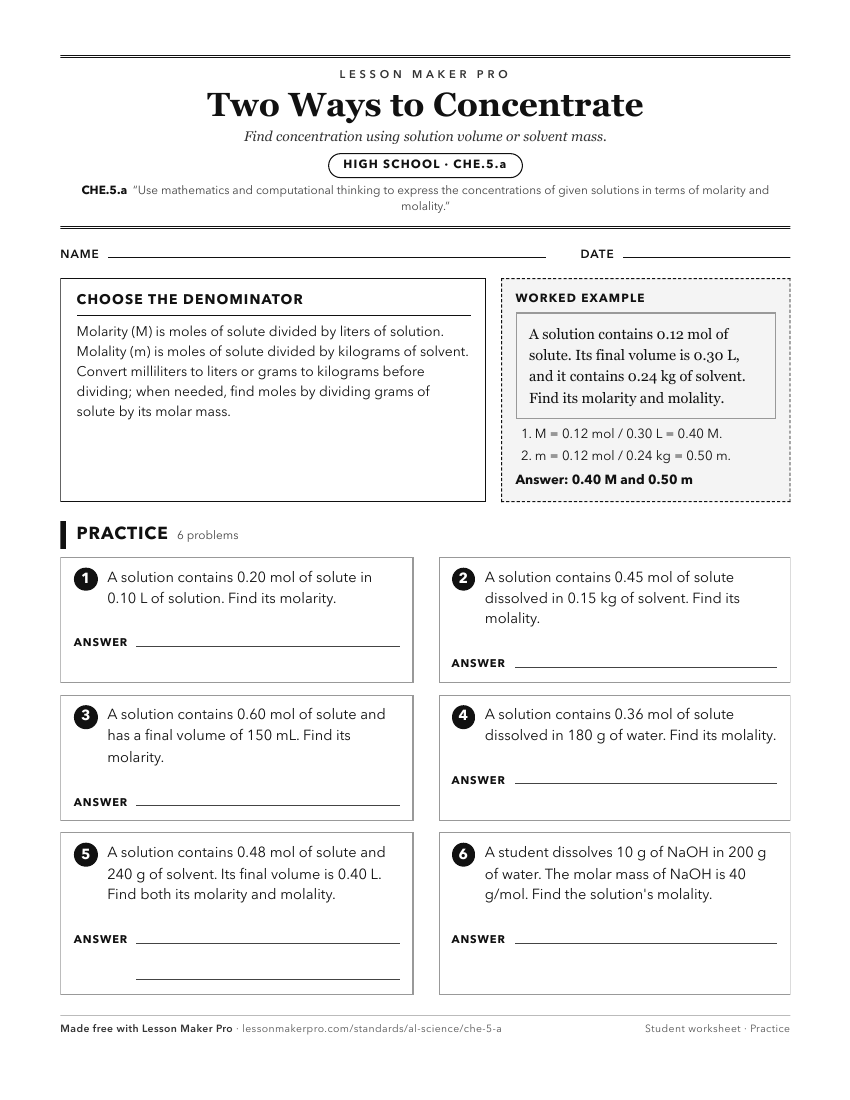
A ready-to-print activity worksheet aligned to CHE.5.a, with an answer key for the teacher on its own page. No account needed.
PDF, US Letter, prints cleanly in black and white.
Download the worksheetKeep exploring
Related Standards
- CHE.5.c
Use mathematics and computational thinking to prepare solutions from both solids and concentrated solutions when given a desired molarity and volume.
- CHE.4.b
Use mathematical representations of the mole concept to solve reaction stoichiometry problems, involving mole-to-mole conversions, mass-to-mole conversions, and...
- CHE.4.a
Quantitatively apply the concepts of the mole and Avogadro’s number to conceptualize and calculate percent composition and empirical or molecular formulas of co...
- PS.6.b
Develop and use particle diagrams to illustrate diluted and concentrated solutions and describe how adjusting amounts of solute and solvent impacts the concentr...
Turn this exact standard into a lesson
Grade, subject, topic, and the complete standard are prefilled. Create one free, no account needed.
Also for this standard:Make a WorksheetMake a QuizMake a Sub Lesson