Alabama Science PS.6.b
The Standard
- PS.6
- Obtain, evaluate, and communicate information to explain how the properties of various types of solutions make them useful in real-world applications.
Develop and use particle diagrams to illustrate diluted and concentrated solutions and describe how adjusting amounts of solute and solvent impacts the concentration of a solution.
2023 Alabama Course of Study: Science · Matter and Its Interactions
Teacher's field guide
What This Standard Means
What Students Need to Do
- Students draw solute and solvent particles in containers of different volumes. They use the diagrams to show how adding solute or solvent changes concentration.
What Mastery Looks Like
- A student shows more solute particles in an equal volume for a more concentrated solution. When water is added, they keep the total number of solute particles the same and show them spread through a larger volume.
Common Misconceptions
- Students may draw larger solute particles to show a stronger solution instead of more particles in the same volume. They may erase solute particles when water is added or assume a larger container always holds a more concentrated solution.
How to Assess It
- On an exit ticket, show six solute dots in a 100 mL container. Ask students to draw separate diagrams after doubling the water and after doubling the solute, then rank all three concentrations.
Lesson moves
Ways to Teach It
Mix one and four drops of food coloring into separate 100 mL cups of water, then sketch dye and water particles in equal-size boxes.
Show two diagrams with six dye dots each, labeled 100 mL and 200 mL; ask which is more concentrated and why.
Give pairs cards showing solute dots in 100 mL boxes; have them sort by concentration and check against another pair.
Use a drink mix label to compare one scoop in 500 mL with one scoop in 1 L; sketch both particle diagrams.
Free download
Printable PS.6.b Worksheet
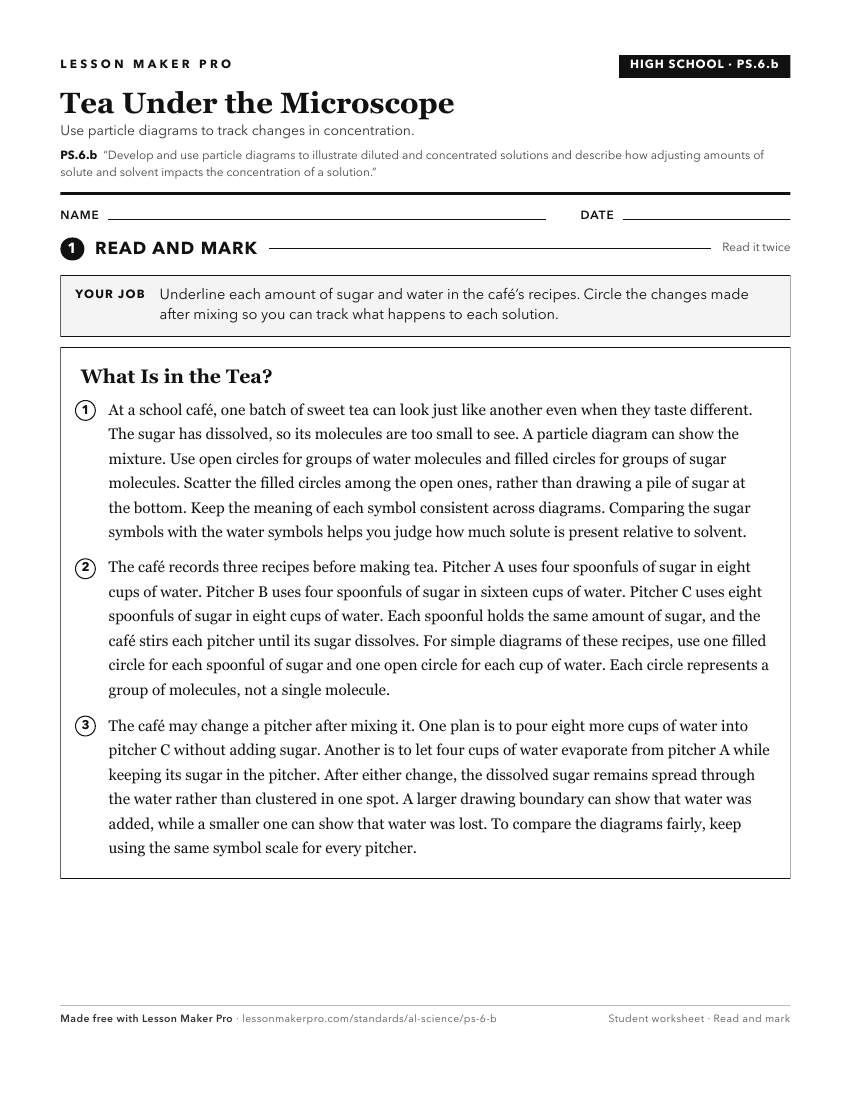
A ready-to-print activity worksheet aligned to PS.6.b, with an answer key for the teacher on its own page. No account needed.
PDF, US Letter, prints cleanly in black and white.
Download the worksheetKeep exploring
Related Standards
- CHE.5.b
Develop and use models to illustrate solute-solvent interactions.
- CHE.5.c
Use mathematics and computational thinking to prepare solutions from both solids and concentrated solutions when given a desired molarity and volume.
- CHE.5.e
Design and conduct experiments to evaluate the effect of solute concentration on the colligative properties of a solution.
- CHE.3.d
Construct an explanation, using particle diagrams and collision theory, for how particle size, concentration, and temperature affect the rate of a chemical reac...
Turn this exact standard into a lesson
Grade, subject, topic, and the complete standard are prefilled. Create one free, no account needed.
Also for this standard:Make a WorksheetMake a QuizMake a Sub Lesson