Alabama Science CHE.3.d
The Standard
- CHE.3
- Develop and use multiple types of models to represent chemical reactions.
Construct an explanation, using particle diagrams and collision theory, for how particle size, concentration, and temperature affect the rate of a chemical reaction.
2023 Alabama Course of Study: Science · Matter and Its Interactions: Energy
Teacher's field guide
What This Standard Means
What Students Need to Do
- Students compare how fast reactions happen when a solid is crushed, a solution is made stronger, or reactants are warmed. They draw particles and explain how each change affects collisions that lead to a reaction.
What Mastery Looks Like
- Students show more exposed surface on a crushed solid and more particles in the same space for a stronger solution. For warmer reactants, they keep particle count the same, draw longer motion arrows, and explain that more collisions have enough energy to react.
Common Misconceptions
- Students may think crushing a tablet creates more matter. They may add particles to a diagram when temperature rises or assume a stronger solution makes each particle move faster. They may count every collision as a reaction.
How to Assess It
- On an exit ticket, ask students to draw three pairs of particle diagrams: whole and crushed tablets, dilute and concentrated solutions, and cold and warm reactants. Have them label why one in each pair reacts faster.
Lesson moves
Ways to Teach It
Place equal masses of whole and crushed effervescent tablets in equal volumes of water, then time each until bubbling stops.
Give students two identical particle sketches and ask, 'How should motion arrows change when the reactants are warmed, and why?'
Give pairs of cards showing one changed condition; students pick the faster reaction and sketch why more collisions succeed.
Show photos of fine sawdust and a solid wood block; ask why sawdust burns faster using sketches of their exposed surfaces.
Free download
Printable CHE.3.d Worksheet
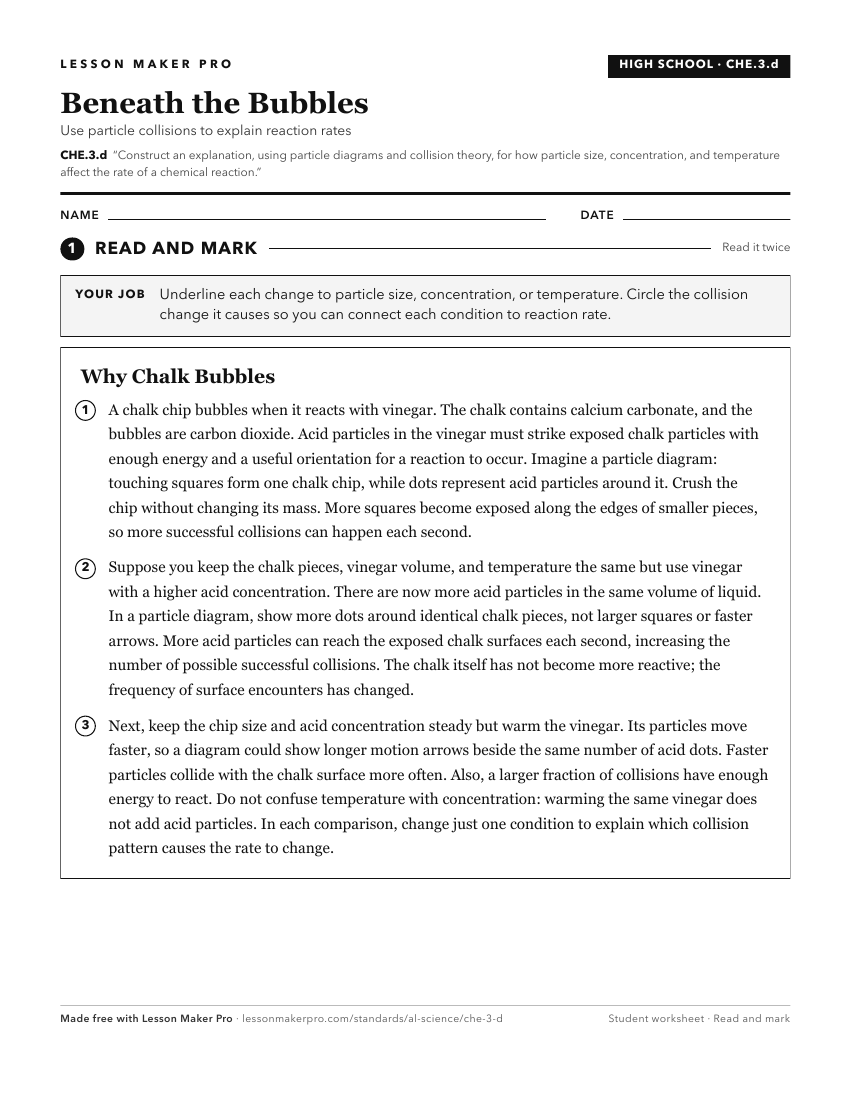
A ready-to-print activity worksheet aligned to CHE.3.d, with an answer key for the teacher on its own page. No account needed.
PDF, US Letter, prints cleanly in black and white.
Download the worksheetKeep exploring
Related Standards
- PS.6.b
Develop and use particle diagrams to illustrate diluted and concentrated solutions and describe how adjusting amounts of solute and solvent impacts the concentr...
- 8.2
Develop and manipulate models to explain changes in particle motion, temperature, and state of a pure substance when thermal energy is added to or removed from ...
- CHE.7.a
Qualitatively and quantitatively relate changes in the temperature and pressure of a gas to particle motion and number of collisions.
- CHE.7
Plan and carry out investigations to determine how the atomic and molecular motion in chemical and physical processes is related to the kinetic molecular theory...
Turn this exact standard into a lesson
Grade, subject, topic, and the complete standard are prefilled. Create one free, no account needed.
Also for this standard:Make a WorksheetMake a QuizMake a Sub Lesson