Alabama Science CHE.7
Standard Cluster
Plan and carry out investigations to determine how the atomic and molecular motion in chemical and physical processes is related to the kinetic molecular theory. a. Qualitatively and quantitatively relate changes in the temperature and pressure of a gas to particle motion and number of collisions. b. Express the relationship among pressure, volume, temperature, and the number of moles of a gas quantitatively, conceptually, and graphically.
2023 Alabama Course of Study: Science · Energy
Cluster contents
Standards in This Cluster
CHE.7 is a cluster heading. These are the individual standards under it.
Teacher's field guide
What This Cluster Means
What Students Need to Do
- Students plan a fair test, measure how a gas responds to changes in volume or temperature, and explain the results using particle motion and collisions. They use graphs and calculations to connect pressure, volume, temperature, and gas amount. They distinguish gas made in a reaction from gas that expands when warmed.
What Mastery Looks Like
- A student changes one variable at a time, records measurements, and draws a correctly labeled pressure-volume graph. They use Kelvin and PV = nRT to calculate an unknown value. They explain why warming makes particles move faster, while adding gas increases the number of particles.
Common Misconceptions
- Students may think heating makes gas particles bigger rather than faster. They may think pressure rises when volume rises in a sealed container at constant temperature, or use Celsius in gas-law calculations. They may mistake gas produced by a reaction for gas that was already there and expanded.
How to Assess It
- Exit ticket: A sealed syringe contains gas at 100 kPa and 20 mL; at constant temperature, it is compressed to 10 mL. Find the new pressure, sketch a pressure-volume curve, and explain the result using particle collisions.
Lesson moves
Ways to Teach It
Connect a syringe to a pressure sensor, record pressure at five volumes, and graph the results.
Sketch two balloons, one on a vinegar-and-baking-soda bottle and one on a bottle in warm water; ask which changes particle count or speed.
Give pairs cards with pressure, volume, moles, and Kelvin temperature, one value blank; have them calculate the missing value using PV = nRT.
Present tire readings of 30 psi before driving and 33 psi afterward; ask students to explain the pressure rise.
Free download
Printable CHE.7 Worksheet
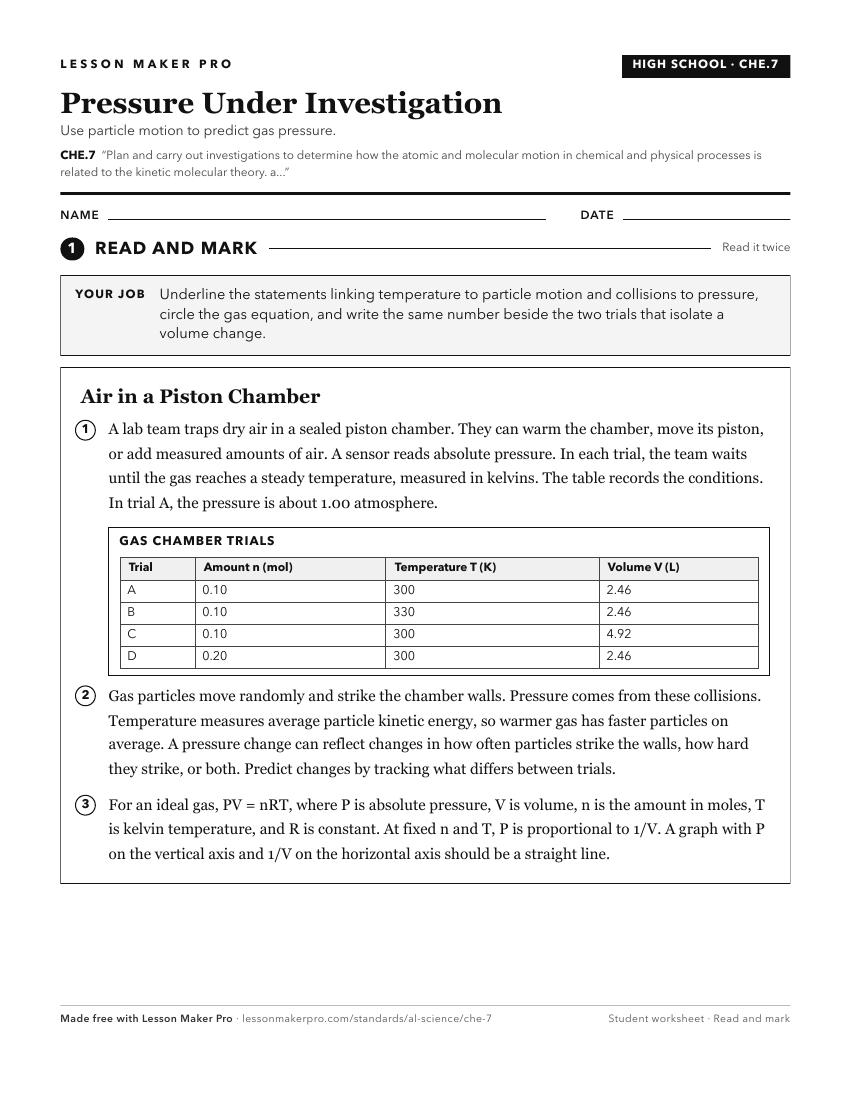
A ready-to-print activity worksheet aligned to CHE.7, with an answer key for the teacher on its own page. No account needed.
PDF, US Letter, prints cleanly in black and white.
Download the worksheetKeep exploring
Related Standards
- PS.5.a
Carry out investigations and use results to compare and contrast the physical and chemical properties of matter.
- K.1
Plan and carry out investigations to determine the effects of forces of different strengths and directions on the motion of an object, including speed, directio...
- 4.2
Plan and carry out investigations to answer questions regarding changes in energy when objects collide, and predict reasonable outcomes based on observed patter...
- PS.1.a
Plan and carry out investigations to explore how mechanical energy is transformed within a system, including kinetic energy, gravitational potential energy, ela...
Turn this cluster into a lesson
Grade, subject, topic, and the complete cluster are prefilled. Create one free, no account needed.
Also for this cluster:Make a WorksheetMake a QuizMake a Sub Lesson