Alabama Science CHE.4.b
The Standard
- CHE.4
- Use stoichiometric ratios to support the claim that atoms, and therefore mass, are conserved during chemical reactions.
Use mathematical representations of the mole concept to solve reaction stoichiometry problems, involving mole-to-mole conversions, mass-to-mole conversions, and mass-to-mass conversions.
2023 Alabama Course of Study: Science
Teacher's field guide
What This Standard Means
What Students Need to Do
- Students balance a reaction and use its coefficients to convert between moles of reactants and products. When given a mass, they use molar mass to convert to moles, apply the mole ratio, then convert back to grams if needed.
What Mastery Looks Like
- For 4.0 g H2 reacting with excess O2, a student calculates 2.0 mol H2 and 36 g H2O. They show units at each step and take the mole ratio from the balanced equation.
Common Misconceptions
- Students may use subscripts instead of coefficients for mole ratios. Some apply the ratio directly to grams, or use the product's molar mass when converting the reactant to moles.
How to Assess It
- Exit ticket: For N2 + 3H2 → 2NH3, how many grams of NH3 form from 6.0 g H2 with excess N2? Show each conversion.
Lesson moves
Ways to Teach It
Give pairs H2, O2, and H2O cards to arrange reaction sets for 2H2 + O2 → 2H2O, then record the ratios.
Ask students to explain in writing why 2 mol H2 and 1 mol O2 make 2 mol H2O, not 3 mol.
Give pairs a 12 g C card and the equation C + O2 → CO2; race to calculate the mass of CO2.
Give students the balanced vinegar and baking soda equation, then ask how much CO2 forms from 8.4 g baking soda with excess vinegar.
Free download
Printable CHE.4.b Worksheet
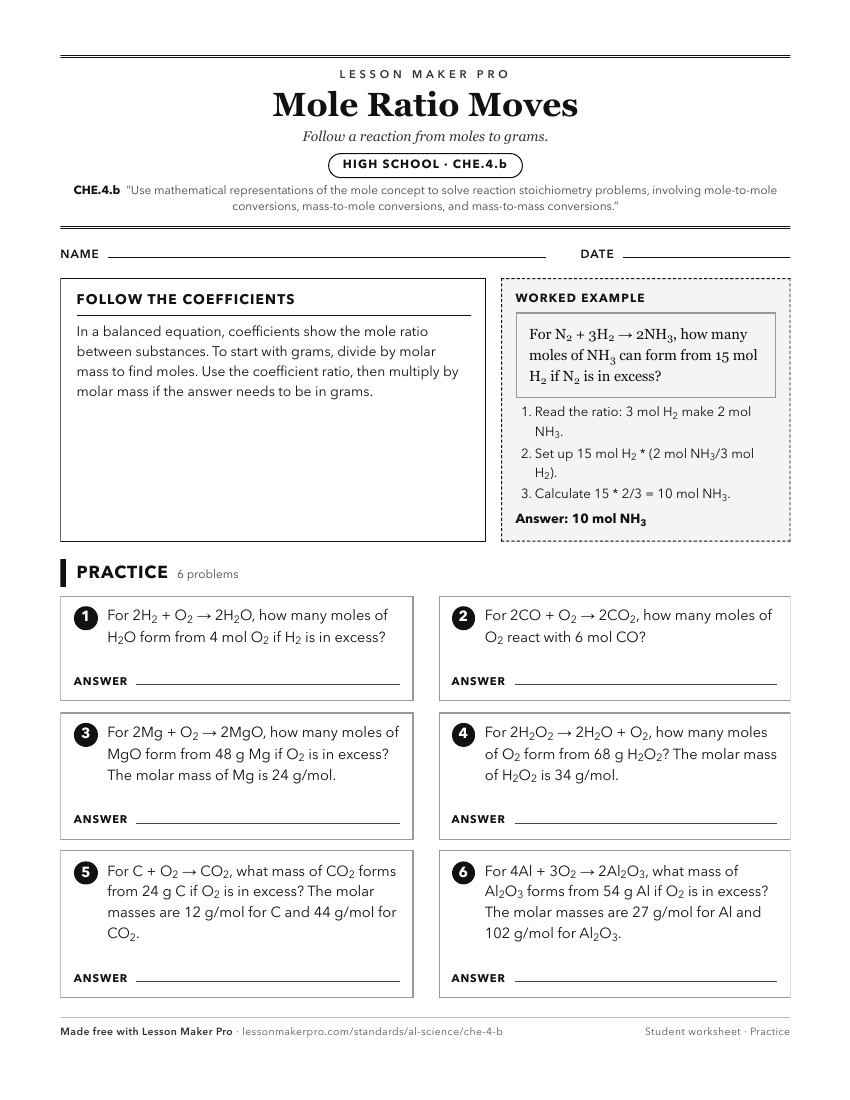
A ready-to-print activity worksheet aligned to CHE.4.b, with an answer key for the teacher on its own page. No account needed.
PDF, US Letter, prints cleanly in black and white.
Download the worksheetKeep exploring
Related Standards
- CHE.4.e
Use mathematics and computational thinking to perform gas stoichiometry calculations involving mass, volume, and number of moles at standard temperature and pre...
- CHE.4.a
Quantitatively apply the concepts of the mole and Avogadro’s number to conceptualize and calculate percent composition and empirical or molecular formulas of co...
- CHE.5.a
Use mathematics and computational thinking to express the concentrations of given solutions in terms of molarity and molality.
- CHE.4.c
Use mathematical models to reveal the relationships among the theoretical, actual, and percent yields of chemical reactions.
Turn this exact standard into a lesson
Grade, subject, topic, and the complete standard are prefilled. Create one free, no account needed.
Also for this standard:Make a WorksheetMake a QuizMake a Sub Lesson