Alabama Science CHE.4.e
The Standard
- CHE.4
- Use stoichiometric ratios to support the claim that atoms, and therefore mass, are conserved during chemical reactions.
Use mathematics and computational thinking to perform gas stoichiometry calculations involving mass, volume, and number of moles at standard temperature and pressure (STP).
2023 Alabama Course of Study: Science
Teacher's field guide
What This Standard Means
What Students Need to Do
- Students balance a reaction and use mole ratios to connect a starting amount to a gaseous reactant or product. They convert between grams, moles, and gas volume at 0°C and 1 atm using molar mass and 22.4 L per mole.
What Mastery Looks Like
- Given a mass of reactant, students can calculate the volume of gas produced at STP and show how the units cancel. They can also work backward from gas volume to the mass or moles of another substance.
Common Misconceptions
- Students sometimes apply 22.4 L per mole directly to grams, skipping the molar mass. They may treat coefficients as gram ratios instead of mole ratios, or assume every gas sample occupies 22.4 L.
How to Assess It
- Exit ticket: At 0°C and 1 atm, how many liters of CO2 form from 10.0 g CaCO3? Use CaCO3 → CaO + CO2 and show each conversion.
Lesson moves
Ways to Teach It
Have pairs order cards labeled grams Zn, moles Zn, moles H2, and liters H2 beside Zn + 2HCl → ZnCl2 + H2.
Explain why 22.4 L O2 yields 44.8 L CO2 at STP when CO is plentiful: 2CO + O2 → 2CO2.
Post 2KClO3 → 2KCl + 3O2; race teams to match 24.5 g KClO3, 0.200 mol KClO3, and 6.72 L O2 at STP.
Show a lime kiln photo and ask how many liters of CO2 100 g of CaCO3 releases at STP: CaCO3 → CaO + CO2.
Free download
Printable CHE.4.e Worksheet
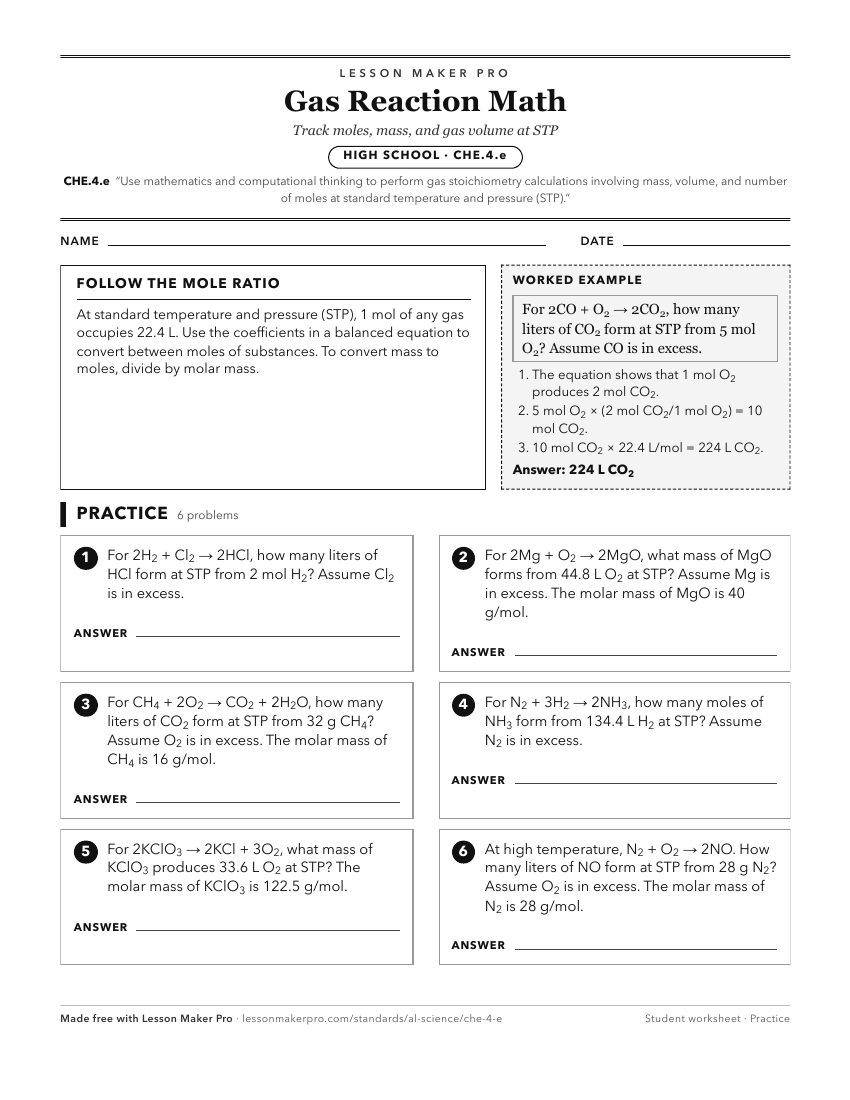
A ready-to-print activity worksheet aligned to CHE.4.e, with an answer key for the teacher on its own page. No account needed.
PDF, US Letter, prints cleanly in black and white.
Download the worksheetKeep exploring
Related Standards
- PS.5.c
Use mathematical and computational thinking to determine the quantitative relationships among temperature, pressure, and volume of confined gases.
- CHE.4.b
Use mathematical representations of the mole concept to solve reaction stoichiometry problems, involving mole-to-mole conversions, mass-to-mole conversions, and...
- CHE.7.b
Express the relationship among pressure, volume, temperature, and the number of moles of a gas quantitatively, conceptually, and graphically.
- CHE.5.a
Use mathematics and computational thinking to express the concentrations of given solutions in terms of molarity and molality.
Turn this exact standard into a lesson
Grade, subject, topic, and the complete standard are prefilled. Create one free, no account needed.
Also for this standard:Make a WorksheetMake a QuizMake a Sub Lesson