Alabama Science PS.5.c
The Standard
- PS.5
- Analyze and interpret data to justify the selection of a specific material for a practical application, considering a range of constraints.
Use mathematical and computational thinking to determine the quantitative relationships among temperature, pressure, and volume of confined gases.
2023 Alabama Course of Study: Science · Matter and Its Interactions
Teacher's field guide
What This Standard Means
What Students Need to Do
- Students calculate how the pressure, volume, and temperature of a fixed amount of gas change. They use Kelvin for temperature and track which conditions stay fixed.
What Mastery Looks Like
- A student can solve for a missing pressure, volume, or temperature using the combined gas law. They can check whether the answer makes sense for a rigid container or a movable plunger.
Common Misconceptions
- Students may put Celsius values into gas law ratios or think pressure and volume rise together at fixed temperature. They may expect pressure to rise when gas warms, even if a movable plunger lets it expand.
How to Assess It
- Exit ticket: A gas starts at 100 kPa, 3.0 L, and 300 K. What is its volume at 200 kPa and 400 K? Show your setup and answer. Expected answer: 2.0 L.
Lesson moves
Ways to Teach It
Connect a syringe to a pressure sensor, move the plunger to marked volumes, wait for stable readings, and graph pressure against volume.
Ask: A sealed steel tank warms from 300 K to 330 K. Which changes, pressure or volume, and why?
Have pairs calculate the new volume when gas at 2 L, 100 kPa, and 300 K reaches 150 kPa and 400 K; check with a spreadsheet.
Give a tire reading of 30 psi at 300 K; predict its reading at 330 K, assuming fixed volume and 14.7 psi atmospheric pressure.
Free download
Printable PS.5.c Worksheet
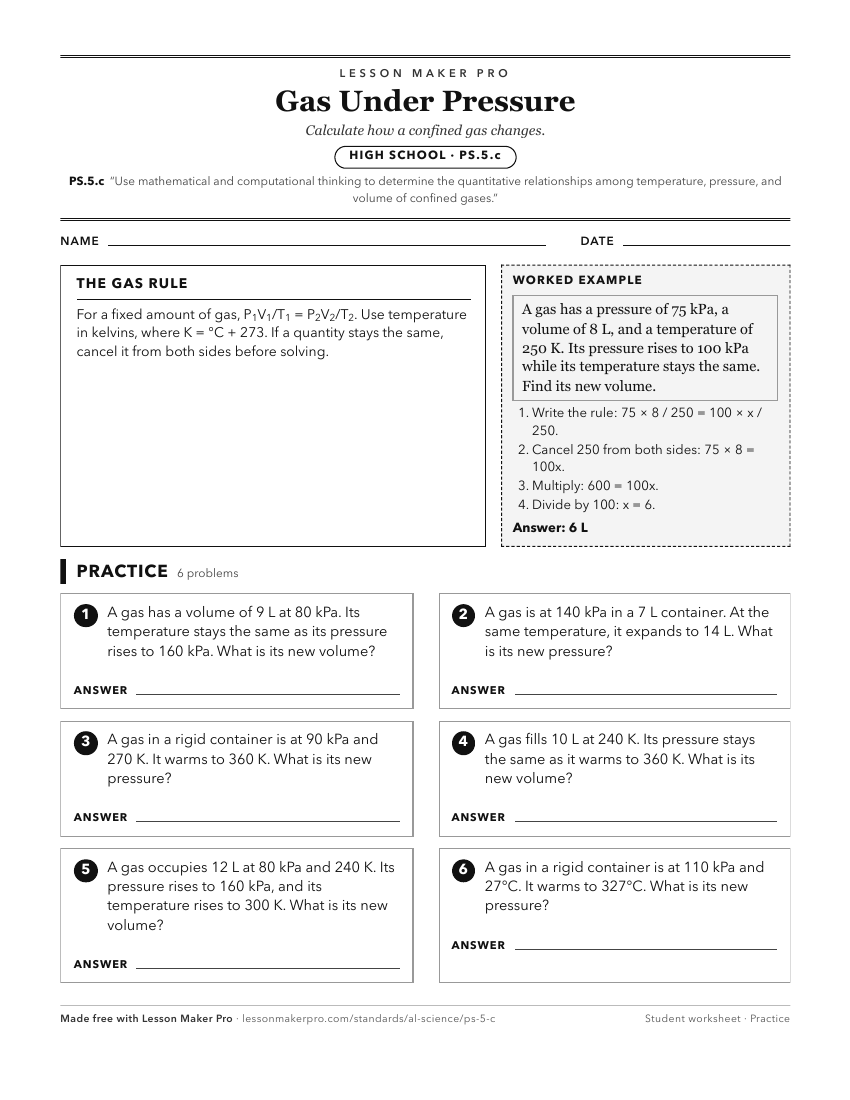
A ready-to-print activity worksheet aligned to PS.5.c, with an answer key for the teacher on its own page. No account needed.
PDF, US Letter, prints cleanly in black and white.
Download the worksheetKeep exploring
Related Standards
- CHE.7.b
Express the relationship among pressure, volume, temperature, and the number of moles of a gas quantitatively, conceptually, and graphically.
- CHE.4.e
Use mathematics and computational thinking to perform gas stoichiometry calculations involving mass, volume, and number of moles at standard temperature and pre...
- P.4
Use mathematics and computational thinking to analyze the effects of pressure changes and buoyant forces in fluid systems.
- CHE.7.a
Qualitatively and quantitatively relate changes in the temperature and pressure of a gas to particle motion and number of collisions.
Turn this exact standard into a lesson
Grade, subject, topic, and the complete standard are prefilled. Create one free, no account needed.
Also for this standard:Make a WorksheetMake a QuizMake a Sub Lesson