Alabama Science 6.8.b
The Standard
- 6.8
- Construct an evidence-based explanation of how the sun’s energy drives the motion and cycling of water through the hydrosphere.
Develop and use a model that illustrates how differences in heat and pressure affect density and the relationship between density and convection.
2023 Alabama Course of Study: Science
Teacher's field guide
What This Standard Means
What Students Need to Do
- Students draw how heating and cooling change a fluid's density. They use arrows to show how those differences make the fluid circulate. They also show how pressing air into less space increases its density.
What Mastery Looks Like
- A student draws warm fluid rising and cool fluid sinking, with a clear reason for each arrow. In a syringe sketch, they show the same amount of air taking up less space when compressed.
Common Misconceptions
- Students may say heat pushes fluid up, rather than recognizing that the warmer fluid is less dense than the fluid around it. Some think pressing a syringe adds more air, instead of packing the same air into less space.
How to Assess It
- Show a cup heated from below and a capped syringe being pushed in. Ask students to add convection arrows, label density changes, and explain what happens to the air in the syringe.
Lesson moves
Ways to Teach It
Place an open jar of red warm water in a clear tub of cool water, watch the plume, then compress air in a capped syringe.
Ask students why the red water rises while air in the syringe gets denser when pushed.
Give pairs particle sketches of heated water, cooled water, and air before and after compression; have them label changes and draw a convection loop.
Play a lava lamp clip; ask students to sketch where wax heats, rises, cools, and sinks as its density changes.
Free download
Printable 6.8.b Worksheet
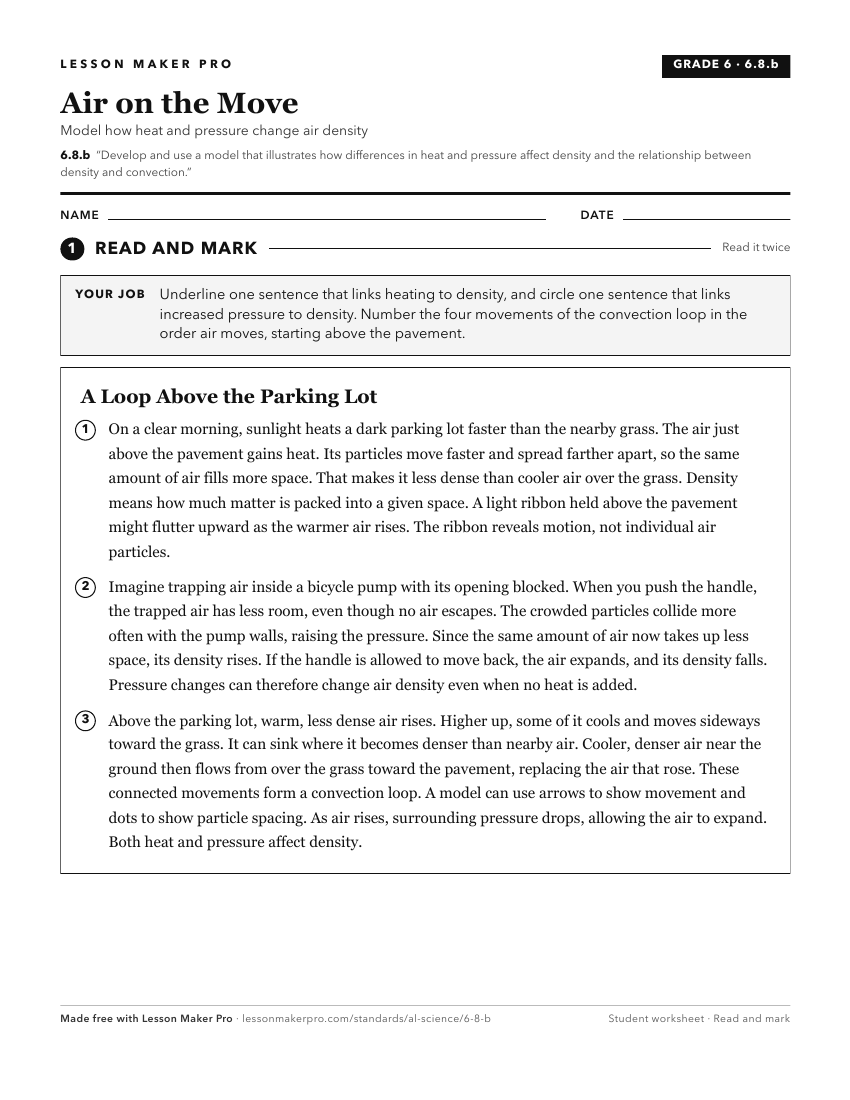
A ready-to-print activity worksheet aligned to 6.8.b, with an answer key for the teacher on its own page. No account needed.
PDF, US Letter, prints cleanly in black and white.
Download the worksheetKeep exploring
Related Standards
- 8.2
Develop and manipulate models to explain changes in particle motion, temperature, and state of a pure substance when thermal energy is added to or removed from ...
- PS.5.c
Use mathematical and computational thinking to determine the quantitative relationships among temperature, pressure, and volume of confined gases.
- ESS.7.d
Use data to construct an explanation of the role of pressure differences in the development of wind systems.
- 6.10.a
Develop models demonstrating how unequal heating and the rotation of the Earth cause local and global wind systems and oceanic currents.
Turn this exact standard into a lesson
Grade, subject, topic, and the complete standard are prefilled. Create one free, no account needed.
Also for this standard:Make a WorksheetMake a QuizMake a Sub Lesson