Alabama Science ESS.7.d
The Standard
- ESS.7
- Obtain, evaluate, and communicate information about the role of energy transfer in wind, precipitation, cloud formation, and front formation.
Use data to construct an explanation of the role of pressure differences in the development of wind systems.
2023 Alabama Course of Study: Science · Earth’s Systems
Teacher's field guide
What This Standard Means
What Students Need to Do
- Students read pressure values and wind observations on weather maps. They use differences between nearby pressure readings to explain why air moves and where winds are likely stronger.
What Mastery Looks Like
- Given pressure readings for equally spaced stations, students identify the high and low pressure areas. They show air moving toward lower pressure and use the readings to explain where wind is likely stronger.
Common Misconceptions
- Students may think wind blows from low pressure toward high pressure. They may also think a high reading alone means strong wind, rather than looking at the pressure difference over a distance.
How to Assess It
- Two pairs of stations are each 100 km apart: A reads 1020 and 1000 hPa; B reads 1012 and 1008 hPa. Which pair should have stronger wind, which way will air tend to move, and why?
Lesson moves
Ways to Teach It
Place pressure cards on a floor grid and have students lay string arrows from higher readings toward lower readings.
Show a weather map and ask, “Why might winds be stronger where the pressure lines are close together?”
Give pairs two pressure maps with the same scale; have them mark highs, lows, likely wind direction, and the strongest pressure change.
Compare beach and inland pressure readings at noon, then explain the direction of the sea breeze recorded at the shore.
Free download
Printable ESS.7.d Worksheet
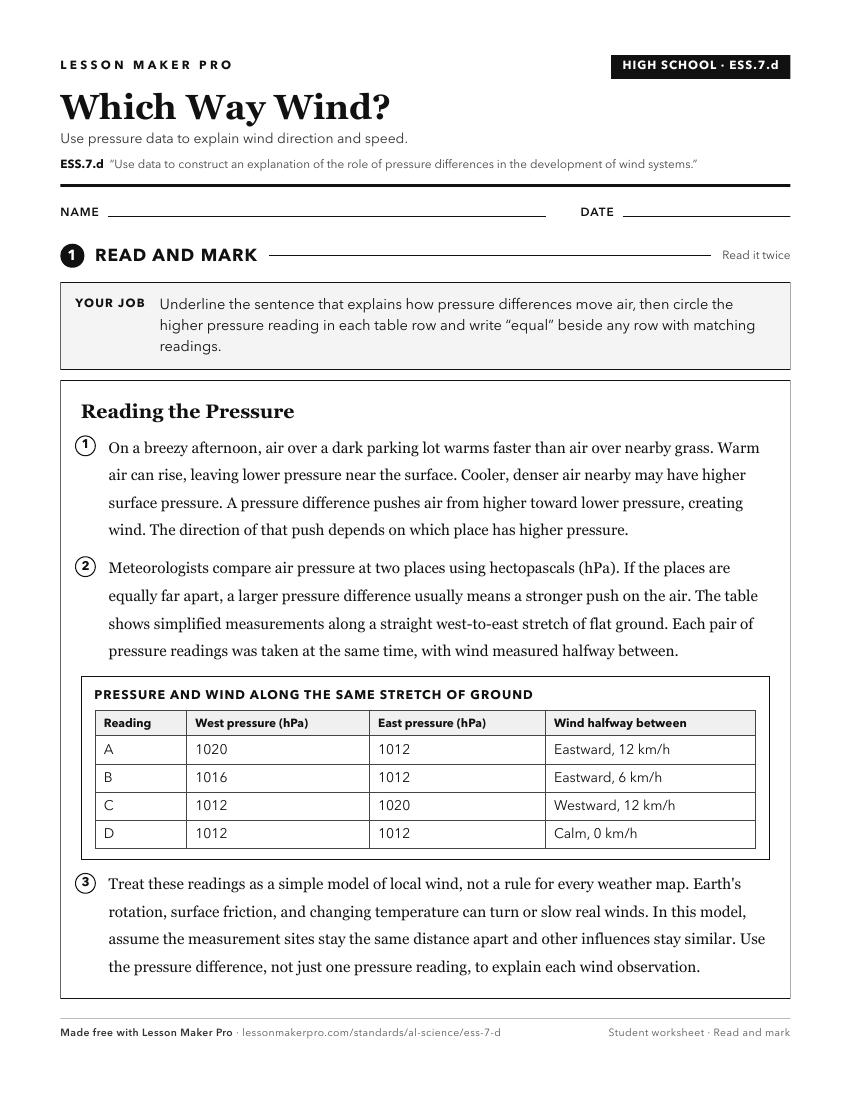
A ready-to-print activity worksheet aligned to ESS.7.d, with an answer key for the teacher on its own page. No account needed.
PDF, US Letter, prints cleanly in black and white.
Download the worksheetKeep exploring
Related Standards
- 6.9.b
Construct an explanation of how air pressure, weather fronts, and air masses are related to weather events.
- 6.10.a
Develop models demonstrating how unequal heating and the rotation of the Earth cause local and global wind systems and oceanic currents.
- ESS.7.c
Construct an explanation of how air masses, source regions, fronts, weather changes associated with frontal passage (including cold, warm, occluded, and station...
- ESS.7
Obtain, evaluate, and communicate information about the role of energy transfer in wind, precipitation, cloud formation, and front formation.
Turn this exact standard into a lesson
Grade, subject, topic, and the complete standard are prefilled. Create one free, no account needed.
Also for this standard:Make a WorksheetMake a QuizMake a Sub Lesson