Alabama Science ESS.7.c
The Standard
- ESS.7
- Obtain, evaluate, and communicate information about the role of energy transfer in wind, precipitation, cloud formation, and front formation.
Construct an explanation of how air masses, source regions, fronts, weather changes associated with frontal passage (including cold, warm, occluded, and stationary fronts), air pressure, air density, temperature, cloud types, and precipitation are related to each other.
2023 Alabama Course of Study: Science · Earth’s Systems
Teacher's field guide
What This Standard Means
What Students Need to Do
- Students use an air mass's source region to predict whether it is warm or cold, moist or dry. They explain how temperature, density, and pressure differences affect cold, warm, occluded, and stationary fronts. They connect each front to clouds, precipitation, and weather changes.
What Mastery Looks Like
- Given winter air from inland Canada and humid air from the Gulf, students identify the denser air and explain how warmer air rises. On a weather map, they predict temperature and pressure trends, likely cloud types, and precipitation for all four fronts.
Common Misconceptions
- Students may think cold air rises over warm air, or that humid air always brings rain. They may confuse occluded fronts with stationary fronts and expect every front to bring a sudden thunderstorm. Some mistake rising pressure for the cause of rain.
How to Assess It
- Show a map with cold Canadian air meeting warm, humid Gulf air at a cold front. Ask students to predict which air rises, how temperature and pressure change after passage, and one likely cloud type and form of precipitation.
Lesson moves
Ways to Teach It
Pour chilled blue water and warm red water into opposite ends of a clear tray; have students sketch which fluid sinks at the boundary.
Show a map of Canadian and Gulf air masses; ask students to write why a cold front could bring towering clouds and heavy rain.
Give pairs four front symbol cards and forecast cards showing temperature, cloud type, and rain; have them match each set and explain why.
Open a local surface map and hourly forecast; find the nearest front and compare its pressure trend, temperature shift, clouds, and rain.
Free download
Printable ESS.7.c Worksheet
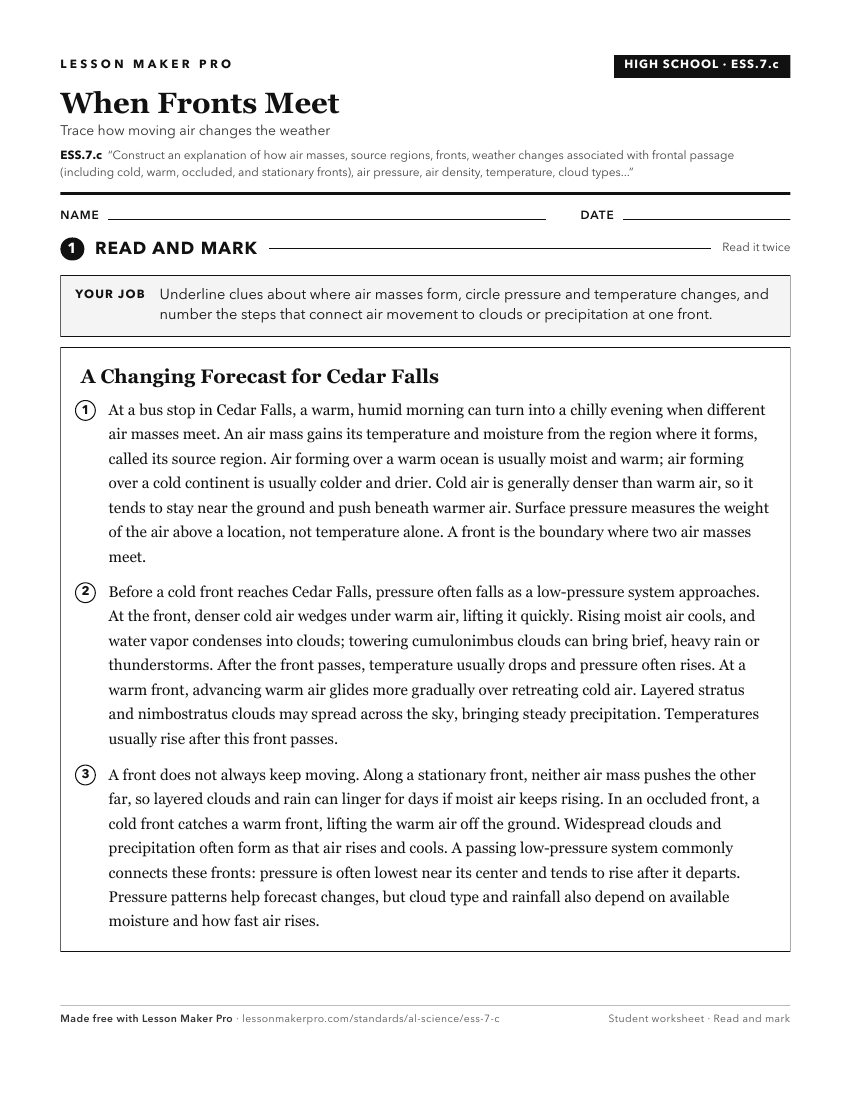
A ready-to-print activity worksheet aligned to ESS.7.c, with an answer key for the teacher on its own page. No account needed.
PDF, US Letter, prints cleanly in black and white.
Download the worksheetKeep exploring
Related Standards
- 6.9.b
Construct an explanation of how air pressure, weather fronts, and air masses are related to weather events.
- ESS.7.d
Use data to construct an explanation of the role of pressure differences in the development of wind systems.
- 6.10.c
Construct an explanation of how altitude, geothermal activity, and oceanic distribution of heat produce typical regional climate patterns.
- ESS.7.e
Analyze and interpret data to create a surface map, including high-pressure and low-pressure systems, isobars, wind barbs, cloud types, precipitation, and front...
Turn this exact standard into a lesson
Grade, subject, topic, and the complete standard are prefilled. Create one free, no account needed.
Also for this standard:Make a WorksheetMake a QuizMake a Sub Lesson