Alabama Science PS.1.b
The Standard
- PS.1
- Evaluate sources of information concerning the law of conservation of energy to illustrate energy transformations in practical applications and natural systems.
Collect, analyze, and use data to explain how thermal energy is transferred by conduction, convection, and radiation.
2023 Alabama Course of Study: Science · Energy
Teacher's field guide
What This Standard Means
What Students Need to Do
- Students record temperatures and movement during tests with a metal spoon, heated water, and a lamp. They use their data to explain how thermal energy moves through contact, moving water, or electromagnetic waves.
What Mastery Looks Like
- Students use readings and observations to support their explanations, not just name a method. They can explain why a spoon handle warms, colored water rises, and a card heats under a lamp.
Common Misconceptions
- Students may say cold moves into a warm object, rather than energy moving from warmer to cooler matter. They may call any upward transfer convection, even when no liquid or gas moves. Some think radiation needs air to travel.
How to Assess It
- Exit ticket: A spoon handle warms from 22°C to 34°C in hot water, dye rises in water heated from below, and a card warms from 22°C to 28°C under a lamp. Name the main transfer method in each case and cite a reading or observation that supports your answer.
Lesson moves
Ways to Teach It
Place metal and wooden spoons in warm water, measure their handle temperatures each minute with an infrared thermometer, and graph the readings.
Show colored water rising in a clear container heated from below, then ask, 'What moved, and how did it carry energy?'
Give teams cards showing a sunlit sidewalk, a hot pan handle, and circulating soup; have them sort and defend each match.
Measure pavement temperatures in sun and shade with an infrared thermometer, then explain why one spot is warmer.
Free download
Printable PS.1.b Worksheet
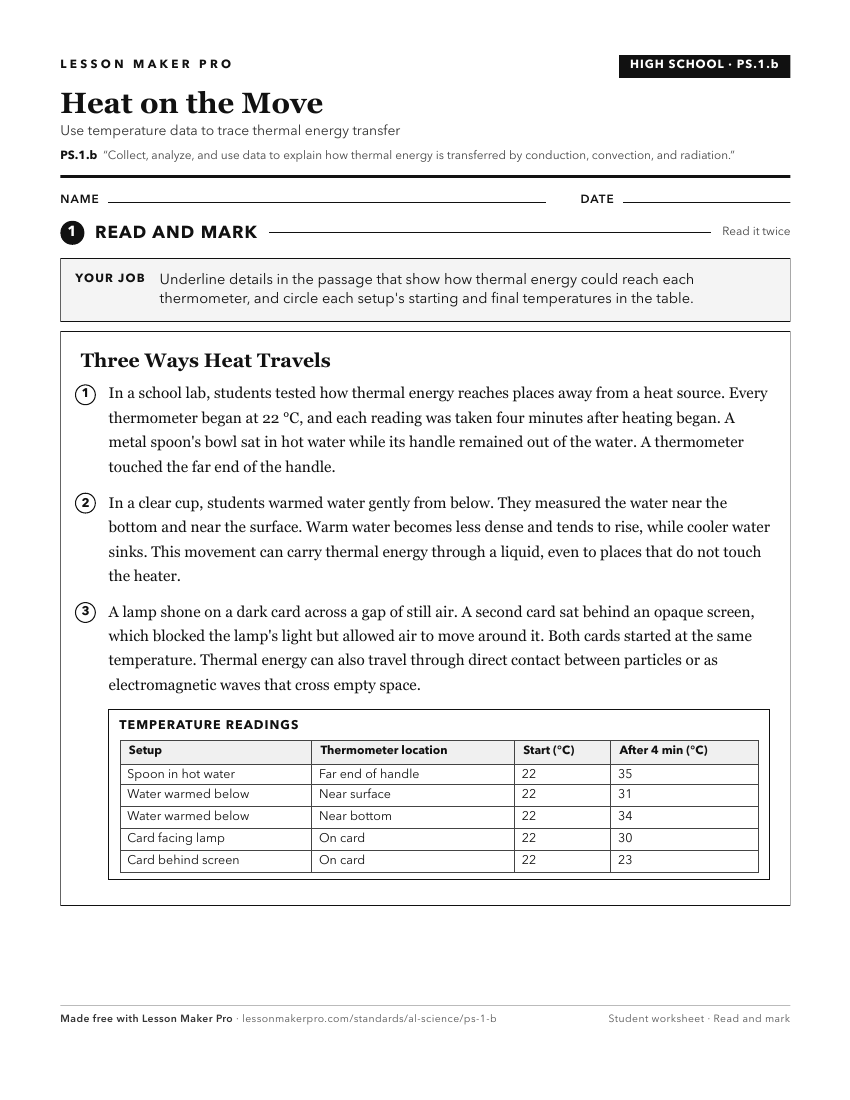
A ready-to-print activity worksheet aligned to PS.1.b, with an answer key for the teacher on its own page. No account needed.
PDF, US Letter, prints cleanly in black and white.
Download the worksheetKeep exploring
Related Standards
- 6.8.a
Plan and carry out an investigation to determine the differences in rates of energy transfer from the sun to air, to land, and to water via conduction, convecti...
- 8.7
Analyze data from an investigation to determine whether thermal energy is released or absorbed in a chemical reaction.
- PS.5.b
Analyze and interpret data to predict changes in the phase of a material based on changes in particle motion, temperature, pressure, or thermal energy.
- 4.3
Plan and carry out investigations to provide evidence that energy is transferred by sound, light, heat, and electric currents.
Turn this exact standard into a lesson
Grade, subject, topic, and the complete standard are prefilled. Create one free, no account needed.
Also for this standard:Make a WorksheetMake a QuizMake a Sub Lesson