Alabama Science 6.8.a
The Standard
- 6.8
- Construct an evidence-based explanation of how the sun’s energy drives the motion and cycling of water through the hydrosphere.
Plan and carry out an investigation to determine the differences in rates of energy transfer from the sun to air, to land, and to water via conduction, convection, and radiation.
2023 Alabama Course of Study: Science
Teacher's field guide
What This Standard Means
What Students Need to Do
- Students test how quickly soil, water, and air warm under a lamp. They compare temperature changes over time and explain how radiation, conduction, and convection move energy.
What Mastery Looks Like
- A student keeps the lamp distance and measurement times the same for each sample. They use their readings to identify which warmed fastest, then explain how sunlight reaches the samples, how warm soil heats nearby air, and what happens when that air rises.
Common Misconceptions
- Students may say sunlight reaches soil by conduction, even though the sun is not touching it. They may call rising warm air conduction or compare only final temperatures without checking starting temperatures.
How to Assess It
- Exit ticket: Under a lamp, soil warms 8°C, water 3°C, and air 2°C in ten minutes. Which warmed fastest? Name how energy traveled from the lamp, then explain how warm soil could heat the air above it and what that air would do next.
Lesson moves
Ways to Teach It
Set equal cups of soil, water, and air under one lamp; measure each cup's temperature every two minutes for ten minutes.
Ask: How does sunlight reach soil, how does soil warm nearby air, and what happens when that air rises?
Give pairs cards showing sunlight hitting soil, a warm rock heating a hand, and warm air rising; sort them by heat transfer type.
Sketch a sunny playground with pavement and a pond; predict which warms faster and where warm air might rise.
Free download
Printable 6.8.a Worksheet
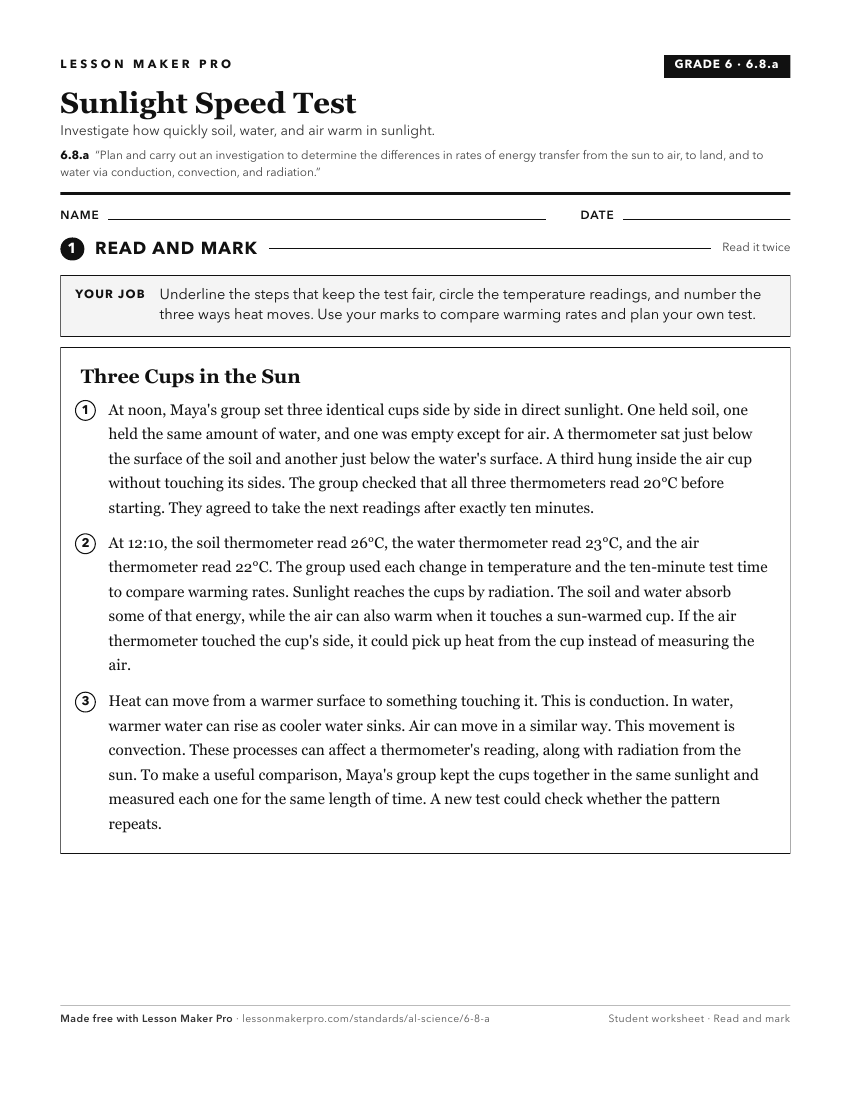
A ready-to-print activity worksheet aligned to 6.8.a, with an answer key for the teacher on its own page. No account needed.
PDF, US Letter, prints cleanly in black and white.
Download the worksheetKeep exploring
Related Standards
- ESS.7.b
Plan and carry out an investigation to determine the differential heating of land and water and explain how these differences create changes in local and global...
- PS.1.b
Collect, analyze, and use data to explain how thermal energy is transferred by conduction, convection, and radiation.
- 4.3
Plan and carry out investigations to provide evidence that energy is transferred by sound, light, heat, and electric currents.
- 6.10
Use observations and data from investigations to demonstrate how the sun, air, land, and water affect Earth’s climate.
Turn this exact standard into a lesson
Grade, subject, topic, and the complete standard are prefilled. Create one free, no account needed.
Also for this standard:Make a WorksheetMake a QuizMake a Sub Lesson