Alabama Science ESS.7.b
The Standard
- ESS.7
- Obtain, evaluate, and communicate information about the role of energy transfer in wind, precipitation, cloud formation, and front formation.
Plan and carry out an investigation to determine the differential heating of land and water and explain how these differences create changes in local and global weather.
2023 Alabama Course of Study: Science · Earth’s Systems
Teacher's field guide
What This Standard Means
What Students Need to Do
- Plan a fair test comparing how sand and water warm and cool. Measure and graph temperatures over time. Use the results to explain coastal breezes and seasonal changes in winds and rain across large regions.
What Mastery Looks Like
- A student keeps lamp distance, sample depth, and measurement times the same. Their graph shows that sand warms and cools faster than water. They explain how warmer air rises, drawing in surface air and changing wind direction.
Common Misconceptions
- Students may assume land and water warm at the same rate. Some think warm air sinks or that daytime sea breezes blow from land to sea. Others miss how seasonal heating differences can shift rain across large regions.
How to Assess It
- Exit ticket: After ten minutes under a lamp, sand is 32°C and water is 24°C. At a nearby coast, where does air rise, and which way does the surface wind blow?
Lesson moves
Ways to Teach It
Put matching trays of sand and water equally far from a lamp; students choose controls and measure temperatures during heating and cooling.
Ask students to explain in three sentences why wind blows from sea to land on a sunny afternoon, using their temperature graph.
Give pairs day and night coast diagrams; have them draw air arrows, then swap papers to check wind direction against temperature clues.
Show a summer monsoon rainfall map of India; students label warmer land, cooler ocean, wind direction, and where moist air may bring rain.
Free download
Printable ESS.7.b Worksheet
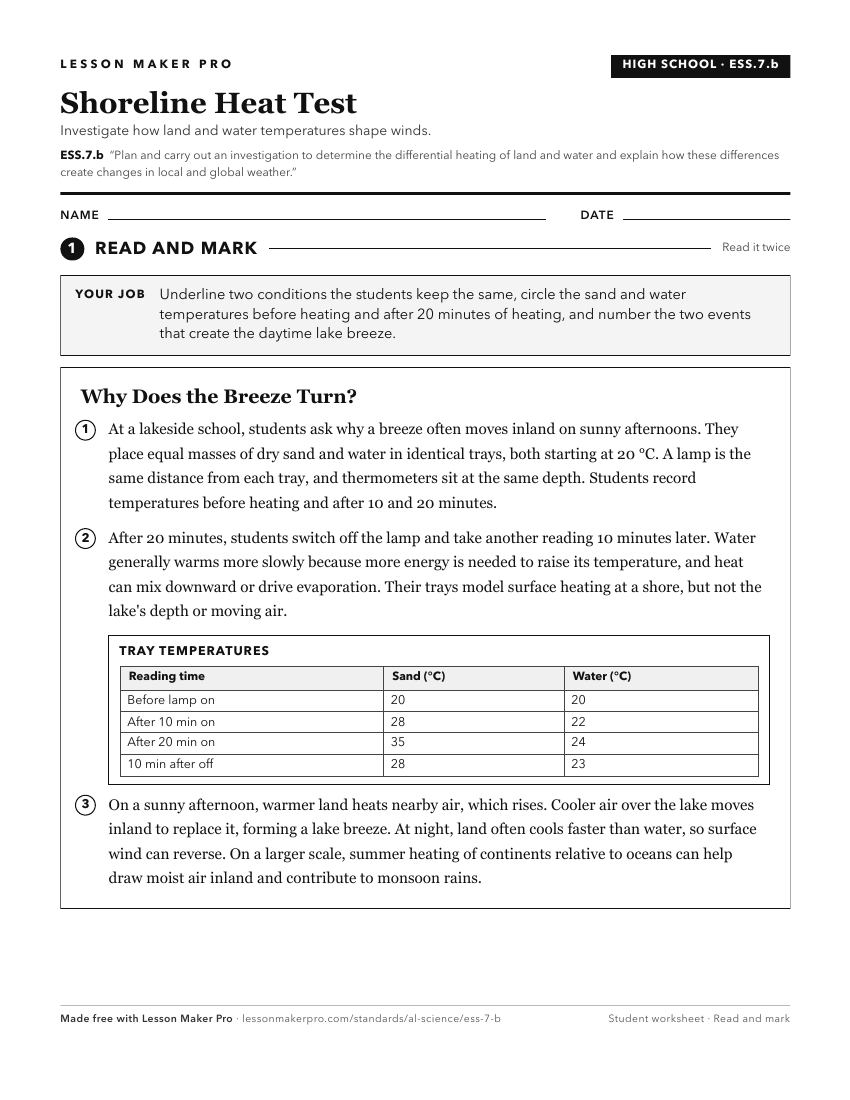
A ready-to-print activity worksheet aligned to ESS.7.b, with an answer key for the teacher on its own page. No account needed.
PDF, US Letter, prints cleanly in black and white.
Download the worksheetKeep exploring
Related Standards
- 6.8.a
Plan and carry out an investigation to determine the differences in rates of energy transfer from the sun to air, to land, and to water via conduction, convecti...
- 6.10
Use observations and data from investigations to demonstrate how the sun, air, land, and water affect Earth’s climate.
- 6.10.b
Construct explanations of how the tilt and curvature of the Earth cause unequal heating of its surface, resulting in regional climates based on patterns of lati...
- 6.10.a
Develop models demonstrating how unequal heating and the rotation of the Earth cause local and global wind systems and oceanic currents.
Turn this exact standard into a lesson
Grade, subject, topic, and the complete standard are prefilled. Create one free, no account needed.
Also for this standard:Make a WorksheetMake a QuizMake a Sub Lesson