Alabama Science CHE.2.e
The Standard
- CHE.2
- Construct explanations of the formation of intramolecular and intermolecular forces and their effects on atomic and molecular interactions.
Construct an explanation of the polarity of a molecule based on electronegativity data and molecular geometry.
2023 Alabama Course of Study: Science · Motion and Stability: Forces and Interactions
Teacher's field guide
What This Standard Means
What Students Need to Do
- Students use electronegativity values to identify polar bonds and show which way each bond dipole points. They use molecular shape to decide whether the dipoles cancel.
What Mastery Looks Like
- Given a Lewis structure and electronegativity table, a student sketches the molecule's shape and marks its bond dipoles. They explain why CO2 is nonpolar but H2O is polar.
Common Misconceptions
- Students often assume any molecule with polar bonds is polar. They may draw water as linear because they ignore the lone pairs on oxygen.
How to Assess It
- Exit ticket: Give students Lewis structures and electronegativity values for CO2 and H2O. Ask them to sketch each shape, mark bond dipoles, and explain which molecule is polar.
Lesson moves
Ways to Teach It
Build CO2 and H2O with a model kit, then attach paper arrows showing each bond dipole.
Ask students to write two sentences explaining why the bond dipoles cancel in CO2 but not in H2O.
Give pairs molecule cards for CO2, H2O, NH3, and CH4 to sort by polarity using an electronegativity table and shape sketches.
Shake cooking oil and water in a clear jar, then ask students to connect the separated layers to molecular polarity.
Free download
Printable CHE.2.e Worksheet
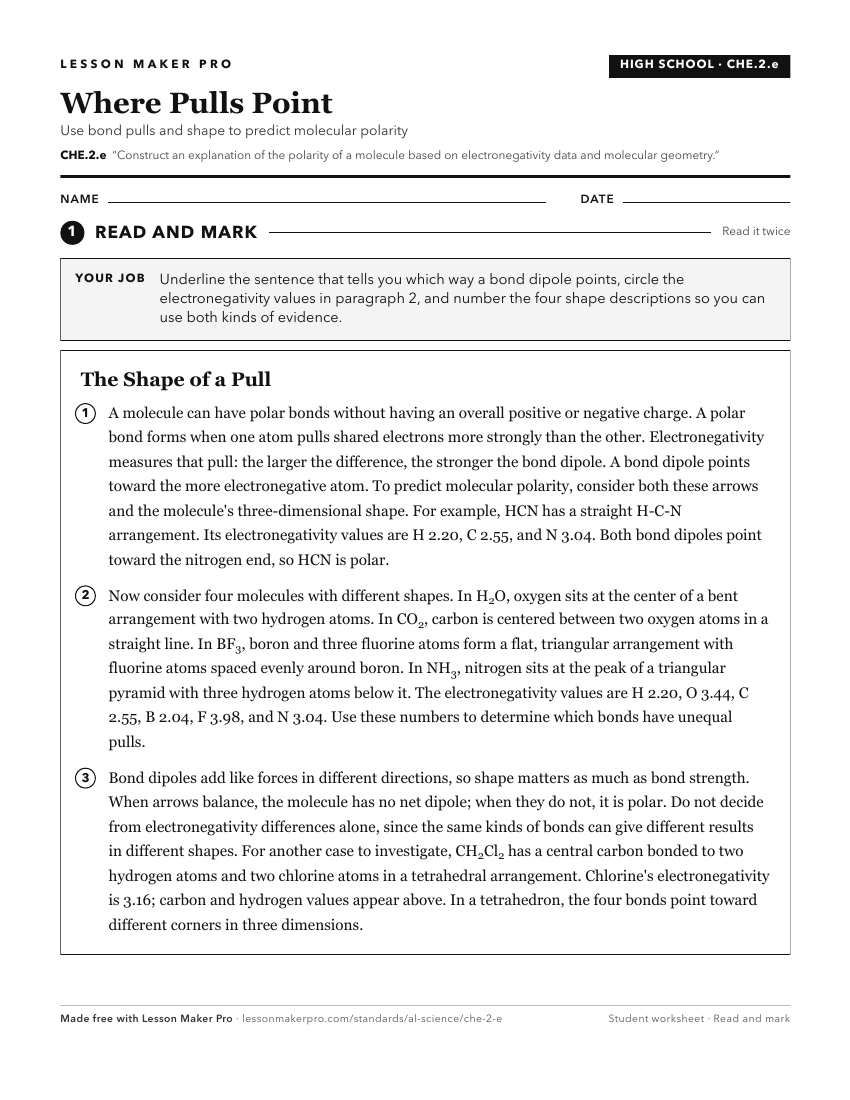
A ready-to-print activity worksheet aligned to CHE.2.e, with an answer key for the teacher on its own page. No account needed.
PDF, US Letter, prints cleanly in black and white.
Download the worksheetKeep exploring
Related Standards
- CHE.2.b
Construct an explanation of the change in potential energy that occurs when chemical bonds are formed.
- CHE.2.d
Develop and use models based on valence shell electron pair repulsion (VSEPR) theory to predict the shape of a molecule up to four electron domains around the c...
- CHE.2
Construct explanations of the formation of intramolecular and intermolecular forces and their effects on atomic and molecular interactions.
- CHE.2.a
Develop and use Lewis dot diagrams to model the formation of covalent and ionic bonds.
Turn this exact standard into a lesson
Grade, subject, topic, and the complete standard are prefilled. Create one free, no account needed.
Also for this standard:Make a WorksheetMake a QuizMake a Sub Lesson