Alabama Science CHE.1.c
The Standard
- CHE.1
- Use the periodic table as a model to predict the structure and properties of atoms and elements.
Analyze and interpret data to identify or describe an element based on its number of protons, its relative abundance of isotopes, its organization and placement of electrons, and its light emission spectrum.
2023 Alabama Course of Study: Science · Matter and Its Interactions
Teacher's field guide
What This Standard Means
What Students Need to Do
- Use proton counts to identify an element on the periodic table. Read isotope abundance data, electron arrangements, and emission lines to check and explain that identification.
What Mastery Looks Like
- Given 10 protons, a student identifies neon and places its 10 electrons as 2, 8 in a neutral atom. They pick neon-20 as the most common isotope from a chart and match the atom’s emission lines to a neon reference spectrum.
Common Misconceptions
- Students often use mass number instead of proton count to name an element. They may think isotopes of an element have different electron arrangements in neutral atoms. Some look for one color instead of a pattern of lines in an emission spectrum.
How to Assess It
- Exit ticket: An unknown has 10 protons, isotope peaks at masses 20 (90.5%), 21 (0.3%), and 22 (9.2%), and emission lines at 585 and 640 nm. Name the element, give its neutral electron arrangement, name its most common isotope, and choose the matching reference: A (585, 640 nm) or B (589, 656 nm).
Lesson moves
Ways to Teach It
Give pairs 10 red and 10 blue counters to model neon, then match its isotope bar chart and emission-line strip to reference cards.
Ask: Why does a chlorine-37 atom remain chlorine when chlorine-35 is more common? Use proton and electron counts in your answer.
Play element bingo with clue cards listing proton counts, shell layouts, isotope percentages, and emission lines; students mark matches on periodic-table grids.
Show photos of neon signs and sodium streetlights beside their printed line spectra; have students link each light’s color to its line pattern.
Free download
Printable CHE.1.c Worksheet
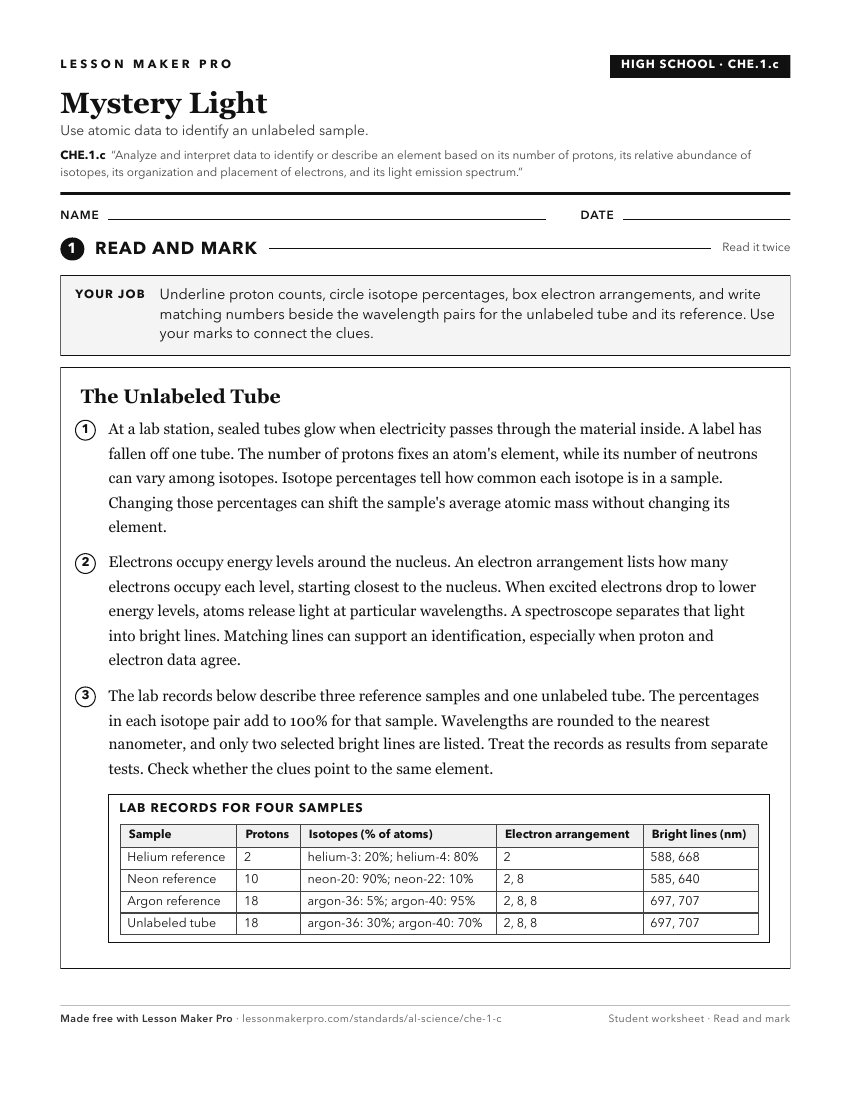
A ready-to-print activity worksheet aligned to CHE.1.c, with an answer key for the teacher on its own page. No account needed.
PDF, US Letter, prints cleanly in black and white.
Download the worksheetKeep exploring
Related Standards
- 8.4.a
Analyze and interpret data to differentiate among elements based on their properties and classify the elements as metals, nonmetals, or metalloids.
- PS.4.a
Obtain, evaluate, and communicate information from the periodic table concerning the structure of an atom and the arrangement of the atom’s protons, neutrons, a...
- PS.4.b
Predict the properties of an element based on the element’s number of protons and valence electrons.
- 8.4
Obtain and communicate information from the periodic table, including atomic number, number of electrons and neutrons, average atomic mass, groups, and periods,...
Turn this exact standard into a lesson
Grade, subject, topic, and the complete standard are prefilled. Create one free, no account needed.
Also for this standard:Make a WorksheetMake a QuizMake a Sub Lesson