Alabama Science PS.4.b
The Standard
- PS.4
- Evaluate the effects of using ions or isotopes of elements as a solution to a complex real-world problem, including cost, safety, trade-offs, and environmental impacts.
Predict the properties of an element based on the element’s number of protons and valence electrons.
2023 Alabama Course of Study: Science · Matter and Its Interactions
Teacher's field guide
What This Standard Means
What Students Need to Do
- Students use proton count to find an element on the periodic table. They use its valence electrons and place on the table to predict reactivity and likely ion charge.
What Mastery Looks Like
- Given 11 protons and one valence electron, a student identifies sodium as a reactive metal that forms a +1 ion. They explain that sodium loses its outer electron.
Common Misconceptions
- Students may confuse proton count with mass number or think gaining an electron changes an element's identity. Some assume atoms with full outer shells form ions as readily as atoms with one outer electron.
How to Assess It
- Exit ticket: An atom has 12 protons and two valence electrons. Name the element, predict whether it is a metal and give its likely ion charge.
Lesson moves
Ways to Teach It
Give pairs 11 proton counters and 11 electron counters; have them build sodium with electrons in 2, 8, 1 shells and predict its ion charge.
Ask students to write two sentences explaining why sodium reacts readily but neon rarely does, using each atom's outer electrons.
Play a mystery element round: show 17 protons and seven valence electrons; students name chlorine and predict its ion charge.
Show table salt and potassium chloride salt substitute labels; students use a periodic table to predict the charge of each metal ion.
Free download
Printable PS.4.b Worksheet
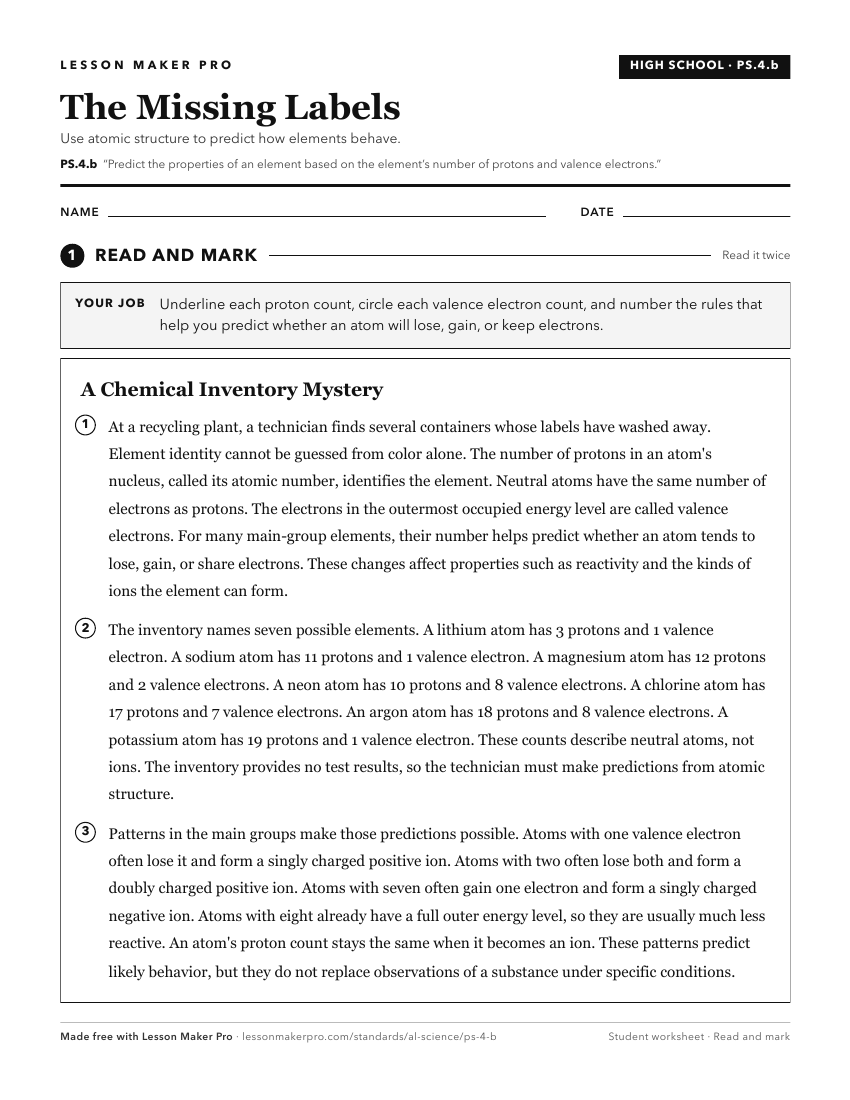
A ready-to-print activity worksheet aligned to PS.4.b, with an answer key for the teacher on its own page. No account needed.
PDF, US Letter, prints cleanly in black and white.
Download the worksheetKeep exploring
Related Standards
- CHE.1.c
Analyze and interpret data to identify or describe an element based on its number of protons, its relative abundance of isotopes, its organization and placement...
- CHE.1.e
Construct explanations of how periodic trends can be used to predict the properties of elements.
- CHE.1
Use the periodic table as a model to predict the structure and properties of atoms and elements.
- PS.4.c
Analyze and interpret data to predict properties of ionic and covalent compounds.
Turn this exact standard into a lesson
Grade, subject, topic, and the complete standard are prefilled. Create one free, no account needed.
Also for this standard:Make a WorksheetMake a QuizMake a Sub Lesson