Alabama Science PS.4.e
The Standard
- PS.4
- Evaluate the effects of using ions or isotopes of elements as a solution to a complex real-world problem, including cost, safety, trade-offs, and environmental impacts.
Analyze and interpret data to explain how radioactive decay changes a radioactive isotope over time and explain how the age of an object can be estimated by the ratio of radioactive isotopes contained within the object’s atoms.
2023 Alabama Course of Study: Science · Matter and Its Interactions
Teacher's field guide
What This Standard Means
What Students Need to Do
- Read a graph or table showing how a radioactive isotope decreases over time. Compare an object's isotope ratio with a reference ratio, then use the half-life to estimate its age.
What Mastery Looks Like
- Given the carbon-14-to-carbon-12 ratio in a wood sample and in living wood, students find how many half-lives have passed and estimate the sample's age. They explain that carbon-14 decays into nitrogen-14 while carbon-12 stays stable.
Common Misconceptions
- Students may think carbon-14 turns into carbon-12, or that all carbon-14 atoms decay at once. Some treat one-quarter remaining as four half-lives instead of two.
How to Assess It
- Exit ticket: A wood sample has one-quarter the carbon-14-to-carbon-12 ratio of living wood. If the half-life is 5,730 years, estimate its age and show your steps.
Lesson moves
Ways to Teach It
Give pairs 16 coins as carbon-14 atoms; flip and remove heads each round, then graph how many coins remain.
Ask, "Why does one-quarter of the living carbon-14 ratio mean two half-lives have passed, not four?"
Have students match cards showing remaining fractions, numbers of half-lives, and ages using 5,730 years per half-life.
Show a photo of an excavated wooden tool and give its carbon-14 ratio as one-eighth of living wood; students calculate its age.
Free download
Printable PS.4.e Worksheet
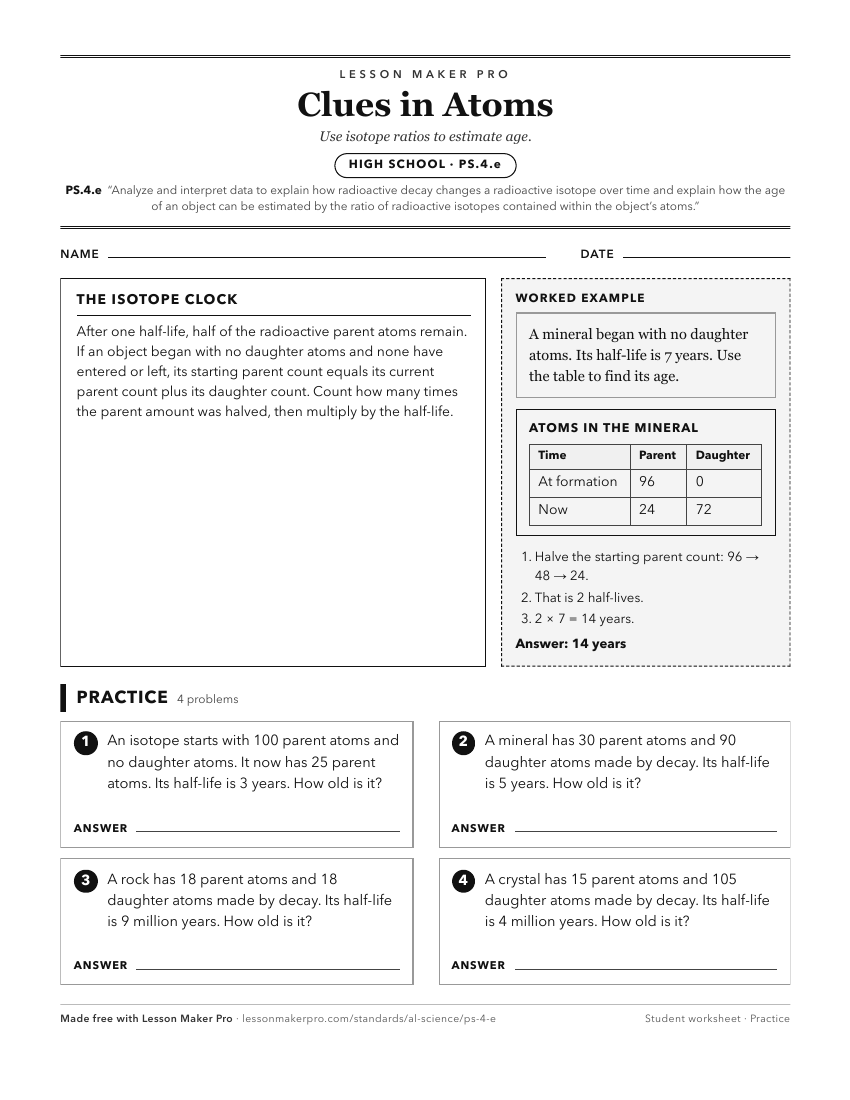
A ready-to-print activity worksheet aligned to PS.4.e, with an answer key for the teacher on its own page. No account needed.
PDF, US Letter, prints cleanly in black and white.
Download the worksheetKeep exploring
Related Standards
- ESS.5.a
Analyze and interpret data to sequence events in Earth’s history, including relative and absolute dating techniques, principles of superposition and crosscuttin...
- PS.4.f
Use mathematics and computational thinking to identify types of radioactive decay based on balanced chemical equations, penetrating power, identity of emitted p...
- CHE.1.c
Analyze and interpret data to identify or describe an element based on its number of protons, its relative abundance of isotopes, its organization and placement...
- 6.7
Analyze data from rock strata and the fossil record to construct a chronology of occurrences in Earth’s history.
Turn this exact standard into a lesson
Grade, subject, topic, and the complete standard are prefilled. Create one free, no account needed.
Also for this standard:Make a WorksheetMake a QuizMake a Sub Lesson