Alabama Science PS.6
Standard Cluster
Obtain, evaluate, and communicate information to explain how the properties of various types of solutions make them useful in real-world applications. a. Plan and carry out investigations to determine how various factors, including temperature, surface area, and stirring, affect the rate at which a solute dissolves in a solvent. b. Develop and use particle diagrams to illustrate diluted and concentrated solutions and describe how adjusting amounts of solute and solvent impacts the concentration of a solution. c. Analyze and interpret data from experiments to determine whether solutions are acidic, basic, or neutral to predict properties of the solutions. d. Plan and carry out investigations concerning neutralization reactions and describe the properties of the reactants and products.
2023 Alabama Course of Study: Science · Matter and Its Interactions
Cluster contents
Standards in This Cluster
PS.6 is a cluster heading. These are the individual standards under it.
- PS.6.a
Plan and carry out investigations to determine how various factors, including temperature, surface area, and stirring, affect the rate at which a solute dissolv...
- PS.6.b
Develop and use particle diagrams to illustrate diluted and concentrated solutions and describe how adjusting amounts of solute and solvent impacts the concentr...
- PS.6.c
Analyze and interpret data from experiments to determine whether solutions are acidic, basic, or neutral to predict properties of the solutions.
- PS.6.d
Plan and carry out investigations concerning neutralization reactions and describe the properties of the reactants and products.
Teacher's field guide
What This Cluster Means
What Students Need to Do
- Students test how temperature, stirring, and exposed solute surface affect dissolving time. They draw particle diagrams to show how adding solute or solvent changes concentration. They use pH results to classify solutions and explain what happens when an acid and a base mix.
What Mastery Looks Like
- A student can change one factor at a time and use timed results to explain dissolving rate. Their diagrams show more solute particles per volume in a more concentrated solution. They use pH readings to identify acids and bases and tell whether a mixture has reached neutral pH.
Common Misconceptions
- Students may think stirring changes how much solute can dissolve, rather than how fast it dissolves. They may draw larger particles to show higher concentration instead of more particles per volume. They may assume every acid-base mixture ends at pH 7, even when one reactant is left over.
How to Assess It
- Exit ticket: Sugar dissolves in 30 seconds when stirred and 90 seconds when still; vinegar shifts from pH 3 to pH 6 after baking soda is added. Ask what stirring changed, whether the mixture is neutral, and how a particle diagram changes when water is added.
Lesson moves
Ways to Teach It
Give groups equal masses of crushed and whole sugar cubes, warm and cool water, and spoons; time dissolving while changing one factor per trial.
Ask students whether a pH 6 mixture of vinegar and baking soda is neutral and what pH reading would show that it is.
Give pairs solute and water particle cards and cup outlines; have them race to show equal concentrations in different volumes.
Compare electrolyte drink labels; calculate grams of sugar per 100 mL and explain how adding water changes the concentration.
Free download
Printable PS.6 Worksheet
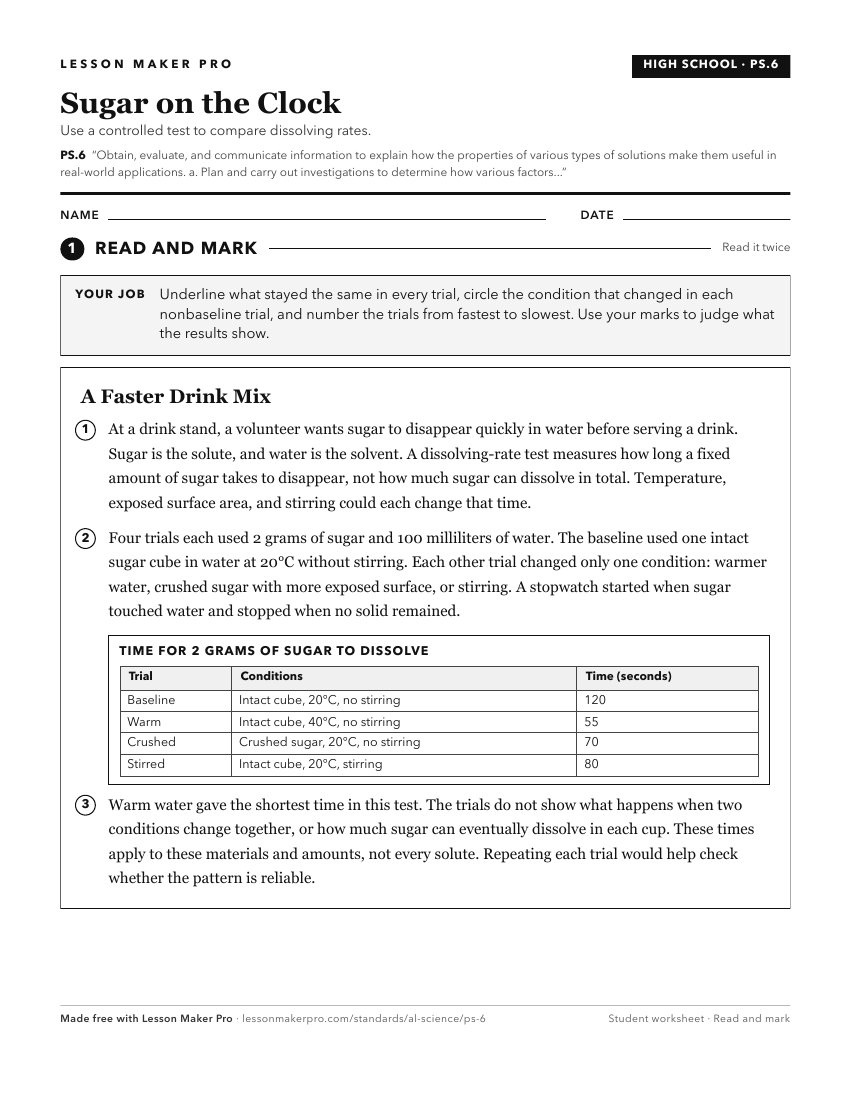
A ready-to-print activity worksheet aligned to PS.6, with an answer key for the teacher on its own page. No account needed.
PDF, US Letter, prints cleanly in black and white.
Download the worksheetKeep exploring
Related Standards
- CHE.5
Obtain, evaluate, and communicate information concerning factors that affect solubility and the properties of solutions.
- CHE.6.a
Obtain, evaluate, and communicate information concerning the properties of acids and bases.
- PS.2
Obtain, evaluate, and communicate information to compare and contrast the properties of mechanical and electromagnetic waves as they relate to real-world applic...
Turn this cluster into a lesson
Grade, subject, topic, and the complete cluster are prefilled. Create one free, no account needed.
Also for this cluster:Make a WorksheetMake a QuizMake a Sub Lesson