Alabama Science CHE.5
Standard Cluster
Obtain, evaluate, and communicate information concerning factors that affect solubility and the properties of solutions. a. Use mathematics and computational thinking to express the concentrations of given solutions in terms of molarity and molality. b. Develop and use models to illustrate solute-solvent interactions. c. Use mathematics and computational thinking to prepare solutions from both solids and concentrated solutions when given a desired molarity and volume. d. Analyze and interpret data to explain the effects of temperature on the solubility of solid, liquid, and gaseous solutes in a solvent and the effects of pressure on the solubility of gaseous solutes. e. Design and conduct experiments to evaluate the effect of solute concentration on the colligative properties of a solution.
2023 Alabama Course of Study: Science · Matter and Its Interactions
Cluster contents
Standards in This Cluster
CHE.5 is a cluster heading. These are the individual standards under it.
- CHE.5.a
Use mathematics and computational thinking to express the concentrations of given solutions in terms of molarity and molality.
- CHE.5.b
Develop and use models to illustrate solute-solvent interactions.
- CHE.5.c
Use mathematics and computational thinking to prepare solutions from both solids and concentrated solutions when given a desired molarity and volume.
- CHE.5.d
Analyze and interpret data to explain the effects of temperature on the solubility of solid, liquid, and gaseous solutes in a solvent and the effects of pressur...
- CHE.5.e
Design and conduct experiments to evaluate the effect of solute concentration on the colligative properties of a solution.
Teacher's field guide
What This Cluster Means
What Students Need to Do
- Students calculate molarity and molality and use those numbers to prepare solutions from solids or stock solutions. They model how solute and solvent particles interact. They use temperature and pressure data to explain solubility, then test how concentration changes freezing point.
What Mastery Looks Like
- Given a target molarity and volume, students calculate the needed mass of solid or volume of stock solution. They use liters of solution for molarity and kilograms of solvent for molality. They read solubility graphs for solids, liquids, and gases, explain why opening soda releases gas, and use test results to predict freezing-point changes.
Common Misconceptions
- Students use the volume of solvent instead of the final solution volume for molarity, or the mass of the whole solution instead of the solvent for molality. They think dilution changes the amount of solute. They assume heating makes every solute more soluble or that adding salt raises water's freezing point.
How to Assess It
- Exit ticket: Calculate the grams of NaCl needed for 200 mL of a 0.50 M solution, using 58.44 g/mol. Then predict whether it freezes above or below pure water.
Lesson moves
Ways to Teach It
Chill tubes of water, 0.5 M NaCl, and 1.0 M NaCl in an ice-salt bath; record freezing temperatures and graph them.
Sketch water molecules around Na+ and Cl- ions, then explain why the oxygen ends face Na+ and the hydrogen ends face Cl-.
Give pairs target molarity and volume cards; calculate NaCl mass or stock volume using 1.0 M NaCl, then check with a partner.
Open warm and chilled sodas, count bubbles for 30 seconds, then explain gas loss as temperature rises and pressure drops.
Free download
Printable CHE.5 Worksheet
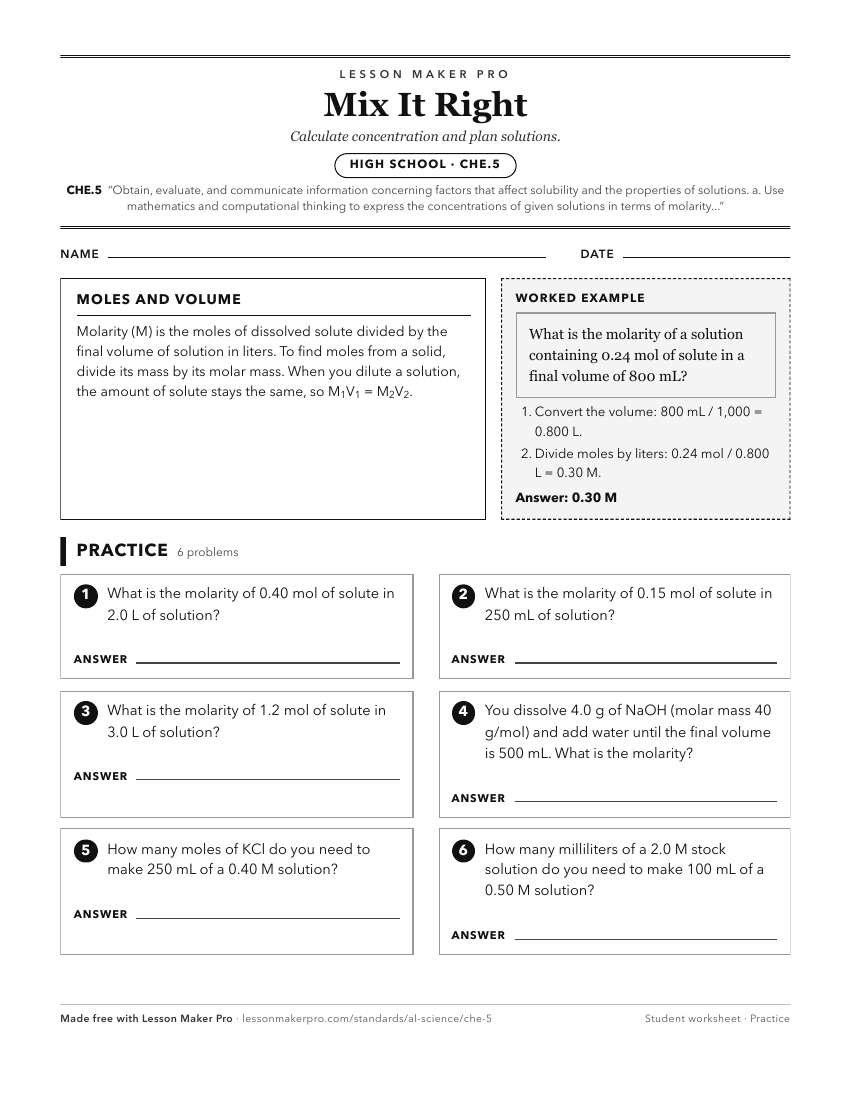
A ready-to-print activity worksheet aligned to CHE.5, with an answer key for the teacher on its own page. No account needed.
PDF, US Letter, prints cleanly in black and white.
Download the worksheetKeep exploring
Related Standards
- PS.6
Obtain, evaluate, and communicate information to explain how the properties of various types of solutions make them useful in real-world applications.
- PS.6.a
Plan and carry out investigations to determine how various factors, including temperature, surface area, and stirring, affect the rate at which a solute dissolv...
- CHE.6.a
Obtain, evaluate, and communicate information concerning the properties of acids and bases.
Turn this cluster into a lesson
Grade, subject, topic, and the complete cluster are prefilled. Create one free, no account needed.
Also for this cluster:Make a WorksheetMake a QuizMake a Sub Lesson