Alabama Science CHE.5.d
The Standard
- CHE.5
- Obtain, evaluate, and communicate information concerning factors that affect solubility and the properties of solutions.
Analyze and interpret data to explain the effects of temperature on the solubility of solid, liquid, and gaseous solutes in a solvent and the effects of pressure on the solubility of gaseous solutes.
2023 Alabama Course of Study: Science · Matter and Its Interactions
Teacher's field guide
What This Standard Means
What Students Need to Do
- Students read tables and graphs to see how temperature changes the amount of a solid, liquid, or gas that dissolves. They also use data to explain how pressure changes the amount of gas that dissolves.
What Mastery Looks Like
- Students cite values at two temperatures and describe the pattern for each substance. They know solids often dissolve more in warm water, gases usually dissolve less, and liquid solutes need their own data. They use pressure data to show that more gas dissolves at higher pressure.
Common Misconceptions
- Students may mistake faster dissolving for a greater amount dissolving. They may assume every substance dissolves more when heated. Some think bubbles leaving an opened soda mean the gas has become more soluble.
How to Assess It
- Exit ticket: At 20°C and 40°C, sugar dissolves at 204 and 238 g per 100 g water, ethanol mixes fully at both, and CO2 dissolves at 1.7 and 1.0 g/L. At 20°C, CO2 solubility rises from 1.7 to 3.4 g/L when pressure doubles; ask students to describe each pattern using the data.
Lesson moves
Ways to Teach It
Add Epsom salt one teaspoon at a time to equal cups of warm and cool water; record the last dose that fully dissolves.
Put sugar, ethanol, and CO2 temperature data on the board; ask students why heating does not increase solubility for every substance.
Make cards with sugar, ethanol, and CO2 values at 20°C and 40°C; pairs sort them by rising, falling, or unchanged solubility.
Open chilled and room-temperature soda over a sink; ask students why the warm bottle loses more fizz when pressure drops.
Free download
Printable CHE.5.d Worksheet
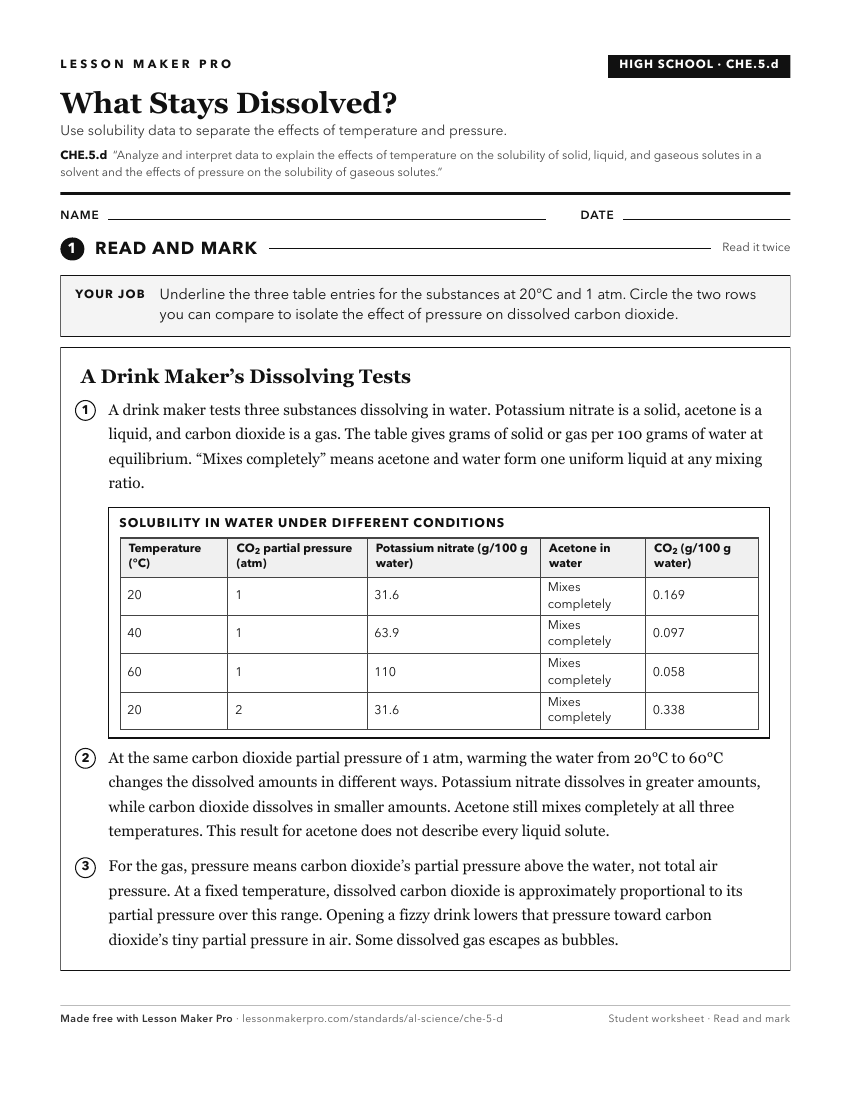
A ready-to-print activity worksheet aligned to CHE.5.d, with an answer key for the teacher on its own page. No account needed.
PDF, US Letter, prints cleanly in black and white.
Download the worksheetKeep exploring
Related Standards
- PS.6.a
Plan and carry out investigations to determine how various factors, including temperature, surface area, and stirring, affect the rate at which a solute dissolv...
- CHE.5
Obtain, evaluate, and communicate information concerning factors that affect solubility and the properties of solutions.
- CHE.5.e
Design and conduct experiments to evaluate the effect of solute concentration on the colligative properties of a solution.
- CHE.2.g
Analyze and interpret data to compare the strengths of intermolecular forces and to explain how these forces affect physical properties.
Turn this exact standard into a lesson
Grade, subject, topic, and the complete standard are prefilled. Create one free, no account needed.
Also for this standard:Make a WorksheetMake a QuizMake a Sub Lesson