Virginia SOL 6.6
SOL Standard (Key Ideas Cluster)
The student will investigate and understand that water has unique physical properties and has a role in the natural and human-made environment. Key ideas include water is referred to as the universal solvent; water has specific properties; thermal energy has a role in phase changes; water has a role in weathering; large bodies of water moderate climate; and water is important for agriculture, power generation, and public health.
Virginia Standards of Learning for Science
Cluster contents
Key Ideas in This Standard
6.6 is a Standards of Learning science standard. These are the key ideas and practices under it.
Teacher's field guide
What This Cluster Means
What Students Need to Do
- Students explain how polarity helps water dissolve many substances and compare properties such as surface tension, density, and heat capacity. They describe how adding or removing thermal energy changes water’s state. They connect water to weathering, climate, farming, electricity production, and public health.
What Mastery Looks Like
- Students use observations or data to explain a water property, rather than only naming it. They trace energy changes during melting, freezing, evaporation, and condensation. They can explain why coastal areas have milder temperatures and why clean water matters to communities.
Common Misconceptions
- Students may think universal solvent means water dissolves every substance. They often confuse heat with temperature or think phase changes create or destroy water. Some believe water changes climate only through rainfall, or that clear water is always safe to drink.
How to Assess It
- Give students four prompts: explain why salt dissolves in water, identify the energy change during evaporation, explain coastal climate moderation, and name one public health concern.
Lesson moves
Ways to Teach It
Test salt, sugar, oil, and sand in water, then record which substances dissolve and support each claim with observations.
Ask students to write why a coastal city and an inland city at the same latitude may have different temperature ranges.
Use phase-change cards showing particles and energy changes, then have teams match each card to melting, freezing, evaporation, or condensation.
Examine a local water quality report and identify one measured contaminant, its possible source, and its effect on public health.
Free download
Printable 6.6 Worksheet
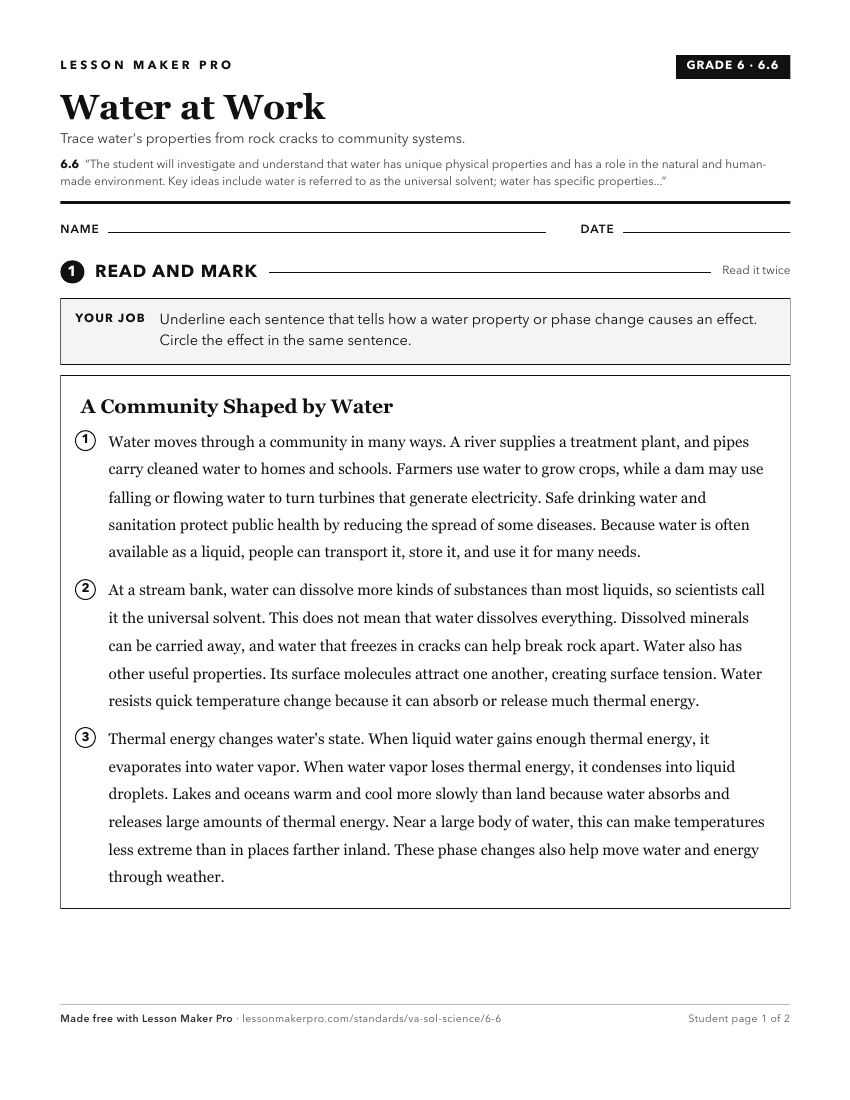
A ready-to-print activity worksheet aligned to 6.6, with an answer key for the teacher on its own page. No account needed.
PDF, US Letter, prints cleanly in black and white.
Download the worksheetKeep exploring
Related Standards
- 3.7
The student will investigate and understand that there is a water cycle and water is important to life on Earth. Key ideas include
- 6.8
The student will investigate and understand that land and water have roles in watershed systems. Key ideas include
- 3.3
The student will investigate and understand how materials interact with water. Key ideas include
- K.4
The student will investigate and understand that water is important in our daily lives and has properties. Key ideas include
Turn this cluster into a lesson
Grade, subject, topic, and the complete cluster are prefilled. Create one free, no account needed.
Also for this cluster:Make a WorksheetMake a QuizMake a Sub Lesson