Virginia SOL 6.6.a
The Standard
- 6.6
- The student will investigate and understand that water has unique physical properties and has a role in the natural and human-made environment. Key ideas include
water is referred to as the universal solvent
Virginia Standards of Learning for Science
Teacher's field guide
What This Standard Means
What Students Need to Do
- Students explain that water dissolves more substances than most liquids. They identify the solvent, solute, and solution in common mixtures and recognize that some materials do not dissolve.
What Mastery Looks Like
- A student can predict whether salt, sugar, sand, or oil will dissolve in water, then use observations to support the prediction. They explain that dissolved matter remains present even when it cannot be seen.
Common Misconceptions
- Students may think water dissolves everything or that a dissolved substance has vanished. They may also confuse dissolving with melting or assume stirring changes whether a substance is soluble.
How to Assess It
- Give students this exit prompt: “Salt dissolves in water, but sand does not. Explain what happens to each material and why water is a useful solvent.”
Lesson moves
Ways to Teach It
Test salt, sugar, sand, and oil in clear cups of water, then record which materials form solutions.
Ask students to write why “universal” does not mean water dissolves every substance, using one example.
Play a sorting game with cards labeled solute, solvent, solution, soluble, and insoluble, matching each term to mixture examples.
Read a sports drink label and identify the substances dissolved in water, then discuss why manufacturers use water as the solvent.
Free download
Printable 6.6.a Worksheet
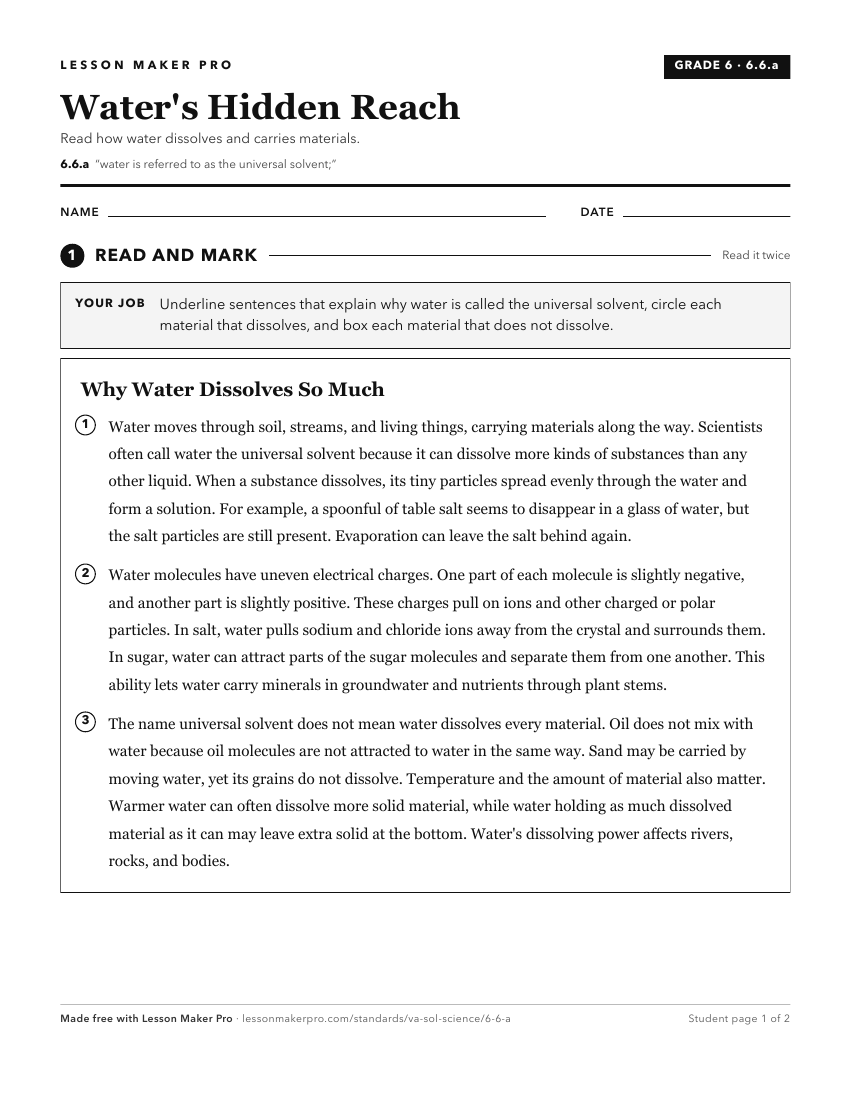
A ready-to-print activity worksheet aligned to 6.6.a, with an answer key for the teacher on its own page. No account needed.
PDF, US Letter, prints cleanly in black and white.
Download the worksheetKeep exploring
Related Standards
Turn this exact standard into a lesson
Grade, subject, topic, and the complete standard are prefilled. Create one free, no account needed.
Also for this standard:Make a WorksheetMake a QuizMake a Sub Lesson